Overview
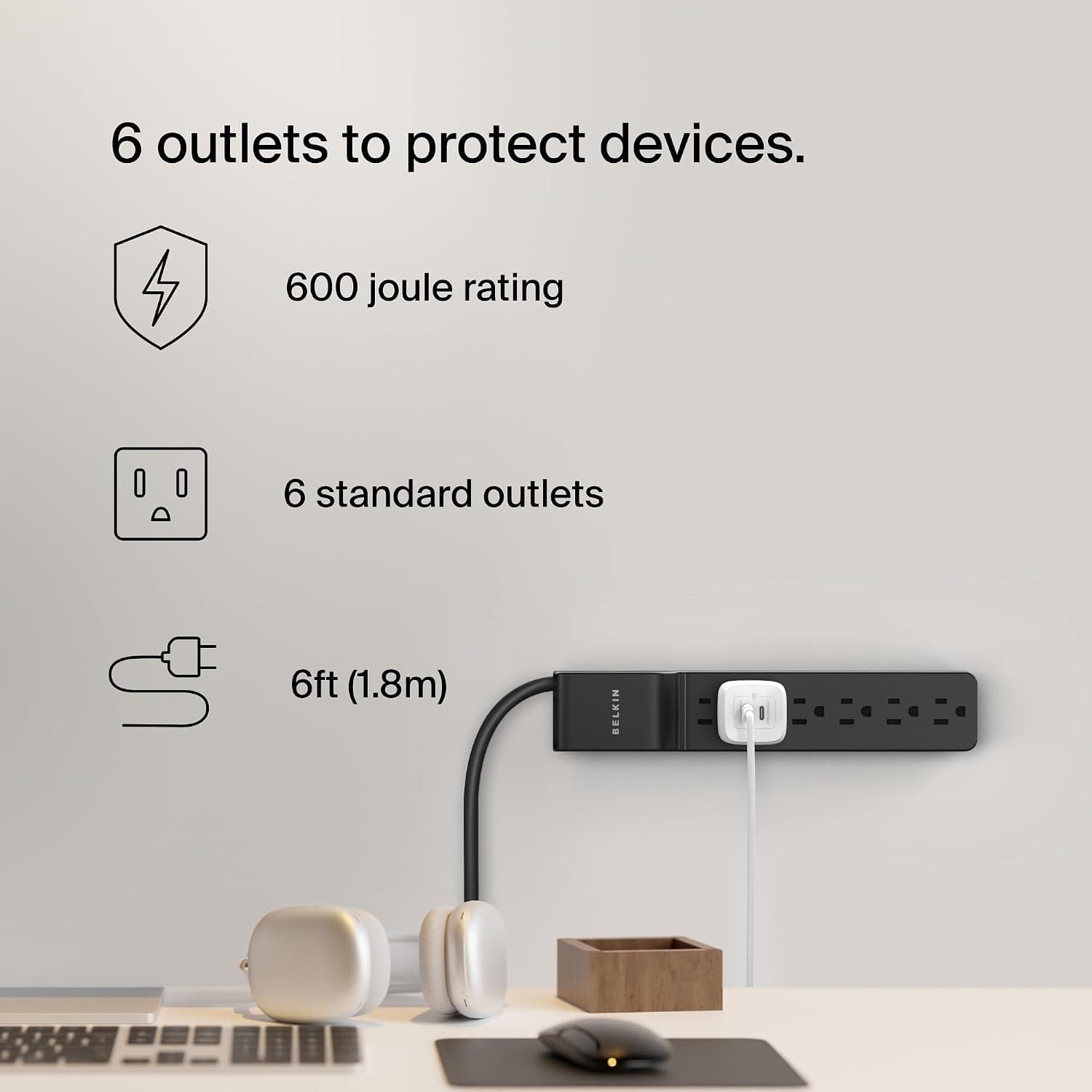
The Belkin 6OTLT SURGE BLK is a surge-protected power tap that combines six AC outlets with integrated USB charging. The short version: it suits people who want to consolidate desk or AV-rack power and charging into a single unit, and it earns its keep most in homes with frequent lightning or with gear you cannot afford to lose — a router, a NAS, a recorder.
Rated voltage is 110V and the plug is Type B (US standard), so using it in Japan means checking outlet shape and possibly adding an adapter. Amazon.co.jp shows 7,889 reviews at 4.7 out of 5 stars (94% positive, captured 2026-09-06), which is a strong showing for a power strip.
Weight is 1.05 lbs (roughly 476 g) — heavy enough not to slide around when a cable is tugged, but not a lightweight wall-mount unit.
Quick Reference by Use Case
The table below reads the supplied specs (6 AC outlets / 6 USB ports / 110V / Type B plug) into practical fit.
| Use case | Fit | Why |
|---|---|---|
| Desk PC, monitor, peripherals | Excellent | Six outlets cover PC, display, speakers and router, with USB for accessories |
| Router / NAS / external drive | Excellent | The use case where surge protection pays off most |
| Fast phone or tablet charging | Fair | Combined USB output is around 2.4A total, shared across all ports |
| USB-C laptop charging | Poor | Ports are Type-A and no USB PD is listed; use the laptop's AC adapter |
| Everyday use in a Japanese home | Fair | US-spec plug and voltage; check compatibility below first |
| Travel or stay in US/Canada | Good | Works directly in Type B regions |
Don't stop at the table. The thing that trips people up here is not performance — it's whether the plug fits and whether you can get a ground connection.
Compatibility Guide
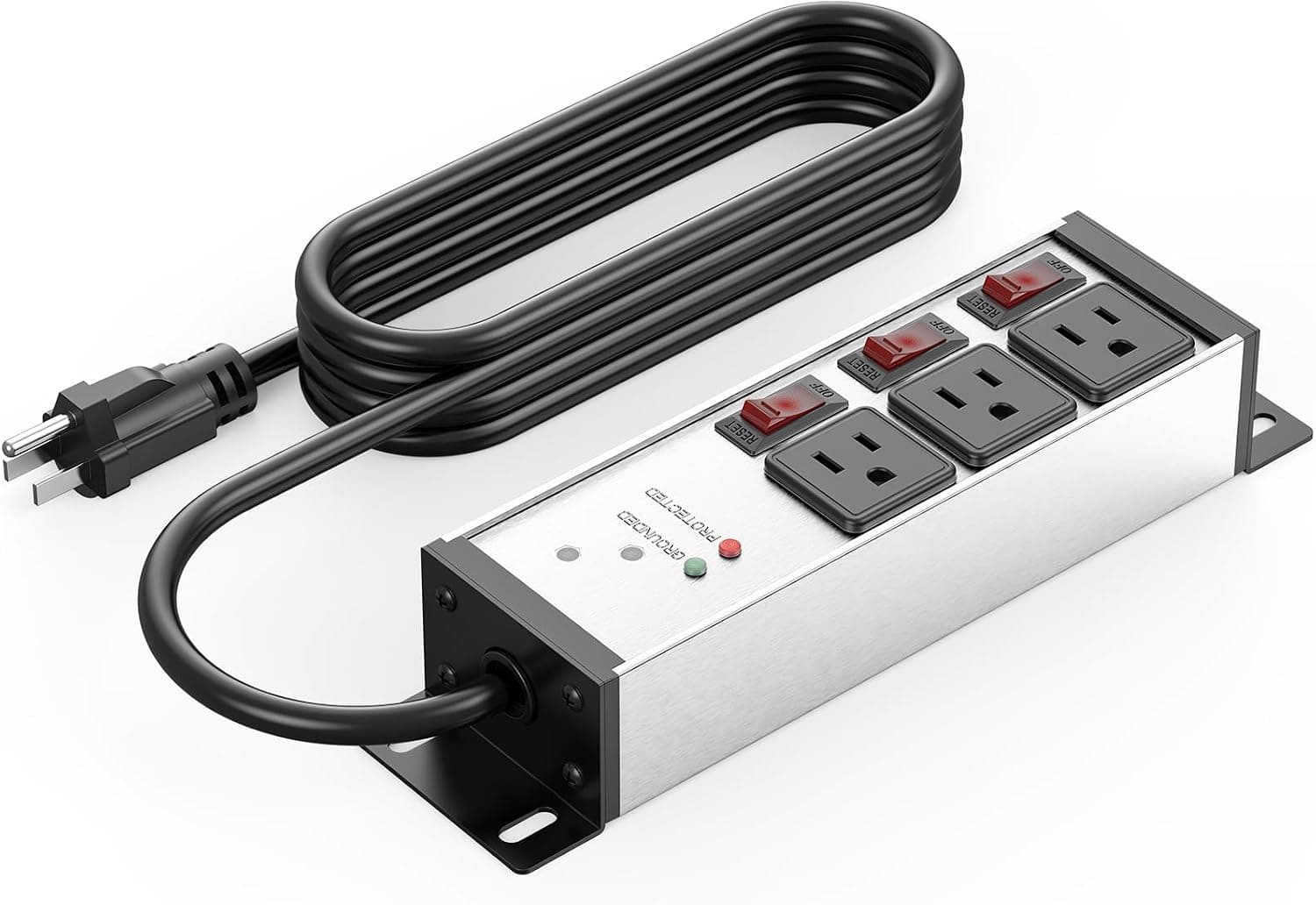
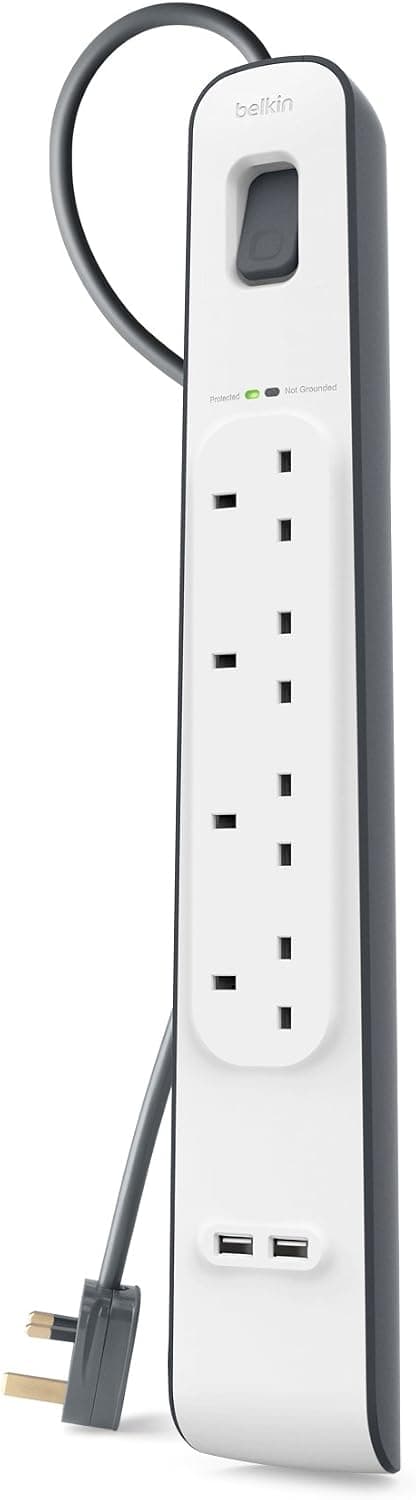
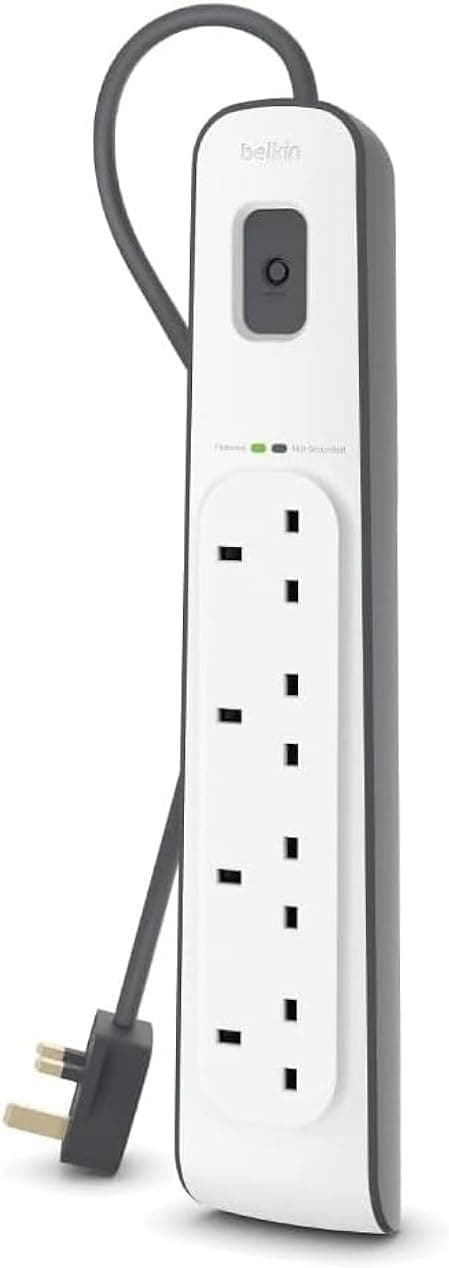
The listed plug is "Type B plug (NEMA 1-15P)." Verify this yourself before buying, because those two terms normally describe different things: Type B is a three-pin grounded plug, while NEMA 1-15P is a two-pin ungrounded one. In other words, the listing data may be internally inconsistent.
A three-pin plug will not go straight into a typical Japanese two-slot outlet and needs a grounded adapter; a two-pin plug will. Checking the product photo for pin count is the most reliable test.
On voltage: the unit is rated 110V while Japanese mains is 100V. Feeding 100V to a 110V-rated device is generally within tolerance, but surge protection circuitry is designed around its intended supply voltage, so treat protection performance as "not guaranteed to spec" when running an imported unit in Japan. If you want certainty, a domestically certified (PSE) surge strip is the safer choice.
Grounding is the other easy thing to miss. Surge protectors typically work by diverting excess voltage to ground, so using one without a ground connection substantially reduces its effectiveness. Many Japanese rooms only have ground terminals near air conditioners or wet areas — confirm your installation spot before ordering.
Device compatibility itself is broad: household appliances, PC peripherals, phones and tablets. But the six AC outlets share a total wattage limit (check the rating printed on the product page), and high-draw appliances such as microwaves, hair dryers and kettles should never be run through a power strip of any brand.
USB is Type-A with roughly 2.4A combined, and no fast-charge standard is documented — six ports does not mean six devices charging quickly.
Physically, outlet spacing is the usual pain point. No pitch measurement is given in the specs, so if you plan to plug in several wall-wart adapters, assume some will block a neighbouring socket.
If that matters to you, pick a strip that explicitly states wide spacing.
Product Info
Belkin is a US accessories brand with a long history in power strips, surge protectors and cables. This model sits in the entry-to-mid tier — it is a surge protector, not a UPS.
It appears to date from around 2012 based on the retail listing date, so it is a long-running design rather than a recent release.
Key specs: six AC outlets, six USB ports, 110V rated voltage, 1.05 lbs.
Only the unit itself is included; warranty follows Belkin's standard terms, and you should confirm the period with your seller.
As captured on 2026-09-06, the Amazon.co.jp price was ¥9,461. That is not cheap for a power strip, largely reflecting its status as an imported model.
Prices move constantly with stock and sales, so always confirm the current figure on the product page. The eBay entry is a search link only, with no specific figure captured.
Reviews stand at 7,889 with 4.7 out of 5 stars — 94% positive as of 2026-09-06.
A rating that high across that many reviews argues against any severe defect rate, though reviews may aggregate across regions and revisions, so they are not specifically a verdict on use in Japan.
Comparison With Alternatives
Three axes matter: outlet count, USB charging capability, and conformance to local standards.
Domestic Japanese surge strips (for example Elecom's 10-outlet model with individual switches) offer more sockets, dust shutters and per-outlet switching, and plug straight into Japanese outlets. For pure home use in Japan, they involve far less friction.
Many, however, lack built-in USB, which means giving up an outlet to a charger.
Belkin's own four-way models (BSV400af2M, BSV401af2M) trade outlet count for easier placement and a lower price — worth considering if six is more than you need. And if your goal is whole-home protection, a panel-mounted SPD like the Generac unit solves a different problem entirely.
This model's case rests on one thing: six AC outlets plus six USB ports in a single device. Without that requirement, domestic models usually win on value.
Best Use Cases
- Consolidating desk cabling — power and USB in one unit, so chargers don't eat outlets. PC, monitor, speakers, router and a lamp all fit.
- Protecting always-on gear — routers, NAS units, external storage and recorders benefit most from surge protection.
- Lightning-prone or unstable-supply locations — the clearest justification for the spend.
- US or Canadian outlet environments — the Type B plug works directly there; Japanese use assumes an adapter and a ground.
- Buyers who want a known brand — 7,889 reviews at 4.7 is a more readable bet than an anonymous budget strip.
Before You Buy
1. This is not a Japan-market product. A 110V rating and Type B plug point to North America.
Plug conversion, grounding and PSE certification all become your responsibility to verify. Expect to buy an adapter.
2. The plug specification is inconsistent. "Type B" and "NEMA 1-15P" normally describe different plugs.
Listing metadata can be wrong, so confirm the actual pin count from the product photo and title. The same caution applies when the seller and shipper are not the manufacturer — some listed specs may belong to a different batch or model.
3. Six USB ports does not mean six fast charges. Combined output is around 2.4A shared across all ports.
Plug in several tablets or power banks and charging slows noticeably. For fast charging, use a separate USB PD charger and let this unit handle AC outlets and surge protection.
4. Surge protectors are consumables. The protective components degrade with every surge absorbed.
Protection is not permanent — after a major strike, or after years of service, it may be depleted. Check whether a protection-status indicator is present and replace the unit if it goes dark.
This matters more for a design that has been on sale since around 2012, and especially for used or long-shelved stock.
5. Without a ground, protection is limited. Diverting surge energy requires somewhere to divert it to.
6. Never use it for high-draw appliances. Microwaves, hair dryers, heaters and kettles on a power strip are a fire risk — a rule for all strips, not a flaw specific to this one.
7. Prices change. ¥9,461 was the figure captured on 2026-09-06 and nothing more.
Domestic strips with similar outlet counts are often cheaper, so decide whether the USB integration, brand and review record justify the gap for you.
Who should skip it: anyone in a typical Japanese home who just needs phone charging and desk power. If you don't want to deal with adapters and grounding, a domestic surge strip will leave you happier.
FAQ
Q. Will it plug into a Japanese outlet as-is? A.
A two-pin plug likely will; a three-pin grounded plug needs an adapter. Because the spec text is inconsistent, check the pin count in the product photo.
Q. It's rated 110V — is Japan's 100V a problem? A.
Supplying 100V to a 110V-rated device is generally within tolerance, but surge circuitry assumes its design voltage, so protection may not perform exactly to spec. For strict assurance, choose a domestic model.
Q. Can the USB ports fast-charge? A.
They are Type-A with roughly 2.4A combined and no documented PD or Quick Charge support.
Use a dedicated charger for fast charging.
Q. Can I charge a laptop over USB?
A. No. Use the laptop's AC adapter in one of the AC outlets.
Q. How long does surge protection last? A.
No figure is given in the specs. As a general rule, replace after a major strike or after years of service.
Q. Are the reviews trustworthy? A.
7,889 reviews at 4.7 stars (captured 2026-09-06) is a solid signal about build reliability, though not necessarily about use under Japanese conditions.
Product Disclosure (Amazon)
- Manufacturer: Belkin
- Seller: 浪越商店
- Fulfilled by: 浪越商店
- ASIN: B0090YEVSE
- Note: This article covers a manufacturer-made product based on Amazon listing details.