Game Overview
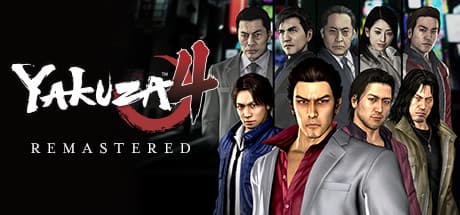
Yakuza 4 Remastered: Multiple Protagonists, One Unforgettable Tokyo Saga is a story-driven action adventure set in Kamurocho, Tokyo, in 2010. A shooting in the entertainment district draws four men into a web of criminal ambitions, personal debts, and concealed motives.
The campaign is divided into character-focused chapters, with apparently separate events gradually converging.
Instead of following Kazuma Kiryu alone, the game also puts players in control of moneylender Shun Akiyama, former yakuza Taiga Saejima, and detective Masayoshi Tanimura. Their occupations, relationships, and reasons for investigating the case create distinct views of the same city.
Previous series knowledge helps with returning characters and organizations, although the central incident is developed within this game.
Released on Steam on January 27, 2021, this remaster supports 1080p presentation at 60fps. Its core loop combines story scenes, close-range combat, compact urban exploration, and optional diversions rather than travel across a vast world.
How the Four Protagonists Change Play
The protagonist changes affect more than the narrative. Akiyama emphasizes quick kicking combinations, Saejima relies on heavy strikes, Tanimura uses parries and grappling, and Kiryu offers a versatile all-round style.
Positioning and the safest way to begin an attack therefore change whenever control passes to another character.
Each section asks players to explore the city, follow leads, improve the active character, and decide how much time to spend on side stories. Progress does not feel like developing one hero continuously because every switch introduces a different move set and growth state.
The benefit is that the combat receives a regular change of pace during a long, dialogue-heavy campaign.
Exploring Kamurocho
Kamurocho is a compact and densely packed entertainment district, not an open world built around long journeys between regions. Players can head directly to objectives, but conversations, side stories, restaurants, and other diversions reveal personalities and everyday life that the main conspiracy cannot show on its own.
The central plot treats violence and organized crime seriously, while optional events can be deliberately comic or strange. That contrast is a defining series trait, but it may surprise anyone expecting an entirely grounded crime drama.
Exploring during each character's chapters makes the change in perspective more meaningful than rushing between main missions.
PC Requirements
The minimum specification lists Windows 10, an Intel Core i5-3470 or AMD FX-6300, a GeForce GTS 450 1GB or Radeon HD 6670 1GB, and 4GB of RAM. The recommended specification moves to an Intel Core i7-3770 or AMD FX-8350, a GeForce GTX 760 2GB or Radeon HD 7950 3GB, and 8GB of RAM.
Both tiers require 35GB of available storage.
These GPU and memory requirements are modest compared with those of current high-end PC games. However, the minimum notes specifically require a processor supporting the AVX and SSE4.2 instruction sets.
Owners of unusually old CPUs or compact systems should check instruction-set support instead of relying only on clock speed or core count.
Check the review panel on this page or the Steam listing for the latest user review trend. Players using a newer operating system should check the current Steam compatibility information before buying.
For stable 60fps play, the recommended tier is the more useful planning target, and keeping more than the stated 35GB free can reduce problems during installation or updates.
Controls and Languages
The game supports Steam Achievements and full controller input, including DualShock controllers. Because combat frequently combines dodging, guarding, grabs, and contextual attacks with nearby objects, a controller is the natural choice for players seeking the console-style feel of the series.
The listed language support covers English, Japanese, Traditional Chinese, and Korean. The original article also identifies English and Japanese full audio support, but interface, subtitle, and audio availability can differ by language.
Check the current Steam language table if a particular combination is essential.
Review Tendencies
Players commonly value the contrasting protagonists, distinct fighting styles, and the eventual convergence of their stories. The combination of a serious crime narrative with humorous optional activities is another strength for those who already enjoy the series' tone.
Criticism is more likely to focus on the chapter-based character switching and the complicated network of people and organizations. A favorite protagonist may disappear from play for a substantial stretch, and newcomers may need to keep track of unfamiliar names.
Movement, combat, and cinematic direction also retain some design traits of the game's original generation when compared with newer entries.
Who Should Play It
Yakuza 4 Remastered suits players who enjoy ensemble crime stories in which people from different social positions approach the same mystery. It is also a good fit for anyone who wants a narrative-heavy game but still expects hands-on brawling and urban exploration between conversations.
For players following the series in order, it is especially notable for expanding the playable viewpoint beyond Kiryu.
Cautions and Who May Not Enjoy It
This is not the best match for someone seeking a huge wilderness to explore or an RPG centered on detailed equipment builds. Its play space is concentrated in an urban district, and its priorities are storytelling, melee combat, and side activities.
It is rated for ages 17 and older because it contains blood, intense violence, partial nudity, sexual themes, strong language, and alcohol use.
The four-part structure also takes time to reveal how everyone is connected. Players who want to remain with one hero throughout the campaign may find each chapter transition disruptive.
For those who enjoy assembling a mystery from changing viewpoints, however, that structure is the main reason to choose Yakuza 4 Remastered.