Game Overview
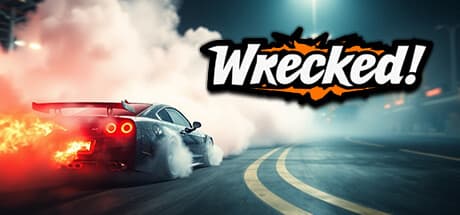
Wreckfest: Full-Contact Racing and Epic Destruction is a full-contact racing game where following the ideal line is not enough to win. Developed by Bugbear, the studio behind FlatOut 1 & 2, and published by THQ Nordic, it was released on June 14, 2018.
It supports both single-player events and online PvP.
The core loop involves choosing a vehicle, entering events, and improving it as you progress. Building only for maximum speed is rarely the complete answer.
Conventional races reward finishing position and damage avoidance, while demolition derbies ask you to disable opponents without sacrificing your own ability to keep moving.
When Contact Becomes Strategy
Wreckfest builds its racing around physics-driven impacts and vehicle deformation. A collision is more than a visual effect because damage and loss of control can change the rest of an event.
Pushing a rival toward a barrier, judging traffic at an intersection, and avoiding a badly damaged car can matter as much as choosing a braking point.
This creates races where a cautious driver can gain several positions by surviving a pileup, while a leader can lose everything in one heavy crash. Unlike a simulator focused mainly on repeatable clean laps, Wreckfest tests how well you anticipate chaos and limit its consequences.
Accidents are unpredictable, but managing that risk gives the game its distinctive competitive layer.
Building for Different Events
In circuit and banger races, acceleration, top speed, handling, and durability must be balanced. Extra protection can help a car survive contact, but it does not serve the same purpose as a setup dedicated purely to pace.
The right compromise depends on the track, expected traffic, and the event objective.
Demolition derbies shift the emphasis from lap time to how you deliver and receive impacts. Repeated head-on attacks are not always the smartest approach; preserving critical parts of your own car while finding useful angles is more sustainable.
Reinforced bumpers, roll cages, and other modifications make the most sense when treated as preparation for a particular type of contest.
Visual customization also lets you give a vehicle its own identity as it accumulates dents and scars. However, the tuning should not be mistaken for an engineering sandbox built solely around minute setup work.
Its main purpose is to make the choice between speed and survival meaningful on the track.
Tips for Your First Events
Early on, focus on finishing rather than trying to win every collision. At a crowded first corner, check the traffic and leave yourself an escape route instead of forcing a move into the smallest gap.
Briefly lifting the throttle before a developing pileup can produce a larger gain than charging into it.
It also helps to separate your racing and derby habits. In a circuit race, unnecessary retaliation may cost more positions and damage than it gains.
In a derby, maintaining room to move and avoiding vulnerable impact angles reveals a deeper game than simply driving into the nearest target.
PC Requirements Explained
The minimum specification lists Windows 10, a 2.8GHz Intel Core i3 or AMD equivalent, a GeForce GTX 560 or Radeon HD 7770, and 8GB of RAM.
DirectX 11 and 32GB of available storage are also required. Steam describes this configuration as a target for approximately 30 FPS at 1080p, so the minimum represents a specific performance expectation rather than an assurance of consistently smooth play.
The recommended specification calls for Windows 10, a 3.0GHz Intel Core i5 or AMD equivalent, a GeForce GTX 970 or Radeon R9 380X, and 8GB of RAM.
It targets approximately 60 FPS at 1080p. Since busy crashes can create rapid motion and demand timely steering corrections, the recommended tier is the more sensible reference point for players who value responsive control.
Both tiers list 32GB of available storage. Keeping additional free space for updates is prudent rather than planning around the exact installation figure.Check the review panel on this page or the Steam listing for the latest user review trend.
Reception and the Source of Its Appeal
Wreckfest has maintained broadly positive player sentiment over time. Its appeal comes from races that change through contact, destruction that affects decision-making, and outcomes not determined by raw speed alone.
Short events can remain entertaining because the traffic itself creates new situations.
The same unpredictability can also divide players. Your experience in online PvP may depend on whether other drivers approach an event competitively, aggressively, or as pure chaos.
Players who can treat a wrecked lead as part of the story are more likely to enjoy the design than those who expect every race to remain orderly.
Who Should Play It
Wreckfest suits players who enjoy destructive racing, damage-aware tactics, and situations that cannot be completely rehearsed. It is particularly appealing if you want accessible racing combined with a sense of vehicle weight and momentum.
Players who like upgrading cars and changing their priorities for different competitions also have a clear progression hook.
There are options for those who prefer structured single-player events and for those seeking unpredictable online PvP. The game supports English, Japanese, and several other languages, making its event rules and customization choices accessible to a broad audience.
Limitations and Who May Not Enjoy It
This is not the best choice for someone who wants clean motorsport with minimal contact. Vehicle damage and the possibility that one collision can overturn a strong race are intentional parts of the design.
If consistent inputs must always produce consistent outcomes for you to have fun, its uncertainty may become frustrating.
It also does not prioritize licensed-car authenticity or exact reproduction of formal racing regulations above everything else. Players interested mainly in meticulous setup engineering should compare it with a dedicated driving simulator.
Conversely, anyone expecting only a spectacle of crashes may be surprised by the importance of racing lines, damage control, positioning, and upgrade choices.