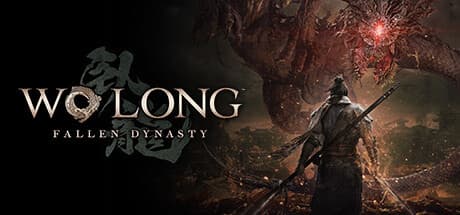
Wo Long: Fallen Dynasty: Dark Fantasy Three Kingdoms Action RPG recasts Later Han China as a battlefield overrun by demons. Set in 184 AD, it follows a nameless militia soldier through conflicts involving troops, monsters, and recognizable figures from the Three Kingdoms era.
Its priority is not strict historical simulation, but fast martial-arts-inspired combat inside a dark fantasy interpretation of the period.
Game Overview
Each battlefield asks you to explore, raise flags, collect equipment, and prepare for increasingly dangerous encounters. Combat revolves around reading attacks, deflecting them, breaking an opponent's posture, and converting that opening into a powerful strike.
Observation and repeated attempts matter more than simply overwhelming enemies with regular attacks.
Progress is organized around separate main and optional battlefields rather than one seamless open world. Optional missions provide room to gather equipment, develop a build, and practice before returning to a difficult encounter.
This structure keeps objectives focused, but may feel restrictive to players primarily seeking unrestricted exploration.
Deflection and Spirit
The defining system is the Spirit gauge, which tracks momentum for both the player and enemies. Successful attacks and deflections improve your position, enabling Spirit attacks, martial arts, and wizardry.
Excessive guarding, failed deflections, or careless ability use can push Spirit in the wrong direction and leave you vulnerable to a break.
Critical attacks, signaled clearly before impact, are especially important. They are difficult to solve through ordinary guarding, so learning the correct deflection timing can reverse an encounter.
Success requires recognizing each enemy's wind-up and rhythm; reacting to the warning alone is not always enough.
Wo Long therefore rewards stepping into an attack and reclaiming initiative. Players accustomed to retreating and waiting at range may struggle until deflection becomes part of their offense rather than an emergency escape.
Once that idea clicks, battles develop a rapid exchange of pressure instead of a simple pattern of blocking and counterattacking.
Morale Makes Exploration Matter
Every battlefield uses Morale Rank, which affects the balance of power between combatants. Raising battle flags and marking flags improves Fortitude, giving you a safer foundation after defeat.
When an enemy seems disproportionately strong, searching for overlooked flags may be more useful than repeatedly attempting the same fight.
Exploration consequently serves as preparation rather than mere collectible hunting. The system lets confident players confront danger early while giving methodical players a way to reduce the disadvantage.
Those who dislike repeating battlefield preparation, however, may find this layer less appealing than a purely skill-based boss sequence.
Builds, Weapons, and Wizardry
Character growth is divided among the Five Phases. Investment can affect health, Spirit management, equipment load, and affinity with different wizardry spells.
Weapon classes such as swords and spears also differ in reach and attack patterns, while martial arts attached to equipment can change how a weapon fits into a combo.
Wizardry includes offense, support, and disruption rather than functioning only as ranged damage. A useful build starts with a clear purpose: support close combat, apply elemental effects, or create safer openings.
The large flow of equipment also introduces a loot-management layer, making the game a better fit for players who enjoy comparing bonuses and refining a setup.
How to Survive the Opening Hours
Avoid treating every exchange as an attack race. Guarding can support early practice while you learn which animations demand a deflection and when an enemy's sequence actually ends.
Trying to deflect every minor strike immediately can lead to frantic inputs, so first concentrate on critical attacks and clearly readable combo finishers.
If a boss stops your progress, check flags, Morale, equipment weight, and weapon reach before assuming that damage is the only problem. Overusing martial arts or wizardry while Spirit is unfavorable can create openings for the enemy.
Separate the defensive phase of an exchange from the moment when a Spirit attack can produce a decisive break.
Multiplayer's Role
The campaign can be played alone, but allied officers and online cooperation can help during difficult battlefields. Additional targets divide enemy attention, providing more room to observe attacks and recover.
Competitive interactions also exist, so the overall design is not limited to an isolated solo journey.
Cooperation does not remove the need to learn the fundamentals. Wide attacks and critical threats may still require an individual response, while an unfocused build remains vulnerable.
A practical approach is to learn an encounter alone first and call for help only when a particular section becomes a roadblock.
PC Requirements
The minimum specification lists 64-bit Windows 10 or 11, a Core i5-8400 or Ryzen 5 3400G, a GTX 1650 4GB or RX 570 4GB, and 8GB of RAM. That target is based on an HDD at 720p and 30fps using the Best Performance graphics setting.
Meeting the minimum should therefore not be interpreted as a guarantee of high-resolution or high-frame-rate play.
The recommended specification lists a Core i7-8700 or Ryzen 5 3600XT, an RTX 2060 6GB or RX 5700 XT 8GB, and 16GB of RAM. Its stated target is 1080p at 60fps on the Standard setting while using an HDD.
Because deflection timing is central to combat, lowering visual settings to maintain stable performance is usually more useful than accepting irregular frame delivery for better image quality.
Both tiers require DirectX 12 and 60GB of available storage. Leaving additional free space is sensible for installation and updates.
Although the published targets use an HDD, players who value shorter loading periods may still prefer installing the game on an SSD.
Reception and Common Criticism
Positive reactions commonly focus on the speed of combat and the satisfaction of turning a dangerous attack into an immediate advantage. The combination of Three Kingdoms figures, demonic enemies, weapon choices, and wizardry also gives the campaign a distinct identity.
Players who embrace deflection often find that the system produces tense but readable duels.
Criticism tends to center on strict input timing, equipment clutter, and the need to search battlefields for flags. The opening can test the core mechanics before every player has fully understood them, creating an unusually sharp first obstacle.
PC performance and control feel can also depend on the individual system, so the recommended tier is the more useful baseline when judging hardware readiness.
Who Should Play It
Wo Long is best suited to players who enjoy studying an opponent, identifying a mistake, and improving over repeated attempts. It particularly favors those who like parry-driven combat where one accurate input can reverse momentum.
The setting also works for players interested in a supernatural reinterpretation of Three Kingdoms figures rather than a faithful historical retelling.
There is additional depth for anyone who enjoys comparing equipment bonuses and adjusting weapons, spells, and Five Phase investment. Optional battlefields and multiplayer create opportunities to gather gear and test alternate builds outside the direct campaign path.
It is a game about improving both execution and character setup through repetition.
Caveats and Who Should Skip It
Players who dislike learning parry timing or repeating difficult encounters should approach with caution. This is not an open-world journey built around unrestricted travel, nor is it a dialogue-heavy RPG with major narrative branches.
It is also a poor substitute for a historical strategy game if authentic Three Kingdoms simulation is the main attraction.
Frequent equipment drops create recurring comparison and inventory work. Anyone seeking uninterrupted sword fighting without build management may find that process cumbersome.
Released on March 3, 2023, the game supports English, Japanese, Simplified Chinese, Korean, and other languages, but current language and system details should still be checked in the store before purchase.