Game Overview
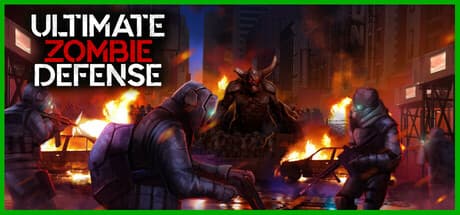
Ultimate Zombie Defense: Co-op Survival Horror in a Sealed European City combines top-down shooting with tactical base defense. A zombie outbreak has placed the suburbs of a European city under quarantine, and the player enters the restricted area as an elite operative.
The mission is to locate the source of the infection and eradicate it.
The central loop is easy to understand: select a defensible position, place barriers such as chain-link fences, and shoot the undead as they approach. Survival depends on more than sustained fire.
Players must shape enemy routes, preserve firing lanes, and decide which direction each squad member should cover.
Both single-player and multiplayer are available, including online co-op. Solo play offers room to learn the controls and placement system at an individual pace.
Co-op, however, makes the defensive systems more meaningful because several players can cover different approaches and repair a failing line together.
Features and Systems
The distinguishing idea is the combination of an immediate top-down shooter with the preparation associated with tower-defense games. Barriers can narrow an approach and concentrate enemies within the squad's line of fire.
Careless construction can also obstruct movement or eliminate an escape route, so placing more objects is not automatically better.
The overhead camera makes threats around the position easier to read than in a first-person game. Positioning and awareness therefore matter alongside aiming.
During co-op sessions, players can naturally divide into roles such as holding the front, firing from safer ground, and responding wherever the perimeter breaks.
Voice communication is not strictly required, but a team that shares attack directions and retreat timing will usually recover more cleanly. The tactical depth comes from maintaining a workable formation while the situation changes.
A rigid plan may fail, so the squad must be ready to abandon part of the defense and reposition.
Early Survival Priorities
New players should avoid defending a large open area from every direction. Reducing the number of accessible routes makes the horde easier to track and lets the team focus its fire.
The inside of the perimeter should still contain enough space for movement, along with a route that can be used if the outer line collapses.
A useful defense balances three needs: clear shooting lanes, room for allies to move, and a safe direction of retreat. A barrier that looks strong may become dangerous if it traps the team.
This makes practical layouts more valuable than elaborate ones.
In co-op, having everyone shoot at the same group can leave another approach unguarded. Assigning loose sectors helps, but players should remain close enough to support one another.
Reacting quickly to a breach is sometimes more important than creating a seemingly perfect fortress before the attack begins.
PC Requirements
The minimum specification lists Windows 10, a 2.5GHz CPU or equivalent, Intel HD Graphics 5000, 4GB RAM, 2GB of available storage, and DirectX 11.
Because an integrated graphics solution appears in the minimum requirements and the installation footprint is modest, the entry barrier is lower than that of many modern large-scale games. A minimum specification should still be treated as a baseline for running the game, not a promise of smooth performance during crowded encounters.
The recommended specification lists Windows 10, a 3.5GHz CPU or equivalent, Nvidia GTX 1050, 4GB RAM, 2GB of storage, and DirectX 11.
Players who value stable co-op sessions should use the recommended GPU as the safer reference instead of aiming exactly at the minimum. On an older laptop or integrated GPU, lower the resolution and graphics options, then check performance when many enemies are present.
Both tiers list 4GB RAM, but that figure describes the game's requirement rather than the needs of every background program. A browser, voice-chat client, and Windows itself also consume memory.
Network stability matters in online co-op as well, so persistent lag or disconnections may require checking the connection rather than only changing graphics settings.
Reception and Player Expectations
Ultimate Zombie Defense has maintained a broadly favorable Steam reception over time. Its appeal is easy to identify: the defense loop is quick to understand, and holding a position with friends creates immediate cooperation.
The connection between placing a barrier and improving a firing position is also visually clear.
Prospective players should not mistake it for a detailed settlement-management simulation or a narrative-led horror adventure. Its focus is an arcade-like cycle of preparation, shooting, and recovering from breaches within contained combat spaces.
Check the live rating panel on the article for the current reception, while judging the game itself by whether this repeatable loop suits your preferences.
Who Should Play It
The game is a good match for players who want to fight zombie hordes with friends while making more decisions than simply choosing a weapon. It particularly suits groups that enjoy dividing responsibilities and adjusting a shared defense under pressure.
Its small storage requirement also makes it an accessible option when drive space is limited.
Solo mode lets players practice controls and construction before joining others. For the confusion, communication, and last-second recoveries that best express the design, playing with friends is the stronger choice.
As a title released on December 8, 2020, it is best selected for its direct gameplay loop rather than compared with recent blockbusters solely on visual technology.
Limitations and Who May Not Enjoy It
Players seeking extensive exploration, a story-heavy campaign, or horror built mainly around suspense may find the emphasis different from what they expected. Base building is a tactical tool for stopping the next assault, not a long-term city-management system.
It favors players who want to test a defensive layout immediately rather than spend hours designing a permanent settlement.
Co-op can become disorganized when every player moves independently or watches the same direction. Anyone who dislikes coordinating positions may not enjoy the multiplayer emphasis.
It may also be a poor fit for players expecting the precision and competitive structure of a dedicated player-versus-player shooter.
Finally, meeting the listed minimum requirements does not guarantee identical results on every PC. Background software, laptop power limits, and connection quality can all affect the experience.
Owners of older systems should be prepared to adjust settings and test demanding horde encounters before assuming that every session will remain equally smooth.