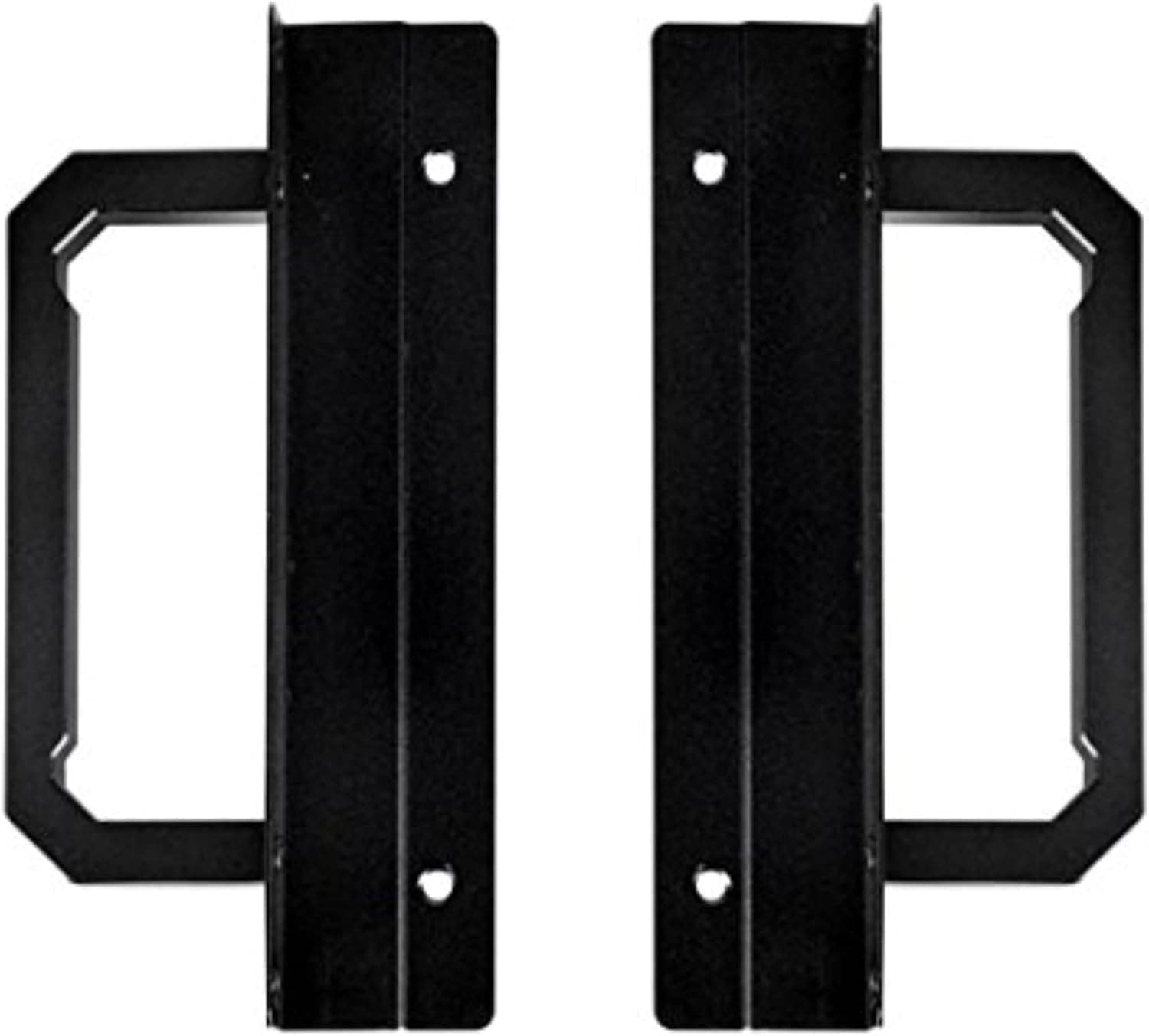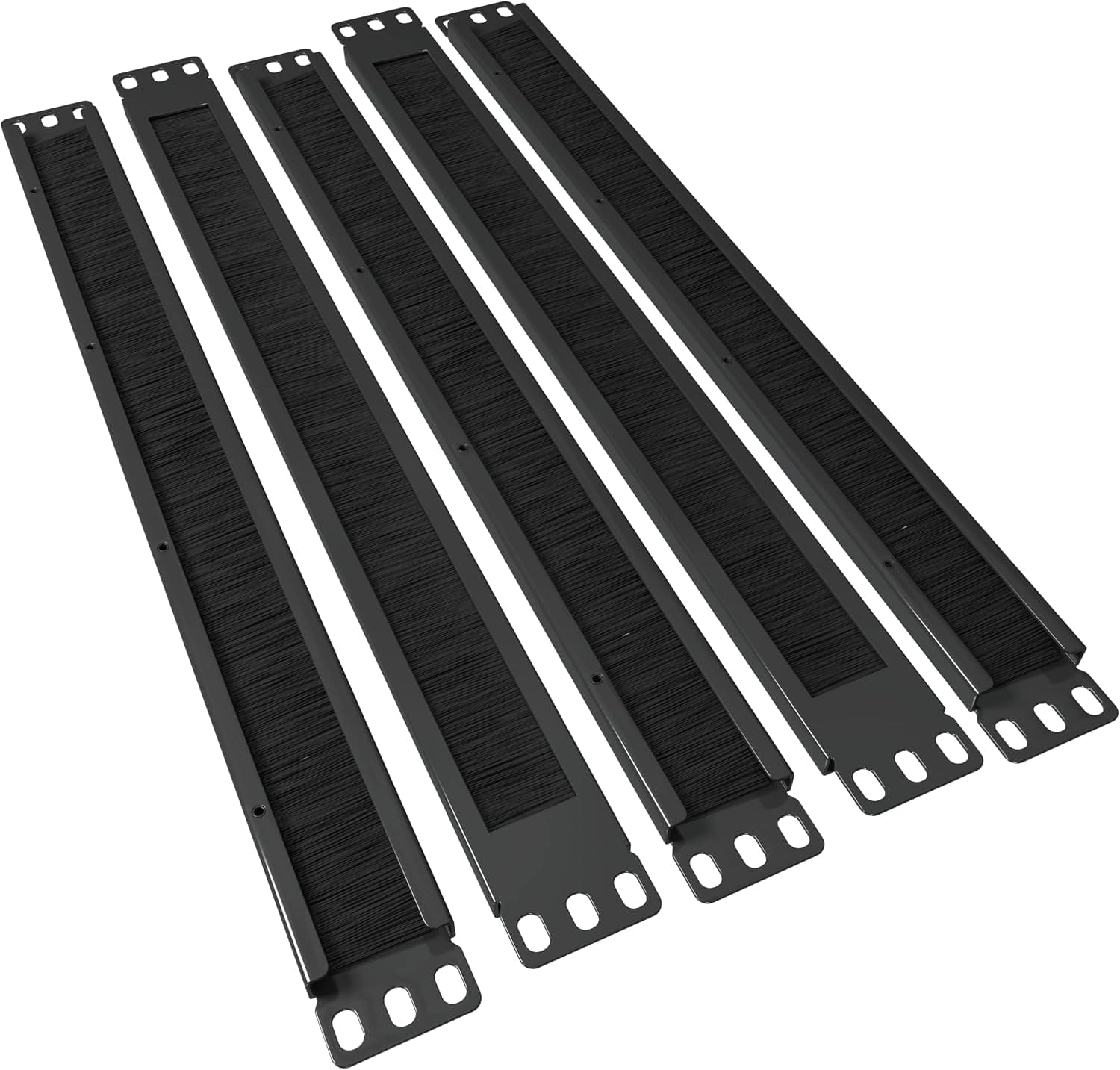
The Tupavco TP1750 is a 1U brush strip panel sold as a 5-pack, designed to fill empty rack units in a standard 19-inch rack while still letting cables pass through. On Amazon.co.jp it was listed at ¥8,284 as captured on September 1, 2026, with 107 reviews averaging 4.7 out of 5 stars (94% positive).
This article covers what it actually does, which racks it fits, and the pitfalls people hit after buying.
Overview
The TP1750 combines two jobs: a blanking panel and a cable pass-through. A steel frame holds dense nylon bristles that part to let cables through and close back around them.
Leaving rack units empty allows hot exhaust air to recirculate from the rear to the intake side, so blanking empty U space is a cooling measure in itself. Unlike a solid steel blank, the TP1750 lets you keep routing power and network cables front-to-back.
It suits home labs and small offices running a 19-inch rack where cabling currently spills out through door gaps. At the September 2026 captured price, that works out to roughly ¥1,657 per panel — poor value if you only need one, but a realistic quantity if you are tidying a whole rack.
Compatibility Guide
It fits standard 19-inch racks (EIA-310 mounting rails), both 2-post open frames and 4-post cabinets. It is 1U tall, black, and secured with the included screws.
Mounting on either the front or rear is supported; in a cabinet, blanking the front is the usual approach to stop cold air short-circuiting.
| Item | Value |
|---|---|
| Material | Steel frame, nylon brushes |
| Quantity | 5 panels |
| Color | Black |
| Installation | Screw mount (included) |
| Form factor | 19-inch rack |
| Height | 1U |
Check three things before installing. First, your rack's hole type: threaded racks (10-32 / M6) versus square-hole racks that need cage nuts.
Square-hole racks may require cage nuts you supply yourself. Second, brush depth — the bristles extend behind the frame, so equipment faceplates or rail stops immediately behind can interfere.
Third, internal width. Half-racks, AV racks with proprietary dimensions, and small network boxes will not accept a 19-inch panel.
Measure the rail-to-rail spacing (around 465mm, roughly 450mm of clear opening) before ordering.
Note that the data category for this article is storage_enclosure, but the TP1750 is not a storage device — it is a rack cable-management and blanking panel used alongside NAS units and disk enclosures, not a product that holds drives.
Product Info
The stated specifications are a steel frame with nylon brushes, a quantity of five, black finish, screw-based installation with hardware included, and 19-inch rack compatibility. Panel thickness, bristle length, usable opening size, and load rating are not published, so check the listing dimensions if your cable bundle is likely to be a tight fit.
The price was ¥8,284 for the 5-pack on Amazon.co.jp as captured on September 1, 2026.
Both the domestic and global listings show the same ASIN, B0B7FQPN32, at the same price; the eBay entry is a search link with no confirmed price. Prices move frequently with stock and sales, so confirm the current figure on the product page before buying.
Per panel that is about ¥1,657 — not dramatically cheaper than single-unit brush panels, but economical when you genuinely need several.
On ratings, 107 reviews average 4.7 out of 5 stars, or 94% positive.
A hundred-odd reviews is a mid-sized sample, so extreme outliers are hard to read, but 4.7 is high for this class of rack accessory.
No warranty period is stated, so initial-defect handling depends on the seller's return policy.
Alternatives Compared
Blanking empty U space can be done several ways.
| Method | Best for | Weakness |
|---|---|---|
| Brush panel (TP1750) | Passing cables front to back | Not a seal; fine dust still passes |
| Solid blanking panel | Pure blocking and airflow separation | No cable path at all |
| Mesh / vented panel | Maximizing front intake | Does little to stop recirculation |
| D-ring cable manager | Horizontal cable routing | No blanking effect |
The TP1750 works best in combination: brush panels only at the heights where cables actually cross, solid blanks everywhere else. You rarely need all five as brushes — concentrating them near switches, patch panels, and the power section at the bottom is more effective for airflow.
Practical Installation Tips
A brush panel does not cool anything on its own; it works only as part of a deliberate airflow path. In a cabinet, blank the entire front so cold air can only enter through equipment intakes.
Route cables through one or two consolidated points and bundle them before they cross the brush, so the bristles close evenly. Scattering thick power cables individually leaves the bristles permanently splayed and reduces the effect.
Order of work matters too. Screwing the panel down first makes it awkward to push large connectors through.
Loosely fit the panel, route the cables, then tighten once the path is settled. Retrofitting into an already-cabled rack may require unplugging cables, so schedule it during a window when equipment can be powered down.
On dust: it reduces accumulation but does not exclude it. The bristles block a large opening; they are not a filter.
In dusty environments an intake-side filter does far more, with the brush panel as a supplement.
Best Use Cases
- Home lab owners with a 19-inch rack: With many empty U, hot exhaust readily recirculates to the intake side, and a panel that blanks while passing cables pays off. The 5-pack fits the stage where you tidy the whole rack at once.
- Small office server or comms rack admins: Good for cleaning up the run between patch panels and switches so the rack looks presentable with the door closed.
- People who reconfigure cabling often: Unlike fixed grommets, brushes accept cables anywhere along the strip, which suits frequent equipment changes.
- Existing solid-blank users: Swapping one or two U for brush panels restores a cable path without giving up the blanking.
If you have no rack, keep gear flat on a desk, or use non-19-inch storage, this product solves nothing for you.
Things to Check Before Buying
The 5-pack is the main decision point. If you only need to blank one U, a single-panel product is cheaper.
The ¥8,284 captured on September 1, 2026 covers five panels, and looks expensive until divided. If you plan to add equipment over time, the bulk price works in your favor.
Do not overestimate the cooling benefit. Blanking reduces recirculation only where a front-to-rear pressure difference exists — a cabinet with doors and separated intake and exhaust paths.
On an open 2-post rack, surrounded by open air, temperature change will be negligible; there the value is cable tidiness, not cooling.
Take "tool-free" claims with caution. Installation is screw-based, so at minimum you need a screwdriver, and square-hole racks are much easier with cage nuts and an insertion tool.
Tight access behind the rack makes even simple screwing slow.
Bristles take a set over time. Thick bundles left in place for long periods hold the bristles open, and they may not fully recover.
If airflow separation matters, keep the number of cables per crossing low and plan on replacing heavily used panels eventually.
Watch for listing inconsistencies. The article data categorizes this as storage_enclosure even though it is a rack panel, and automatically collected listing fields sometimes carry values from other products.
Before ordering, confirm from the product image and title that you are buying the 1U brush panel 5-pack. The same applies to price: the figure here is as captured on September 1, 2026.
FAQ
Q. Is it useful on an open 2-post rack? A.
For cable routing, yes. For airflow separation, barely — use a doored cabinet if cooling is the goal.
Q. Do I need to supply screws or nuts? A.
Mounting screws are included. Square-hole racks assume cage nuts are already fitted; supply your own if you have none spare.
Q. Does it block dust completely? A.
No. It is a bristle barrier, not a filter.
Pair it with an intake-side filter if dust is a concern.
Q. How many panels do I need? A.
Only as many as the heights where cables actually cross — often one or two in a home rack. Blank the rest with solid panels for better airflow separation.
Q. Can I use it in a rack holding a NAS or disk enclosure? A.
Yes, in any 19-inch rack. The NAS handles its own cooling, but reducing rack-wide heat pockets helps.
Product Disclosure (Amazon)
- Manufacturer: Tupavco
- Seller: Amazon US
- Fulfilled by: Amazon US
- ASIN: B0B7FQPN32
- Note: This article covers a manufacturer-made product based on Amazon listing details.