Game Overview
Check the review panel on this page or the Steam listing for the latest user review trend. You handle preparation, acceleration, speed control, braking, and station stops rather than merely watching the scenery pass.
High-speed passenger service, urban rapid transit, and heavy freight each demand a different rhythm and make you pay attention to different controls.
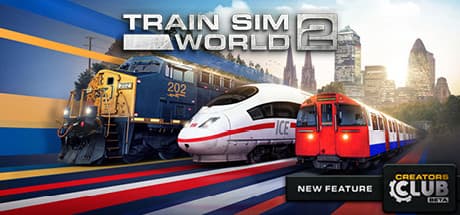
The included locomotives feature the DB ICE 3M and the CSX AC4400CW. German high-speed running rewards planning ahead for changing limits, London Underground services emphasize repeated acceleration and accurate stops, and freight work requires early decisions because a long, heavy consist cannot be handled like a commuter train.
Switching routes therefore changes more than the view; it changes how you approach the entire drive.
Learning the Controls
The appeal lies in balancing power and braking against signals, gradients, speed restrictions, and train weight. High-speed operation emphasizes anticipation and smooth inputs, while underground services compress those decisions into short station intervals.
Freight introduces slower responses and makes poor speed planning harder to correct at the last moment.
You do not need to understand every cab control immediately. A sensible progression is to learn starting and normal braking first, add signal and speed-limit awareness, and then study procedures unique to each locomotive.
Players who enjoy diagnosing why a stop went wrong will find more value here than those who simply want to hold a throttle open.
Routes and Customization
Train Sim World® 2 also includes tools for personalizing trains and arranging experiences around its railway environments. This is not a network-building management game in which every track is placed from scratch.
Its creative features are better understood as ways to vary and personalize operation on the available railway content.
Short commuter runs can suit a brief session, while freight and high-speed services reward more uninterrupted time. The commitment varies with the activity selected, so new players should begin with shorter tasks and learn how long preparation and driving take.
Repeating a familiar section under different conditions is part of the appeal rather than filler to rush through.
PC Requirements
The minimum specification lists a 64-bit version of Windows, an Intel Core i5-4690 or AMD Ryzen 5 1500X, and 8 GB of RAM. Graphics requirements begin at a GeForce GTX 750 Ti or Radeon R9 270 with at least 2 GB of VRAM.
The game also requires 20 GB of available storage and DirectX 10.
The recommended specification moves to a Core i7-4790 or Ryzen 7 1700 and a GeForce GTX 970 or Radeon RX 480 with at least 4 GB of VRAM. Memory and storage remain at 8 GB and 20 GB.
Since the largest step is in CPU and GPU capability, players seeking more headroom around detailed stations and long consists should treat the recommended tier as the more useful target.
A mouse and keyboard or an Xbox controller is required. A controller can make the principal driving inputs convenient, but keeping a mouse available helps when interacting with smaller cab switches.
The listed requirements also contain a driver note for older AMD hardware, so owners of relevant cards should verify driver compatibility before installing.
Reception and Player Expectations
The game is most likely to satisfy players who value distinct locomotive procedures, cab immersion, and gradual improvement. Its mix of high-speed passenger, underground, and freight work provides meaningful variety because each service changes braking distances and workload.
A clean stop or well-planned speed reduction can become its own reward even when the route is already familiar.
The same structure can frustrate players who dislike repeated practice or procedural controls. Much of the satisfaction comes from running a service accurately, not from constant spectacle or rapidly changing objectives.
When reading current user feedback, separate opinions about the driving model from opinions about content selection, then prioritize the category that matters to you.
Who Should Play It
It suits railway fans who want to operate a cab rather than only admire trains from outside. Players who enjoy repeating a route to refine braking points, or changing locomotives to learn a new control style, are especially likely to appreciate it.
Newcomers can also use the contrast among passenger, underground, and freight services to discover which kind of railway operation interests them most.
It is also a good match for players seeking a solitary simulation focused on personal mastery instead of competition. Train Sim World® 2 was released on August 20, 2020, so the best purchasing question is whether its included locomotives and routes appeal to you, rather than whether it is the newest entry available.
Limitations and Who Should Skip It
Players primarily seeking unrestricted free roaming, railway-company management, or track construction should look elsewhere. The central activity is learning the supplied vehicles and operating within established railway environments.
Anyone expecting immediate arcade-style speed or frequent dramatic events may find the necessary learning and repetition too deliberate.
The supplied language list includes English, French, German, Italian, Spanish, Polish, Russian, and Simplified Chinese, but does not list Japanese. Because operating terminology and instructions matter, players who require Japanese support should verify the current store listing before buying.
It is also worth checking present OS, input, and driver information against your own system, as platform details can change over time.


