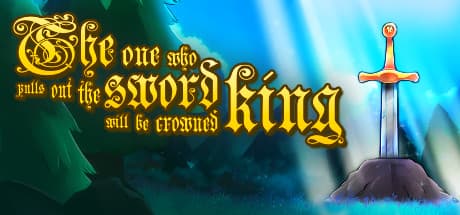
Game Overview
The One Who Pulls Out the Sword: A Darkly Comedic Medieval Challenge covers The One Who Pulls Out the Sword Will Be Crowned King, an experimental indie game built around one scene from Arthurian legend. Developed and published by Majorariatto, it was released on March 28, 2022.
Your entire objective is to use the mouse, pull the sword all the way out of its stone, and claim the crown.
There are few controls to learn, but performing that one action is the challenge. This is not a button-mashing action game: it tests whether you can maintain a long, controlled mouse movement without losing your grip or running out of physical space.
A failed attempt sends you back to try again, giving a very short game an unusual degree of tension.
Features and Systems
The defining mechanic is that the sword becomes longer and heavier as more players succeed online. It is best understood as asynchronous competition rather than a conventional match in which several players fight on the same screen.
Earlier victories accumulate into a tougher task for later challengers, steadily pushing the crown farther away.
Nearly all play revolves around grabbing the sword and carefully drawing it upward. Because the interaction is so simple, a small slip feels disastrous, while finally seeing more of the blade creates genuine anticipation.
Instead of equipment, skill trees, or character progression, the design focuses on whether you can complete one deliberately awkward physical input.
The game includes single-player and multiplayer elements, but it should not be mistaken for a cooperative medieval adventure or a full competitive combat game. Its online identity comes primarily from other players changing the conditions of your challenge through their success.
Starting alongside friends, comparing completion attempts, or sharing the struggle on a stream can make the central joke more effective.
System Requirements
The minimum specification lists Windows 8, a Dual Core processor, a Radeon HD 4850 or GeForce 830M, and 2 GB RAM. It also requires only 300 MB of available storage, so it is not positioned like a demanding modern 3D release.
On an older laptop, confirm that its graphics hardware meets or exceeds the listed minimum before playing.
A mouse is explicitly required. A touchpad is poorly suited to a long drag because repositioning a finger can interrupt the motion.
In practice, a reliable mouse and enough clear desk space may matter more to the experience than high-end PC hardware.
No recommended specification is provided, so a particular resolution or frame-rate target cannot be guaranteed from the supplied data. The listed minimum requirements are modest, but players concerned about compatibility with newer operating systems should check the current store information before installing.
Reception and Common Impressions
The game has maintained a strongly positive reception over time. Its clearest strength is the way an instantly recognizable legend supports an equally understandable mechanical joke: every new king makes life worse for the next candidate.
Although the experience is brief, finally succeeding creates the kind of story players naturally want to share.
The same focus can also produce negative reactions. The controls are intentionally awkward, failure leads to repeated motions, and there is little variety for anyone expecting a broad action game.
Enjoyment depends on whether you can treat frustration, imprecision, and apparent futility as part of the dark comedy rather than defects to be removed.
Practical Tips Before an Attempt
Before pulling quickly, test how much room your mouse has and how far the cursor travels. Clearing the desk helps prevent reaching its edge during a critical part of the motion.
Avoid changing sensitivity repeatedly; instead, find a setting that lets you maintain a steady movement comfortably.
If several attempts fail, pause and rest your hand rather than immediately rushing back in. The challenge involves sustained concentration as much as reflexes.
Trying to finish a short game in one impatient burst can make the input less consistent and the experience more frustrating.
Who Should Play It
It suits players who enjoy unusual indie concepts, compact high-difficulty challenges, and dark comedy built from a familiar medieval legend. It is also a good match for people who prefer learning through immediate attempts instead of reading a lengthy tutorial.
Friends and streamers can use its simple premise as an easy challenge to compare and discuss.
This is less about consuming a long story than seeing how far one mechanical idea can be pushed. Players who regard failed attempts and the eventual completion story as part of the entertainment are most likely to appreciate it.
Caveats and Who Should Skip It
Do not approach it expecting a story-driven medieval RPG, sword-fighting combat, or continuous live competition against other players. There is no equipment progression designed to make repeated attempts steadily easier.
Its short-form structure also makes it a poor fit for someone seeking dozens of hours of varied content.
The listed supported languages are English and Spanish from Spain; Japanese support is not listed in the supplied data. The central objective and mouse interaction are visually straightforward, but anyone who requires full Japanese text should verify the current language listing before playing.
Finally, an extended dragging motion may strain the wrist or arm. Stop and rest if discomfort develops.
Although the hardware requirements are light, using a regular mouse instead of a touchpad is important for engaging with the challenge as intended.


