Game Overview
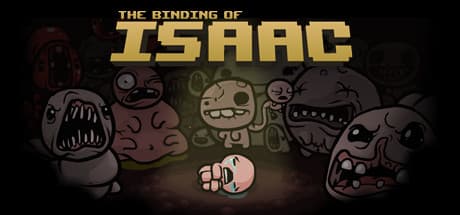
The Binding of Isaac: A Rogue-Like Descent into Madness is a top-down action RPG shooter about a boy fleeing into his basement after his mother hears a divine command demanding a sacrifice. Released on September 28, 2011, it was developed by Edmund McMillen and Florian Himsl.
Its grotesque, cartoon-like imagery turns themes of religion, domestic fear, and guilt into a deliberately unsettling setting.
A typical run consists of clearing rooms, collecting items and limited-use resources, defeating a floor boss, and descending farther underground. Isaac attacks by firing tears while moving around enemy shots and avoiding contact damage.
Death ends the current attempt and removes that run's equipment, so progress comes largely from learning enemy behavior and recognizing which items are useful.
Features and Systems
Room layouts, enemies, bosses, and item rewards are randomly assembled, preventing one route from solving every run. Players must judge whether their remaining health, keys, and bombs justify further exploration or whether it is safer to approach the boss.
The controls are compact, but resource decisions have a major effect on survival.
Treasure changes more than a statistic. Items can alter Isaac's appearance and affect properties such as tear movement, attack rhythm, or effective range, forcing different approaches to familiar encounters.
A fortunate combination can turn a difficult run into a destructive power trip, while an awkward setup exposes weaknesses in positioning and dodging.
Exploration also rewards attention to room and wall layouts. Bombs and keys may open opportunities, but spending them early can leave later rewards inaccessible.
This creates a constant choice between immediate value and keeping resources for an unknown room, making accumulated knowledge nearly as important as reflexes.
Advice for Early Runs
New players benefit more from studying attack directions and safe positions than from rushing toward the next floor. Losing health to ordinary enemies can leave too little room for error against a boss.
Trying unfamiliar items and remembering their effects is part of the intended learning process rather than wasted time.
Avoid spending every key or bomb as soon as it appears. Inspecting more of a floor can reveal a better use for a scarce resource.
Random generation still means that a sound decision may produce a weak result, so enjoying the game requires accepting that some attempts cannot be rescued.
System Requirements
The listed minimum specification calls for Windows XP, Vista, or 7; a 2.5 GHz processor; 1GB RAM; a DirectX 9.0c-compatible graphics card; 50MB of storage; and DirectX 9.0c.
These CPU, memory, and storage requirements are extremely light by modern hardware standards. The game does not demand the large installation space associated with current big-budget releases.
However, these are old minimum requirements, and no recommended specification is supplied in the provided data. They should not be read as a guarantee for every current operating system or hardware configuration.
Check the current Steam compatibility information before buying, especially if you plan to run this original release on a recent version of Windows.
Reception and Review Tendencies
The game's lasting appeal comes from producing varied situations from a small set of controls and letting players restart quickly after failure. Discovering an unexpectedly effective item combination is satisfying, while improved knowledge makes later decisions feel more deliberate.
Its disturbing imagery and religious themes also give it an identity far removed from a conventional fantasy dungeon crawler.
The same randomness can produce uneven difficulty and major differences in offensive strength between attempts. Players who want every failure to reflect execution alone may find that frustrating.
The game also expects repeated experimentation, making it less suitable for anyone who wants complete explanations and a direct path through the content.
Who It Suits
The Binding of Isaac is a strong fit for action-roguelike fans who enjoy adapting to a different collection of tools on every attempt. It also suits players who prefer many compact runs and gradual mastery over a single linear campaign.
Its strange visual humor and oppressive themes are important parts of the appeal, not incidental decoration.
Cautions and Who Should Skip It
The game includes material associated with domestic abuse, religious extremism, blood, bodily waste, and grotesque creatures. Players seeking a cheerful dungeon adventure, or those sensitive to those themes, may find it unpleasant.
Its simple-looking presentation should not be mistaken for child-friendly subject matter.
This article covers the original 2011 release of The Binding of Isaac, not a later related edition. Features and technical behavior from other versions should not be assumed to apply here.
Confirm the title, release date, and supported environment on the store page so that you select the version you actually intend to play.