Game Overview
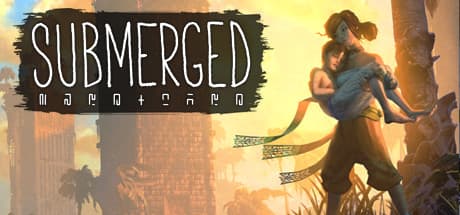
Submerged: Explore a Flooded City's Beauty is a third-person adventure about Miku, a girl searching a drowned city for supplies that may save her sick brother. Released on August 4, 2015, it replaces combat and character builds with navigation, observation, climbing, and environmental discovery.
The main loop has Miku pilot a small fishing boat between partially submerged buildings, use a telescope to identify promising locations, and climb exterior routes to reach supplies. There are no enemies to defeat or weapons to improve.
Progress is instead driven by the cityscape, the siblings' situation, and clues that gradually reveal what happened to this place.
Features and Systems
Exploration alternates between boating and climbing. On the water, distant landmarks help determine where to travel next.
After landing, the player follows ledges, pipes, window frames, and other visible handholds toward rooftops and supplies.
The telescope is a practical navigation tool rather than a decorative feature. Checking the skyline from an open or elevated position is more useful than sailing without a destination.
The game rewards noticing building shapes and possible routes, not mastering combat timing.
Its lack of combat does not automatically make every part effortless. Threat management is absent, but reading the environment becomes the central task.
Players who enjoy pausing to study ruins and imagine their history are more likely to appreciate the deliberate pace.
The story is delivered through discoveries instead of long conversations or constant exposition. Saving Miku's brother provides an immediate objective, while the city's past is assembled from environmental details and collectibles.
This approach works best for players comfortable interpreting fragments rather than receiving every answer directly.
Getting Started
Early on, use the telescope to mark supply locations and visit nearby objectives instead of trying to cover the entire map immediately. Before climbing, look up at the whole building and identify a chain of reachable ledges.
Observation matters more than complex inputs during these sequences.
Optional discoveries provide additional context about the city and its characters, but the main journey does not require every collectible. This gives the player some control over pacing.
Take detours when the atmosphere is the priority, or follow supply markers when steady progress matters more.
PC Requirements
The minimum specification lists 64-bit Windows 7, a 2.0 GHz or faster dual-core CPU, a GeForce 9800 GTX or Radeon HD 4770, 4 GB of RAM, and DirectX 10.
The recommended setup lists a 2.5 GHz Intel Core i5, a GeForce GTX 760 or equivalent GPU, 8 GB of RAM, and DirectX 11.
Both tiers require 3 GB of available storage.
These requirements are modest by current desktop standards, but an older integrated GPU should not be assumed to match the listed dedicated cards. If water, vegetation, or long views cause uneven performance, lowering resolution, shadows, and view-related settings is a sensible starting point.
Hardware near the minimum may require choosing between visual detail and smoother movement.
Check the review panel on this page or the Steam listing for the latest user review trend. Players using a newer Windows version should check the current store information and recent user reports before buying.
Laptop users should also confirm that the game launches on the dedicated GPU when one is available.
Review Tendencies
Players are likely to value the freedom to explore without combat pressure, the quiet combination of art and sound, and the straightforward objective. Sessions are easy to divide around individual supply runs, while the controls impose less learning overhead than a combat-heavy adventure.
The repeated rhythm of sailing, locating a route, and climbing can also feel limited to anyone expecting elaborate puzzles or demanding traversal. When reading current feedback, look beyond comments about visual atmosphere.
Opinions on repetition, camera behavior, and the density of discoveries are more useful for deciding whether the game matches your preferences.
Who Should Play It
Submerged suits players who enjoy scenic navigation, combat-free exploration, and stories that leave room for interpretation. If drowned towers and ruins reclaimed by nature are appealing in themselves, travel becomes part of the reward rather than downtime between encounters.
It is also approachable for players who do not want reflex tests or complicated build systems. Multiple supported languages, including Japanese and English, are listed in the supplied data.
Check the current Steam language table to confirm exactly which interface, subtitle, and audio options are available.
Cautions and Who Should Skip It
This is not a strong fit for players seeking combat, deep progression systems, branching decisions, or a constant stream of new mechanics. Its calm repetition of climbing, observing, and boating is intentional.
Anyone who needs frequent mechanical escalation may find it monotonous.
The supplied metadata mentions multiplayer, while the described core experience follows Miku in a solo exploration journey. Anyone purchasing specifically for cooperative or competitive play should verify the current player-count and feature listings on Steam first.
Because this is an older release, it is also wise to confirm current OS support and language details rather than relying solely on legacy metadata.