Game Overview
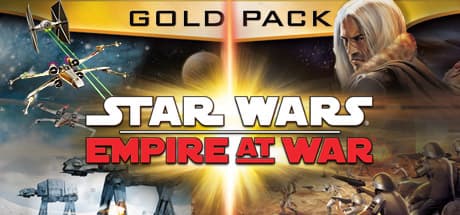
STAR WARS™ Empire at War: Gold Pack - Command the Galactic Civil War combines galaxy-level management with real-time battles fought in space and on planetary surfaces. You select a faction, build fleets, secure worlds, and move forces across the galactic map before directly commanding them when combat begins.
The core loop alternates between preparing your economy and armies, selecting an invasion route, and resolving battles in real time. Space engagements focus on fleets and target selection, while ground battles involve infantry, vehicles, and other battlefield units.
Decisions made on the strategic map therefore shape the forces and options available in the next fight.
The Gold Pack includes the original game and expansion content featuring the Star Wars Underworld. This adds another perspective beyond the Rebel Alliance and Galactic Empire, with faction-specific methods of influencing the galaxy.
Choosing a different side changes more than the appearance of the units; it also changes how you approach expansion and disruption.
Features and Systems
The appeal is not limited to watching familiar ships and machines exchange fire. On the galactic map, you must decide which planets deserve protection, where production should be concentrated, and which fronts can temporarily be abandoned.
Spreading units evenly may leave every position vulnerable, while concentrating them creates openings elsewhere.
Space and ground combat demand different compositions and priorities. A fleet of impressive capital ships is not automatically the answer to every opponent, and selecting the right target can be as important as raw firepower.
On the ground, positioning around reinforcement points and defensive structures can determine whether a limited deployment succeeds.
Alongside campaign play, the package provides modes for more focused battles and multiplayer. This makes it possible to practice combat without committing to a full conquest, although the strategic campaigns remain the centerpiece.
Because this is a long-running PC title, players buying it mainly for online competition should check the current matchmaking and community situation first.
A Practical Starting Approach
New players should establish defensible fronts before expanding in every direction. Dividing all units evenly across planets makes it difficult to form a fleet capable of a decisive counterattack.
Treating the main striking force and local delaying garrisons as separate tools usually produces clearer strategic choices.
During combat, avoid sending every unit forward as one group without examining enemy types and ranges. Concentrating attacks on an important target can be more effective than distributing damage.
If a battle is clearly unfavorable, preserving forces for the wider galactic campaign may matter more than contesting every position.
Players unfamiliar with RTS controls can begin with single-player content and learn each unit's role at a manageable pace. The game rewards observation and adjustment rather than a single universal army composition.
Losses become useful information when they reveal a weak fleet balance or a poorly chosen invasion route.
System Requirements in Context
The minimum CPU requirement is an Intel Pentium III 1.0GHz or AMD Athlon 1.0GHz, paired with 512MB of RAM.
Graphics requirements begin with a 64MB card supporting Shader Model 2.0, with the ATI Radeon 9600, NVIDIA 7200, and Intel 965 given as examples.
The recommended specification calls for an Intel Pentium Dual Core CPU, 1GB of RAM, and a 256MB graphics card supporting Shader Model 3.0.
The listed examples are the ATI Radeon X1900 and NVIDIA 8600. These requirements are extremely light by current gaming standards, so compatibility with an older title is more likely to matter than raw PC performance.
Check the review panel on this page or the Steam listing for the latest user review trend. Modern Windows versions are not included in that published list, so resolution, launch, or display issues may require compatibility settings or a community-documented workaround.
Check the current Steam compatibility information before purchasing for a newer system.
Reception and Review Trends
Empire at War has maintained strong user sentiment over many years and remains a notable classic among licensed RTS games. Players commonly value the connection between galactic decisions and real-time battles, the distinct fantasy of commanding Star Wars factions, and the game's support for community-created content.
Its age is also visible. Unit control, pathfinding, interface behavior, and other conveniences may feel less refined than in modern strategy games.
Players who expect extensive automation or a contemporary UI should approach it as an older design rather than a current-generation RTS.
Community content can considerably extend the experience, but it is not always plug-and-play. Requirements, load order, compatibility, and instructions vary between projects.
It is sensible to learn the unmodified game first and then add one project at a time.
Who Should Play It
This package suits Star Wars fans who want to command fleets and ground forces instead of following a fixed hero-led adventure. It also fits players who enjoy planning production and routes before battle, then revising their composition after a failed attack.
The Rebel Alliance, Galactic Empire, and Underworld provide different viewpoints on the conflict. Familiarity with the setting makes the units and strategic situations more meaningful, but the underlying campaign structure can still appeal to general RTS players.
It is particularly attractive to anyone interested in exploring community content after completing the official material.
Limitations and Who Should Skip It
The listed languages are English, French, Italian, German, and Spanish; Japanese is not included. Because unit information and strategic choices involve reading, players who require Japanese support should verify the current language options before buying.
This is not an action game built only around immediate spectacle. Managing production, distributing forces, and monitoring several fronts are central to success.
Players who want only brief battles, modern presentation, or frictionless unit behavior may find the older interface and systems difficult to accept.
The game was released on May 26, 2010, and its presentation should be judged in that context. Its lasting value comes from linking galactic conquest with two distinct forms of real-time combat, not from competing with current games in visual technology or interface polish.