Game Overview
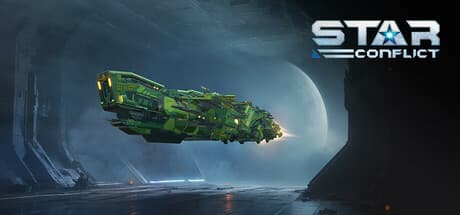
Star Conflict: Free-to-Play Space Combat MMO is a space-combat game built around piloting ships in PVP and PVE, then expanding and refining a personal fleet. It was released on February 27, 2013, developed by Star Gem Inc., and published by Gaijin Network Ltd.
The core loop is to select a ship and modules, deploy into combat, and revise the setup before the next sortie. This is not a shooter in which the player explores on foot.
Managing a ship's direction, movement, aim, and engagement distance gives combat a different rhythm from a conventional FPS.
Ships and Customization
The game includes more than 100 ships, nine tactical roles, and hundreds of modules. Its depth comes from matching a hull and module setup to a preferred role or activity, rather than simply finding one universally superior craft.
Ship and module production adds another layer to the cycle of combat and fleet development.
That breadth can also make the opening hours difficult to parse. Instead of trying to understand every ship immediately, new pilots are better served by choosing one approachable role and learning movement, aiming, and effective range.
Other configurations become easier to judge once those fundamentals are familiar.
Choosing Between PVP and PVE
PVP takes place across numerous space locations and includes competition between corporations for influence. Because opposing players can adjust both their builds and behavior, positioning and coordination matter alongside equipment choices.
New players should expect to notice a gap between themselves and experienced pilots.
PVE provides missions and quests that can be tackled alone or with allies. It is the more practical place to test controls and modules before committing to competitive battles.
In cooperative play, considering the nine tactical roles and filling a missing team function may be more useful than pursuing personal results alone.
PC Requirements
The minimum requirements list Windows 10, a 2.3GHz Intel Core 2 Duo or 2.5GHz AMD A6-9220, and 6GB RAM.
Graphics hardware must support Pixel Shader 3.0, with 512MB NVIDIA, AMD Radeon, or Intel HD 3000/HD 4000 hardware given as examples.
AMD Radeon X1000 hardware is explicitly unsupported.
The storage requirement is 8.5GB, making installation relatively manageable beside many modern large games.
These are minimum requirements, however, and they do not promise high settings or a stable frame rate. No recommended specification was supplied, so systems close to the minimum—especially those using integrated graphics—should be approached with reduced resolution and visual settings in mind.
Online combat also makes frame-rate drops during busy encounters more noticeable than a simple average performance figure suggests. On an older PC, test load and input response in PVE first.
Adjust resolution, effects, shadows, and related options if combat becomes difficult to read or control.
Reception and Common Impressions
Star Conflict has maintained an audience over a long period of operation. Its appealing points include direct ship combat, a large selection of ships and modules, and the option to alternate between competitive and cooperative content.
Players who enjoy experimenting with roles and builds have more reasons to remain engaged than those seeking a single, fixed loadout.
The same long-running structure can create friction. The volume of systems and the experience gap in PVP may be intimidating, particularly for anyone trying to identify an optimal build immediately.
Setting a limited initial goal—one ship or one role—makes the learning process more manageable.
Who Should Play It
This is a good fit for players who enjoy piloting spacecraft and regard post-battle loadout changes as part of the fun. It also suits people who want both solo or cooperative PVE and competitive PVP, or who are interested in joining a corporation and building longer-term multiplayer connections.
Its modest listed storage and minimum hardware requirements may appeal to players without a recent high-end PC. Meeting the minimum does not automatically mean smooth play, though, so some willingness to tune settings is still important.
Caveats and Who Should Skip It
Players looking specifically for on-foot gunplay may find that ship orientation and distance management do not satisfy the same preference. The game may also be a poor match for anyone who dislikes comparing many ships and modules or expects to understand every progression option within a short session.
PVP results do not depend on a build alone; piloting experience and teamwork also matter. Players willing to practice in PVE and revise a setup after mistakes are more likely to settle in than those expecting immediately even matches.
The supplied data does not confirm language support, so anyone who requires a Japanese interface should check the language listing on the Steam product page before installing.