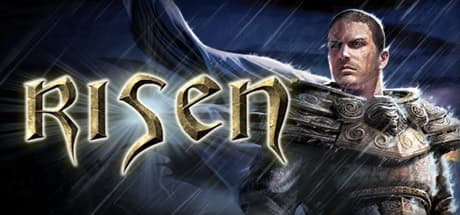
Game Overview
Risen: Forge Your Path in a Gritty Fantasy World is a third-person open-world RPG set on Faranga, an island thrown into turmoil by mysterious earthquakes and hostile creatures. Developed by Piranha Bytes and published by THQ Nordic, it was released on October 2, 2009.
You begin as an unnamed castaway rather than an established hero. The basic rhythm is to reach settlements, speak with residents, take jobs, improve your equipment and skills, and gradually venture into ruins connected to the island's crisis.
Progress depends not only on combat, but also on deciding whom to help and which faction to approach.
Features and Systems
Risen makes early weakness an important part of its progression. Wildlife and minor enemies can be dangerous before you acquire training and equipment, while fighting several opponents at once can quickly become a losing situation.
Preparing healing supplies, watching attack patterns, and learning when to retreat matter more than simply rushing toward every encounter.
Character development can focus on bladed weapons, staff fighting, or magic. Advancement is tied to people and places in the world, so finding someone able to teach a skill is part of the experience.
Because spreading resources across every discipline can leave the character without a clear strength, choosing a main combat style early is usually the safer approach.
Faranga contains numerous side quests involving residents, local conflicts, creatures, and hidden areas. Decisions can affect relationships and later developments, making dialogue a practical source of information rather than background flavor.
Exploration, conversation, combat, and training feed into one another, distinguishing the game from action RPGs built mainly around collecting increasingly powerful loot.
Getting Through the Early Game
A cautious route is more effective than repeatedly challenging the strongest enemy you can find. Complete nearby tasks, learn the layout of each settlement, and speak with more than the obvious quest giver.
Conversations may reveal trainers, alternative solutions, or warnings about areas that are currently too dangerous.
Commit enough resources to establish one dependable way of fighting before experimenting widely. Caves and ruins can also make encounters harder through darkness and confined spaces, so enter them with supplies and an escape route in mind.
If an opponent appears unreasonable, exploring elsewhere and returning after further training is often a valid solution.
System Requirements
The listed minimum calls for a 2GHz Intel Pentium 4 or equivalent AMD CPU, a DirectX 9.0c-compatible GeForce 7900 or Radeon X1800-class graphics card with 256MB of video memory, 4GB of RAM, and 5GB of free storage.
The supported OS list covers Windows XP, Vista, 7, 8, 10, and 11. By current gaming-PC standards, the raw hardware requirement is very light.
With a game of this age, compatibility can matter more than processing power. Resolution, aspect ratio, input behavior, drivers, or modern operating-system behavior may require attention after the first launch.
No recommended specification was supplied, so a particular frame rate or high-resolution target should not be assumed from the minimum requirements alone.
Reception and Player Impressions
Risen has maintained a strong reputation among players who appreciate limited guidance, a demanding opening, and progression connected to factions and trainers. The transition from avoiding dangerous areas to overcoming them later is a major source of satisfaction.
Its compact, interconnected island also rewards learning the landscape instead of following a checklist across an oversized map.
Common reservations concern dated movement, combat feel, and presentation. Players seeking immediate power or modern convenience may find the opening frustrating, while those who enjoy learning an older RPG's rules are more likely to appreciate it.
The advertised scope exceeds 60 hours, though actual playtime depends heavily on side quests, exploration, and reading dialogue.
Who Should Play It
Risen suits players who want to choose their own route, care about faction relationships, and enjoy a rough, grounded fantasy atmosphere. It is especially appealing if preparation, retreat, and returning stronger sound rewarding rather than inconvenient.
It also fits players who prefer a world with memorable connections between locations over sheer geographical scale. Specializing in swords, staffs, or magic gives the character's gradual rise from vulnerable castaway to capable adventurer a clear sense of direction.
Caveats and Who Should Skip It
Japanese is not included in the supplied language list. The listed options include English, French, German, Italian, Spanish, Polish, and Russian, so confirm that you are comfortable reading one of the supported languages.
Since dialogue informs quests and consequential choices, the language barrier can remove a substantial part of the experience.
This is a poor fit for anyone who wants constant objective guidance, immediately flashy combat, or modern animation and controls. Cloud saves, achievements, and trading cards are listed, but the source data also mentions multiplayer support, which is unusual for this primarily single-player title.
Store metadata can be mixed or revised, so verify current language and feature listings before purchasing.