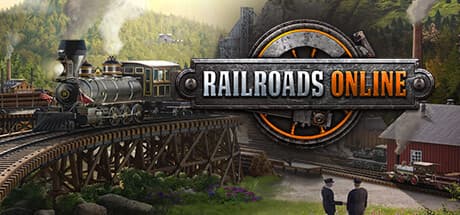
Game Overview
Railroads Online: Build Your Steam Empire is an open-world railway simulation inspired by the American golden age of steam. Rather than merely driving on finished routes, players lay track, operate locomotives, connect industries, and improve the resulting transport network.
The central loop is to inspect the terrain and industrial locations, construct a route, haul cargo, and reinvest in further infrastructure. Track construction and driving are closely linked because gradients and curves affect how practical a line is to operate.
Much of the satisfaction comes from testing an imperfect railway, identifying its weaknesses, and rebuilding it into a reliable system.
Developed by Stefan Kelnberger and published by astragon Entertainment, the game was released on December 5, 2024. It supports English, Japanese, and several other languages.
Single-player, cooperative play, and online multiplayer let players choose between deliberate solo planning and a shared construction project.
Track Building and Logistics
A defining feature is that railway management takes place in a three-dimensional world rather than only on an abstract route map. Reaching a destination by the shortest line is not enough.
Players must consider manageable grades, curves that trains can negotiate, and sufficient working space around yards and industries.
Industrial buildings can be positioned freely, allowing players to shape both the railway and the logistics network it serves. That flexibility creates meaningful design choices, but it can also overwhelm anyone who expects the game to provide a single correct solution.
Building and testing one short route before attempting a large network makes construction problems easier to identify.
The Extended Edition Bundle includes additional material such as the Lake Valley map, more locomotives and passenger cars, a tutorial, and an in-game encyclopedia. Its contents differ from the standard edition, so buyers should inspect the current edition listing before choosing.
The useful question is not simply how many vehicles are included, but whether the extra map and learning tools fit the intended way of playing.
Solo and Cooperative Play
Solo play allows one person to survey terrain, build track, operate trains, and plan logistics at an unhurried pace. It suits players who enjoy refining a line without coordinating every decision with a group.
As the railway expands, however, the amount of work controlled by one person also increases.
Co-op makes it possible to divide responsibilities between construction, operations, and planning. This structure fits a railway project well, but coordination still matters.
If several players build toward different goals, the result may be awkward junctions or facilities that are difficult to use, so agreeing on a route and roles beforehand can prevent extensive rebuilding.
PC Requirements
The minimum specification calls for 64-bit Windows 10 or Windows 11, an Intel Core i3-8100 or similar processor, 4 GB of RAM, and either a GeForce GTX 760 or Radeon R9 285. Both listed GPUs require 2 GB of VRAM.
DirectX 11 and 6000 MB of available storage are also specified.
These minimum requirements are best treated as an entry point for basic play, not a promise of ample performance with a large network. The recommended hardware rises to a Core i5-11600K or Ryzen 5 5600X, 8 GB of RAM, and a GeForce RTX 3070 or Radeon RX 6800.
At least 8 GB of VRAM and DirectX 12 are requested, creating a substantial gap between the minimum and recommended tiers.
Older GPUs and models with limited VRAM may therefore require lower resolution or graphics settings. Although the listed installation space is modest, leaving extra room for updates and temporary files is sensible.
Laptop users should also confirm that the game is using the dedicated GPU rather than integrated graphics.
Reception and Player Expectations
The appeal lies in turning manually built track into a functioning railway, but the experience is deliberately specialized. It emphasizes patient construction, testing, and logistical improvement more than the immediate speed of driving a completed route.
Enjoyment therefore depends heavily on whether repeated adjustment feels satisfying or tedious.
Before buying, it is useful to inspect recent player feedback for the current state of controls, multiplayer behavior, and update-related issues. Physics-driven building games often trade convenience for flexibility, and an older comment may not describe the present build accurately.
Players who can treat rebuilding as part of engineering rather than wasted progress are more likely to appreciate the design.
Who Will Enjoy It
Railroads Online suits players who want to build track and manage freight instead of only occupying the driver's seat. Efficiency-minded players can optimize grades and facility placement, while scenery-focused builders can create a railway with a distinctive appearance.
Unlike a conventional racing game with fixed courses and rankings, it expects players to define their own goals and workflow.
It is also a strong candidate for groups seeking a persistent construction project. Track and facilities remain visible evidence of the work completed together, giving multiplayer a long-term project character.
An interest in steam locomotives, industrial logistics, or terrain-based route planning provides the clearest reason to consider it.
Caveats and Who Should Skip It
Players who want rapid rewards or a tightly directed sequence of missions may struggle with its pace. Fine track adjustments, test runs, and rebuilding take time.
If construction feels like an obstacle between driving sessions, the game's core attraction may instead become its largest source of friction.
The recommended GPU is also far more demanding than the minimum listing. A PC that only meets the baseline may have little spare performance for larger saves or ambitious visual settings.
Use the recommended tier as the safer reference and adjust expectations according to display resolution and the desired frame rate.
Multiple languages, including English and Japanese, are supported, but learning the terminology and free-form tools can still take time. Edition contents should also be checked carefully on the store page.
Confirm that the selected package includes the maps, vehicles, tutorial, or encyclopedia features you actually want.