Overview
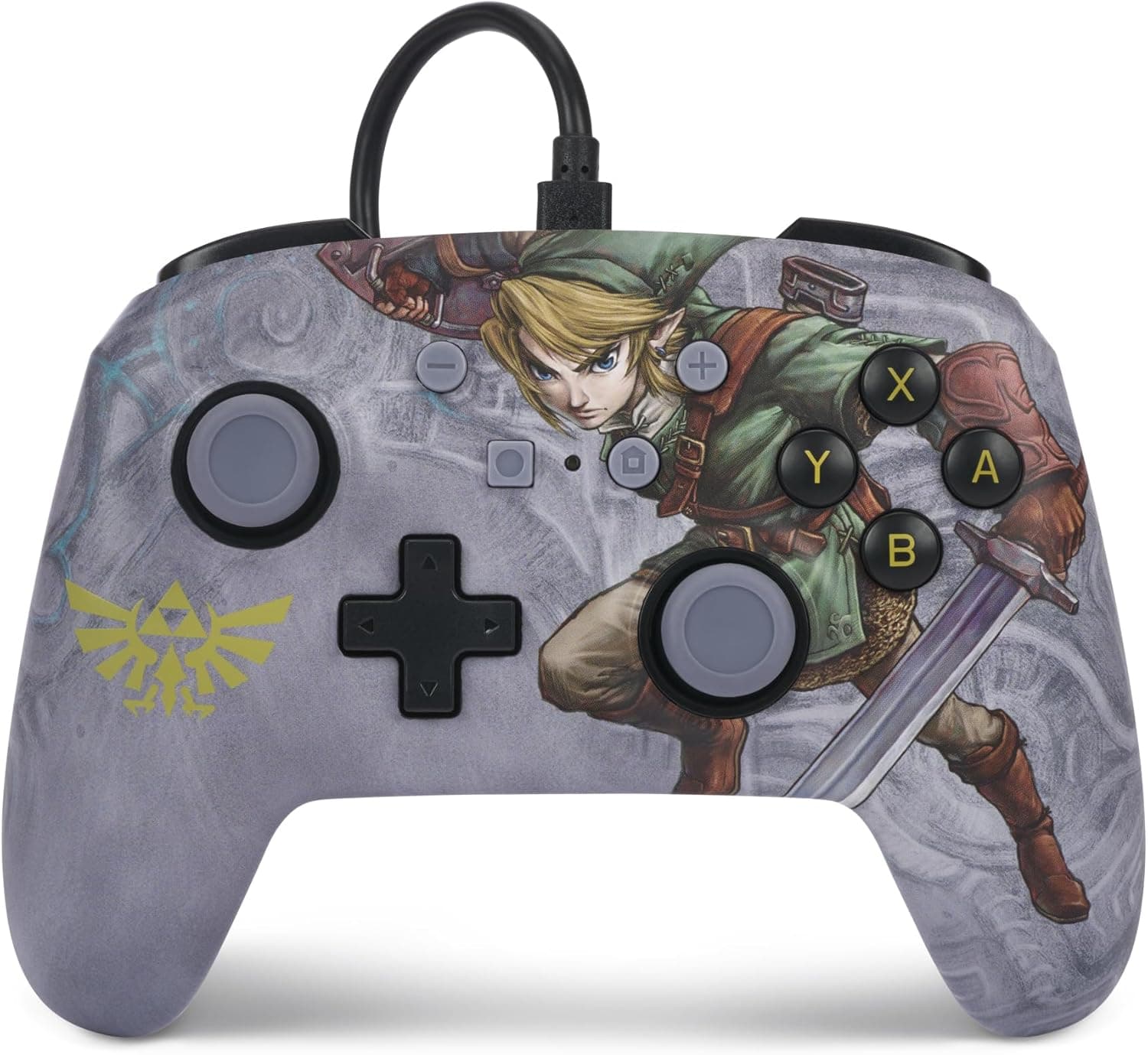
The PowerA Enhanced Nintendo Switch Controller Wired in the Valiant Link design is an officially licensed wired pad themed around The Legend of Zelda. The short verdict: this is not a Pro Controller replacement.
It is a Pro Controller with several features removed, and two mappable rear buttons plus a striking design added in their place. Buy it understanding that trade, and you will be happy.
Buy it expecting parity with first-party hardware, and you will not.
It measures 15.01 × 10.59 × 6.1 cm and weighs 135.17 g.
Nintendo's own Pro Controller sits around 240 g, so this pad is noticeably lighter both on paper and in the hand. That lightness exists precisely because there is no battery inside.
If your wrists complain during long sessions, the weight alone can justify the purchase.
On Amazon.co.jp it holds a 4.4 / 5 average across 43 reviews (roughly 88% positive, captured June 2026).
The rating is solid, but 43 is a small sample — a point that matters later when we talk about durability.
Compatibility Guide
Supported platforms are the Nintendo Switch (all models, including OLED) and PC over USB. Connection is wired USB only — there is no Bluetooth and no wireless dongle.
The practical detail that matters most: you plug into the dock's USB-A ports, not the console itself. That makes this effectively a TV-mode controller.
Using it in tabletop or handheld mode would require adapting to the console's USB-C port, which is outside the intended design. Confirm you are happy with docked-only play before buying.
The cable is roughly 3 m, which comfortably covers a normal sofa-to-TV distance. Still, wired means cable management forever.
If your dock is buried behind the TV, plugging in every session becomes a small daily annoyance — reposition the dock first.
PC use is possible over USB, but this is a Switch product. Expect generic input-device behaviour; there is no guarantee that rear-button mapping or rumble behave the same way as on Switch.
| Intended use | Verdict |
|---|---|
| Switch TV mode (docked) | The intended use case. Fine |
| Switch tabletop / handheld | Needs adapting; not recommended |
| Switch OLED model | Works via the dock's USB ports |
| PC over USB | Recognised, but unsupported officially |
| Wireless | Not supported at all |
The more your play is "sit down in front of the TV," the better this fits. Portable-first players should look elsewhere.
Product Info
The spec sheet is deliberately simple: wired USB, two mappable rear buttons, 15.01 × 10.59 × 6.1 cm, 135.17 g, a roughly 3 m cable, and official Nintendo licensing.
The box contains the controller and documentation only — no extra cables required.
On pricing, as captured at specific moments: Amazon.co.jp listed ¥8,740 on 6 June 2026 and ¥8,473 on 27 August 2026.
A few hundred yen of drift over a few months means there is no urgency; waiting for a sale is reasonable. A separate eBay US record shows $11.00 as of 14 July 2026, but that is very likely a used or differently-conditioned listing and cannot be compared directly with the domestic price.
Always check the current price, seller and condition on the product page.
We do not state a release date here, because no verifiable release information is present in the source data. Check the product page for exact model details.
Getting the Most From the Rear Buttons
The two mappable rear buttons are the reason this pad exists. The core strategy is to move any input you would otherwise press while wanting your thumb to stay on the stick.
In action games, that usually means jump or dodge, so you can keep aiming the camera while moving. In open-world titles, sprint or item use.
In fighting games, block or an assist button. In racers, drift or item fire.
Assigning menu-confirm inputs, by contrast, gains you nothing and just invites misfires.
Do not map both buttons at once. Set one, play for a few hours, then add the second. Rear buttons take time to stop triggering accidentally, and learning two at once tends to break your muscle memory rather than build it.
Versus the Pro Controller and Third-Party Rivals
The key differences against Nintendo's Pro Controller are wireless operation and, more importantly, motion controls (gyro), HD rumble and amiibo (NFC). PowerA's wired Enhanced line generally omits these, which is how the price and the low weight are achieved.
Details can vary by model and revision, so if gyro or amiibo is non-negotiable for you, verify the feature list on the product page before ordering.
Against other third-party pads, this one competes on design and licensing reassurance rather than features. If you want more capability, wireless pads with charging docks or Hall-effect sticks outclass it — at a higher price, or with a small hit to connection reliability.
Best Use Cases
- Zelda fans who value owning something that looks the part, not just works.
- Long TV-mode sessions, where 135 g and zero battery anxiety both pay off.
- First-time rear-button users, testing the concept before spending on a premium pad.
- Households needing a spare pad for guests and local multiplayer.
- Players tired of pairing and wireless latency, who just want plug-and-play.
Things to Check Before Buying
First, the lack of gyro can be a dealbreaker. Bow aiming and motion-required minigames will either be impossible or put you at a real disadvantage.
Check whether the games you actually play rely on motion controls — this single point cleanly separates who should and should not buy.
Second, do not expect HD rumble or amiibo scanning. Coming from a Pro Controller, the difference in rumble quality is immediately noticeable, and frequent amiibo users will end up keeping a first-party pad alongside this one.
Third, the wired constraints go beyond the cable. This pad may not wake the console from sleep, so you can still need the console or another controller to power on.
And because it connects through the dock, handheld play is effectively off the table. Treating a wired pad as "a cheap Pro Controller" is where most disappointment comes from.
Fourth, durability is hard to judge. With only 43 reviews, there is not enough data to spot long-term patterns like stick drift or cable strain-relief failure.
The cable base is the usual weak point on wired pads, so make it a habit from day one to pull the connector, never the cable.
Finally, watch for mismatched listing data. The price records here place a ~¥8,500 domestic listing next to an $11.00 overseas one; used units, different colourways and different variants often share the same product name.
Listing metadata (manufacturer, model number, supported platforms) can also be simply wrong. Confirm the product image, title, seller and condition yourself before ordering.
And remember this is a licensed third-party accessory. Continued compatibility across future system updates or new hardware is not guaranteed.
Treat it as a purpose-limited second controller rather than your primary one, and it will serve you well.
FAQ
Q. Can I use it in handheld or tabletop mode?
A. Not as intended. It plugs into the dock's USB ports and assumes TV mode.
Q. Does it support gyro / motion controls? A.
PowerA's wired Enhanced pads generally omit motion controls. If you need gyro, confirm the feature list on the product page first.
Q. Can it scan amiibo?
A. NFC is typically not included. You will need the console or a Pro Controller for amiibo.
Q. Do I need an app or PC to map the rear buttons? A.
Wired models of this type usually map on-controller. Follow the included manual for the exact procedure.
Q. Does it work on PC? A.
It is usually recognised over USB, but it is officially a Switch product, and rear-button or rumble behaviour may differ. For PC-first use, buy something that advertises PC support.
Q. Pro Controller or this? A.
If you need gyro, amiibo or wireless, buy the Pro Controller. If you play docked and value light weight, rear buttons and the design, this is a valid pick.