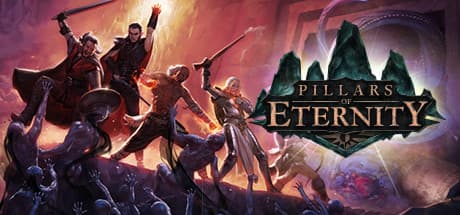
Pillars of Eternity: A Rich Fantasy RPG Adventure is a single-player, isometric CRPG developed by Obsidian Entertainment. You play as a Watcher, someone able to perceive souls and fragments of their past, while investigating a crisis involving children born without souls.

Dialogue, exploration, combat, and companion stories feed into one another, so decisions often matter beyond the scene in which they are made.

Game Overview

The core loop involves gathering information in settlements, examining competing accounts of a problem, and taking a party of up to six characters into wilderness areas and dungeons. Following only the main objective gives you less context than speaking with residents, reading documents, and pursuing companion quests.

Many conflicts lack a clean moral answer, leaving you to decide whose motives deserve trust.

Released on March 26, 2015, the game modernizes the structure of classic isometric computer RPGs. It is not an action RPG built around reflexes; success comes from reading, planning formations, and combining party abilities.

Players looking for both dense storytelling and tactical control are the audience most likely to appreciate it.

Choice and Role-Playing

Your background, attributes, knowledge, and established disposition can open different approaches in conversation. Solutions are not limited to generic persuasion: an intimidating response, specialized insight, or respect for another culture may change how an encounter develops.

Choices also resist a simple good-versus-evil scale, and a decision that helps one community may impose a cost on another.

The setting treats souls and reincarnation as social, religious, and political realities rather than decorative lore. There are many unfamiliar names and historical references, but they help explain why characters disagree and why the central crisis matters.

The game rewards players who consult the journal and untangle those viewpoints instead of skipping dialogue to reach the next fight.

Party Building and Combat

Combat unfolds in real time but can be paused whenever you need to issue orders. Positioning, holding enemies at the front line, protecting fragile allies, and timing limited-use abilities are more important than rapid input.

Preparing a formation before contact and using narrow doorways can be safer than attempting to repair a chaotic melee after every enemy has reached the back line.

Party members cover roles such as durable front-line defense, healing and support, crowd control, and ranged damage. A group built only for damage can collapse when enemies bypass its front line or apply disabling effects.

New players should begin with a balanced formation and pause frequently to check targets, status effects, and threatened companions.

Practical Tips for the Opening Hours

Not every hostile group must be defeated as soon as it appears. If attacks rarely connect or party members fall almost immediately, reconsider the target, damage approach, and defensive matchup rather than assuming equipment is the only answer.

Leaving a difficult area and returning with more companions is a valid part of progression.

Keep several saves while exploring, particularly before unfamiliar ruins or major conversations. Avoid spending every strong ability on the first enemy group when more encounters may follow.

Reading ability descriptions and learning what each one counters gradually makes strategy more important than raw levels alone.

System Requirements

The listed minimum configuration requires 64-bit Windows Vista or newer, an Intel Core i3-2100T at 2.50 GHz or AMD Phenom II X3 B73, and an ATI Radeon HD 4850 or NVIDIA GeForce 9600 GT.

It also calls for 4 GB of RAM and 14 GB of available storage. These components belong to an older performance tier, so many newer Windows PCs may qualify, although drivers, resolution, and background applications can still affect results.

No recommended specification was provided with the article data, so performance at high resolutions or during effect-heavy battles cannot be guaranteed from the minimum list alone. Systems close to the minimum should use modest graphics settings and close unnecessary applications to preserve memory.Check the review panel on this page or the Steam listing for the latest user review trend.

Reception and Common Impressions

Pillars of Eternity has maintained a strong reputation over time. Its layered setting, dialogue with consequential choices, and tactical party control are recurring strengths in player discussion.

The original treatment of souls and the personal stories of companions also help distinguish it from a routine fantasy quest.

Common reservations concern the heavy concentration of text and unfamiliar terminology near the beginning. Managing several characters at once can also feel demanding if the pause function is ignored.

Players seeking fast action or frequent, immediate rewards may find its pace deliberate rather than exciting.

Who Should Play It

This is a strong match for players who enjoy reading dialogue, examining conflicting viewpoints, and making decisions without a single approved answer. Fans of faction-driven role-playing such as Fallout: New Vegas may appreciate how beliefs and interests shape each dispute.

It also suits anyone who enjoys stopping combat to inspect the battlefield and construct a coordinated sequence of orders.

Players interested in character creation and party composition can adjust the difficulty and explore different approaches. Following a consistent character concept is often more rewarding than looking up an optimal response to every conversation.

The game works best when imperfect results are accepted as part of the character's story.

Caveats and Who May Not Enjoy It

It is a poor fit for anyone primarily seeking action-based combat, brief dialogue, or constant objective guidance. Its large amount of text is integral to the experience, and skipping it removes much of the context that makes later choices meaningful.

If managing equipment and abilities across a full party sounds tiring, beginning on a lower difficulty is the more comfortable option.

The supplied language data lists English, French, Italian, German, Spanish, Russian, and Polish among the supported languages, but does not list Japanese. Because understanding text is central to the game, players who require Japanese should check the current Steam language table and confirm whether interface, subtitle, and audio support meet their needs.

Store metadata can change, so verify the live listing before purchasing.