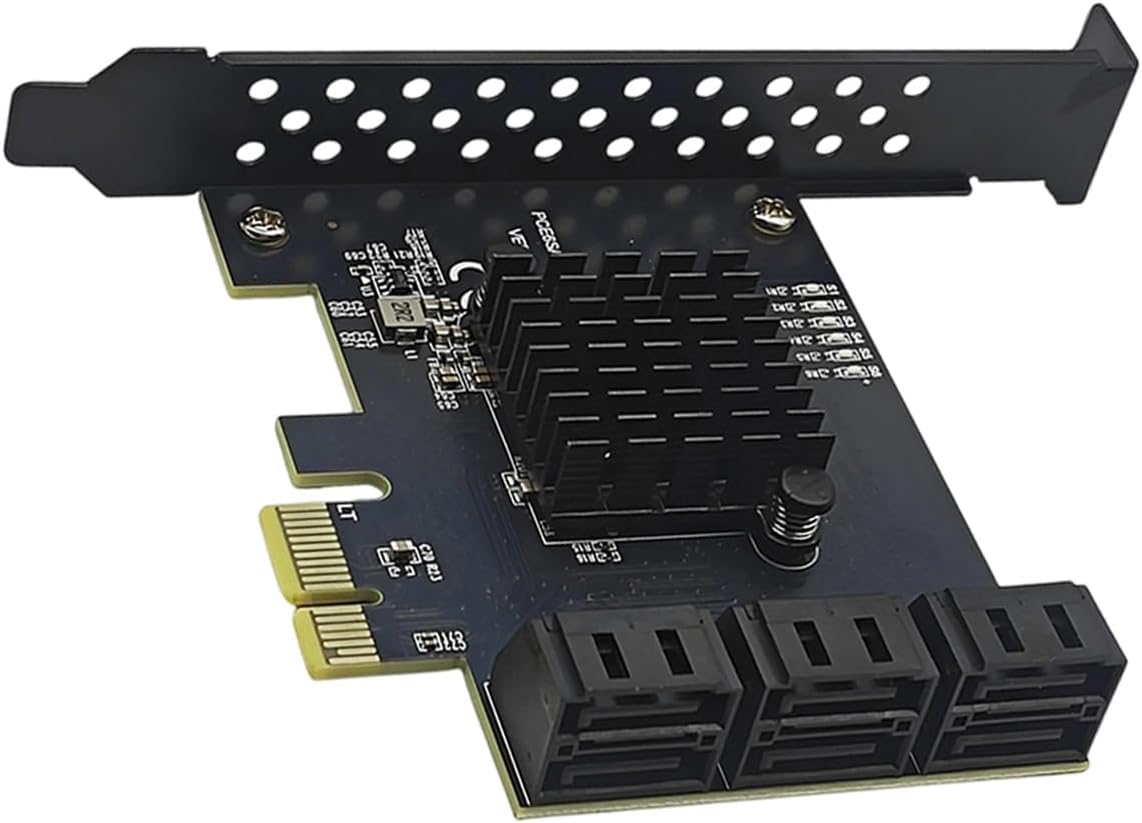
This article covers PCIE 1X.
Overview
This expansion card adds six SATA III ports to any desktop PC with a PCI Express 3.0 x1 or x4 slot. It uses a Realtek RTL9100VB controller paired with a JMicron JMB582 chip for reliable operation. Each port supports transfer speeds up to 6Gbps, and the card supports hot-plug and plug-and-play, making it easy to connect additional HDDs or SSDs without rebooting. It is an affordable solution for users who have run out of motherboard SATA ports or need to build a storage-heavy system on a budget.
Compatibility Guide
The card fits into any PCIe 3.0 x1 or x4 slot, and can also be installed in x8 or x16 slots (it will operate at x1 or x4 speeds). It is compatible with Windows, Linux, and other major operating systems; most systems will recognize it without extra drivers, though occasional driver installation may be needed. All six SATA ports support SATA III (6Gbps) and are backward compatible with SATA I/II devices. Power is drawn entirely from the PCIe slot, so no external power connector is required. However, if you plan to connect many power-hungry 3.5-inch HDDs, ensure your power supply has sufficient capacity.
Product Info
This controller card is primarily sold through at an affordable price of approximately ¥4,568. The combination of RTL9100VB and JMB582 chips places it in the entry-level segment – it lacks hardware RAID but delivers straightforward port expansion at a low cost. Typical warranty periods range from 30 days to one year depending on the seller. You can check current pricing and availability on [](
Best Use Cases
First, it is ideal for desktop users who need more SATA ports – for example, if your motherboard has only four SATA connectors but you want to install six SSDs or HDDs. Second, it works well for building a budget home NAS or file server; the six ports allow you to connect multiple drives, and hot-plug support makes swapping drives convenient. Third, it is a great choice for repurposing an old PC into a media archive or backup station, enabling you to add storage capacity without replacing the motherboard.
Things to Consider
This card does not support hardware RAID, so if you need data redundancy or striping, you will have to rely on software RAID solutions such as Windows Storage Spaces or Linux mdadm. Also, because the card uses a PCIe 3.0 x1 interface, the total bandwidth available to all six ports is roughly 1GB/s (one direction). While this is sufficient for typical HDDs and SATA SSDs (which rarely exceed 550MB/s per drive), simultaneous heavy reads/writes on multiple drives may saturate the link. Additionally, some systems may not recognize a boot drive connected to this card; it is recommended to use motherboard SATA ports for boot drives and reserve this card for additional storage.