This article covers 2ポートギガビットPCIeネットワークアダプター.
Overview
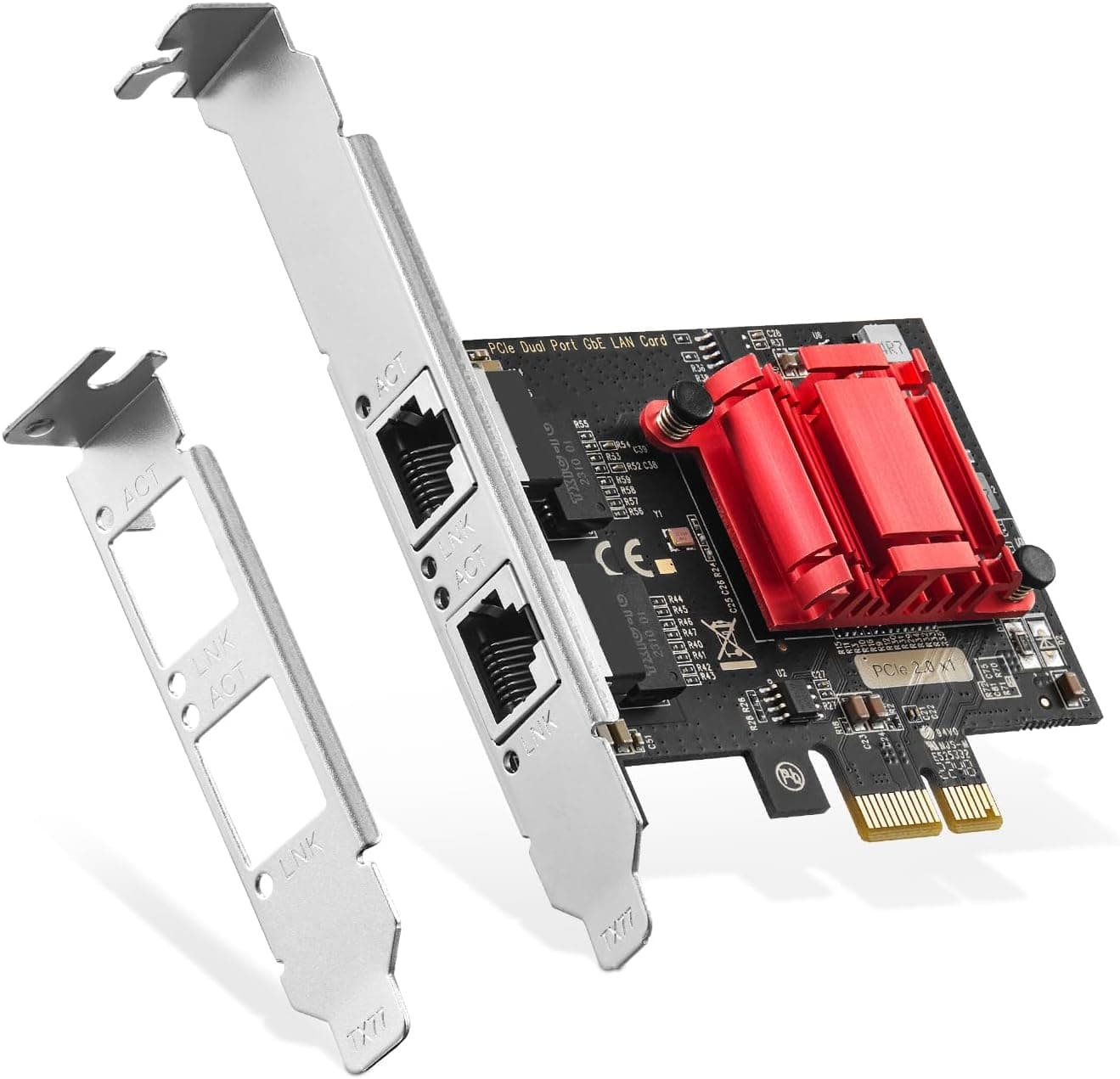
The Binardat 2-Port Gigabit PCIe Network Adapter is a dual-port wired LAN expansion card powered by the Intel 82575/82576 controller. With two RJ45 ports supporting 1000Mbps Gigabit Ethernet, it is well-suited for server environments where bandwidth separation is needed, or for workstation setups that require simultaneous access to multiple networks. Operating over a PCI Express 2.1 x1 interface, the card fits into x1, x4, x8, or x16 slots. It ships with both a standard bracket and a low-profile bracket, making it compatible with compact chassis as well. Supported operating systems include Windows 7 and later, Windows Server 2016/2012/2008, and Linux, ensuring broad compatibility.
Connectivity & Compatibility
Interface: PCI Express 2.1 x1 (compatible with x1/x4/x8/x16 slots). Not compatible with legacy PCI slots. Network standards: IEEE 802.3, 802.3u, 802.3ab; auto-negotiation for 1000BASE-T, 100BASE-TX, and 10BASE-T. Cable: Cat5e or higher UTP, supporting distances up to 100 meters (328 feet). OS support: Windows 10/8.1/8/7, Windows Server 2016/2012/2008, Linux. Drivers can be installed from the included CD-ROM or downloaded from Binardat/Intel official websites. * Advanced features: PXE boot, Auto MDIX, IEEE 802.1Q VLAN tagging, full-duplex flow control (802.3x), and 9.5KB jumbo frames.
Product Info
This product is an entry-to-mid-range dual-port Gigabit network card from Binardat. It leverages the proven Intel 82575/82576 controller chip, offering reliable stability and broad driver compatibility. Priced in the ¥3,800–¥3,900 range, it delivers excellent value for a dual-port Gigabit LAN card. The package includes a standard bracket (pre-installed), a low-profile bracket, a driver CD-ROM, and a manual. Warranty details are provided by the manufacturer; please check the product page for specifics.
Best Use Cases
Home server or NAS users: Two ports allow you to separate LAN and WAN traffic or set up link aggregation for redundancy. The Intel chipset provides the stability needed for 24/7 operation. Virtualization enthusiasts: If you run Hyper-V, VMware, or other hypervisors, having two physical ports lets you assign dedicated network interfaces to different virtual machines, isolating management traffic from data traffic. Desktop PC with a failed onboard LAN: If your motherboard's Ethernet port stops working, this card offers a quick and affordable way to restore wired Gigabit connectivity, provided you have a free PCIe slot. Not ideal for: Users who need 2.5GbE or 10GbE speeds. This card is limited to 1Gbps per port. Also, it cannot be used in motherboards with only legacy PCI slots.
Product Disclosure (Amazon)
- Manufacturer: Binardat
- Seller: nnianstar
- Fulfilled by: Amazon
- ASIN: B0C4H4WNL9
- Note: This article covers a manufacturer-made product based on Amazon listing details.