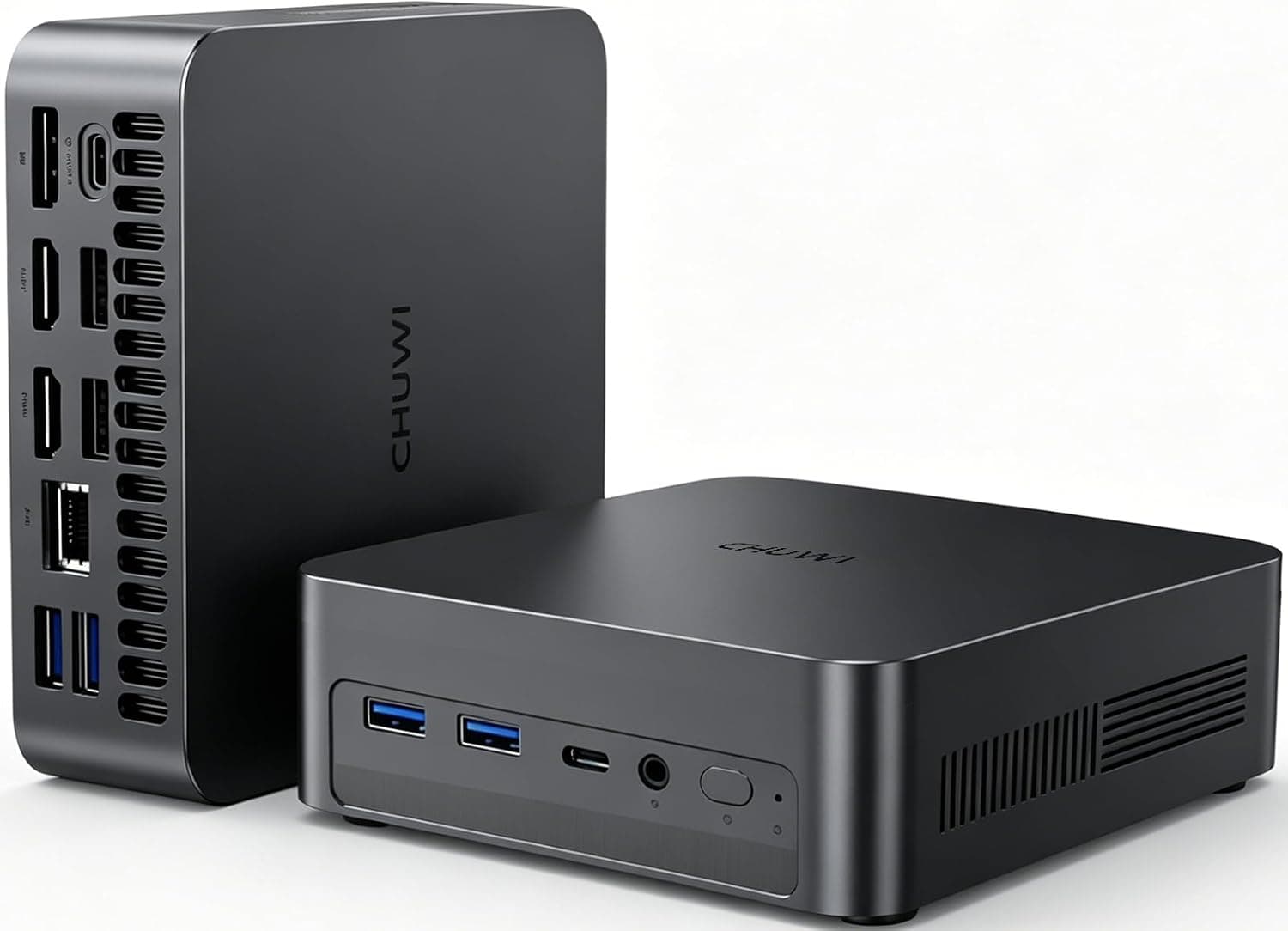
Overview
The NiPoGi E3B is a compact mini desktop built around the AMD Ryzen 7 7736U. That chip brings eight cores and sixteen threads, a 2.7GHz base clock, and a boost ceiling of 4.7GHz when the performance profile is selected in the BIOS. NiPoGi pairs it with 24GB of LPDDR5 memory and a 512GB M.2 SSD, so the machine arrives as a finished Windows 11 Pro system rather than a kit you have to assemble.
What makes the E3B interesting is how much expansion it squeezes into a small chassis. There are two M.2 slots in total, and storage can grow to as much as 8TB. Video output runs through HDMI, DisplayPort, and USB 3.2 Gen2 Type-C, which means three 4K displays can be driven at once. Wired networking is handled by two ports rated up to 2.5Gbps, and Wi-Fi 6 with Bluetooth 5.2 covers the wireless side.
This is a machine aimed at people who want a small footprint without giving up multi-monitor work or fast local storage. It sits comfortably in the middle of the mini PC market, above the entry-level boxes but well short of workstation-class desktops.
Compatibility Guide
The Ryzen 7 7736U is soldered to the board, so this is not a system for anyone planning to swap processors later. Memory is LPDDR5 mounted on the board as well, which means the 24GB you buy is the 24GB you keep. Plan around that fixed capacity rather than assuming an upgrade path.
Storage is more flexible. The two M.2 2280 slots are not identical: one accepts a PCIe (NVMe) drive and the other takes a SATA SSD. When adding capacity, check which slot you are filling, because a SATA drive in the NVMe slot or the reverse will not work. A sensible split is to keep the system drive on the NVMe side and use the SATA slot for bulk data.
For displays, the HDMI, DisplayPort, and USB 3.2 Gen2 Type-C outputs let you run three 4K screens together. The dual 2.5Gbps Ethernet ports also make the E3B usable as a small router or firewall box for people who want to run that kind of software at home or in a small office.
Product Info
The E3B lands in the mid-range of the mini PC segment. Its Ryzen 7 7736U is a Zen 3+ part built on a 6nm process with a 15W TDP and 16MB of L3 cache, which keeps power draw modest while leaving headroom for multitasking. Integrated AMD Radeon graphics run 12 cores at up to 2200MHz, enough for photo editing, video playback, and design software.
The 24GB of LPDDR5 and 512GB SSD combination is sized for people who want a working machine out of the box rather than a project. Pricing sits in the affordable-to-mid range for a complete Windows 11 Pro mini PC with this much memory.
Best Use Cases
- Home users who want several screens for office work and research: three 4K-capable outputs and dual 2.5Gbps Ethernet let you expand displays and networking at the same time, though anyone chasing discrete-GPU gaming performance should look elsewhere.
- People who keep large photo and video libraries on the machine itself: two M.2 slots allow up to 8TB of total storage, but buyers who expect to add memory later will be disappointed.
- Anyone who needs a small always-on secondary machine or network appliance: the low-power CPU and twin wired ports suit router or firewall duty, while heavy 3D gaming at high settings is out of scope.
Things to Consider
Because memory is soldered LPDDR5, there is no way to add capacity after purchase. Decide up front whether 24GB covers your workload. The two M.2 slots also differ in interface, and the SATA slot will not match NVMe speeds, so prioritize the NVMe side if fast storage matters.
Integrated Radeon graphics are capable for everyday tasks but cannot match a desktop with a discrete GPU. If your main interest is demanding 3D titles at high settings, this is the wrong class of machine. For office work, media playback, and multi-monitor productivity, the balance of size, price, and expansion is easy to justify.
FAQ
Q: Can I upgrade the memory to 32GB later?
A: No. The LPDDR5 memory is soldered to the board, so the 24GB configuration is fixed. Choose the system with your final memory needs in mind.
Q: How much storage can I add?
A: There are two M.2 2280 slots with a combined ceiling of 8TB. One slot takes a PCIe (NVMe) drive and the other takes a SATA SSD, so confirm the interface before buying an upgrade drive.
Q: Can I run three 4K monitors at once?
A: Yes. HDMI, DisplayPort, and USB 3.2 Gen2 Type-C each carry video, allowing three 4K displays to be connected simultaneously.
Product Disclosure (Amazon)
- Manufacturer: NiPoGi
- Model: E3B
- ASIN: B0HJG1QLTH
- Note: This article covers a manufacturer-made product based on Amazon listing details.