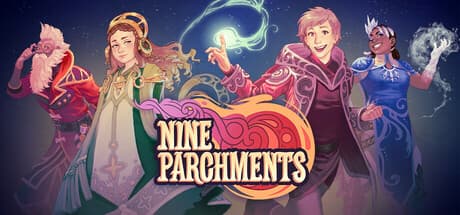
Game Overview
Nine Parchments: Co-op Blast 'Em Up with Magical Mayhem is an isometric action RPG and twin-stick shooter from Frozenbyte, the studio behind the Trine series. Released on December 5, 2017, it follows runaway apprentice wizards searching for lost parchments to complete their spellbooks.
The core loop is straightforward: fight groups of enemies with real-time spells, collect magical loot, develop a character, and continue through the adventure. Because spells are aimed rather than selected through turn-based menus, combat combines the immediacy of a shooter with light RPG progression.
Combat and Progression
Players must aim while moving, choose a suitable spell, and avoid hostile attacks. Success is not simply a matter of firing as quickly as possible.
Distance, enemy movement, and the time needed to commit to an attack all affect whether a spell creates an opening or leaves the wizard exposed.
Characters gain levels, collect magical loot, and can have their appearance customized. Progression provides a reason to keep experimenting, but it does not replace action skills.
Positioning, target selection, and the ability to recover after being surrounded remain important throughout the game.
The colorful effects make the action readable and entertaining when the battlefield is controlled, but a crowded encounter can become visually busy. Players need to track their own wizard while attacks, enemies, and allies cross the same space.
That controlled confusion is central to the experience rather than a rare interruption.
How Co-op Changes the Game
The game supports solo play and local multiplayer for up to four players. More wizards add more attacks, but they also add movement and effects to an already active screen.
A larger party therefore does not automatically make every encounter easier.
Even simple coordination helps. Agreeing on a priority target, avoiding unnecessary separation, and deciding who should move forward can prevent a manageable fight from becoming disorderly.
The game works especially well for groups that can laugh when a plan collapses instead of treating every mistake as a failed optimization.
Anyone buying primarily for co-op should confirm that there are enough compatible input devices and that every player can comfortably see the shared display. The supplied article data explicitly confirms local multiplayer for up to four players.
If remote play is essential, check the current Steam feature listing before purchasing rather than assuming that every co-op mode works online.
System Requirements Explained
The minimum specification calls for a 64-bit version of Windows 7, 8, or 10 and 4 GB of RAM. The listed CPU baseline is a 1.8 GHz dual-core Intel Core i3, i5, or i7, or a 2.0 GHz dual-core AMD processor.
Graphics requirements list 1 GB of video memory and an NVIDIA GeForce 500 Series or Radeon HD 6000 Series GPU, with DirectX 10 support.
Installation requires 7 GB of available storage. That is modest beside many modern games, but the minimum specification should still be treated as a baseline for running the game rather than a promise of smooth performance in every crowded encounter.Check the review panel on this page or the Steam listing for the latest user review trend.
No recommended specification was supplied with the article data, so a particular resolution or frame rate cannot be guaranteed here. Integrated graphics can also be difficult to compare directly with the named desktop GPU families.
If performance drops when spell effects fill the screen, lowering resolution or visual settings may provide useful headroom.
Reception and Common Impressions
Players commonly appreciate the direct spellcasting, colorful presentation, and lively co-op situations. The connection between shooter-style controls and accessible character growth makes the game easy to understand without requiring extensive build research before the action begins.
Its deliberately hectic character can also divide opinion. Busy battles may obscure hazards, while repeated combat encounters will appeal more to players who enjoy improving execution than to those expecting a completely new type of activity in every stage.
Current reception should be checked in the live information shown alongside the article.
Early-Game Approach
At the beginning, focusing on one dangerous enemy is usually easier to manage than having every player attack in a different direction. Remaining stationary while casting can invite enemies to close in, so learning a rhythm of attacking and repositioning is valuable.
A newly acquired spell should be tested for reach and commitment time, not judged only by how powerful it appears.
In a local group, avoid spreading so far apart that players lose track of one another. Staying within a readable formation makes it easier to respond when someone is pressured.
Distinct character appearances can also help everyone identify their wizard when several effects overlap.
Who Should Play It
Nine Parchments suits players who want twin-stick spell combat, light RPG advancement, and shared-screen co-op in one package. It is also a natural option for Trine fans interested in Frozenbyte's fantasy style but looking for continuous combat rather than a puzzle-led adventure.
Groups that enjoy improvisation and can laugh at accidental chaos are the strongest match. Solo play remains available, allowing one player to learn aiming, movement, and spell behavior before introducing the additional complexity of a local party.
Caveats and Who May Not Enjoy It
This is not designed as a precision-focused competitive shooter or a dialogue-heavy role-playing game. Players who dislike visually busy combat may find the overlapping enemies and spell effects tiring.
Groups that demand flawless efficiency may likewise find the chaotic co-op design more frustrating than amusing.
The supplied data lists support for English, French, Italian, German, Spanish, Japanese, Russian, and Simplified Chinese. Language and multiplayer feature listings can change, so verify the current Steam page before buying.
In particular, do not treat local and online co-op labels as interchangeable when planning to play with people in different locations.


