This article covers MSI RTX3050 VENTUS 2X 6GB OC PCIe4.0 デュアルファン.
Overview
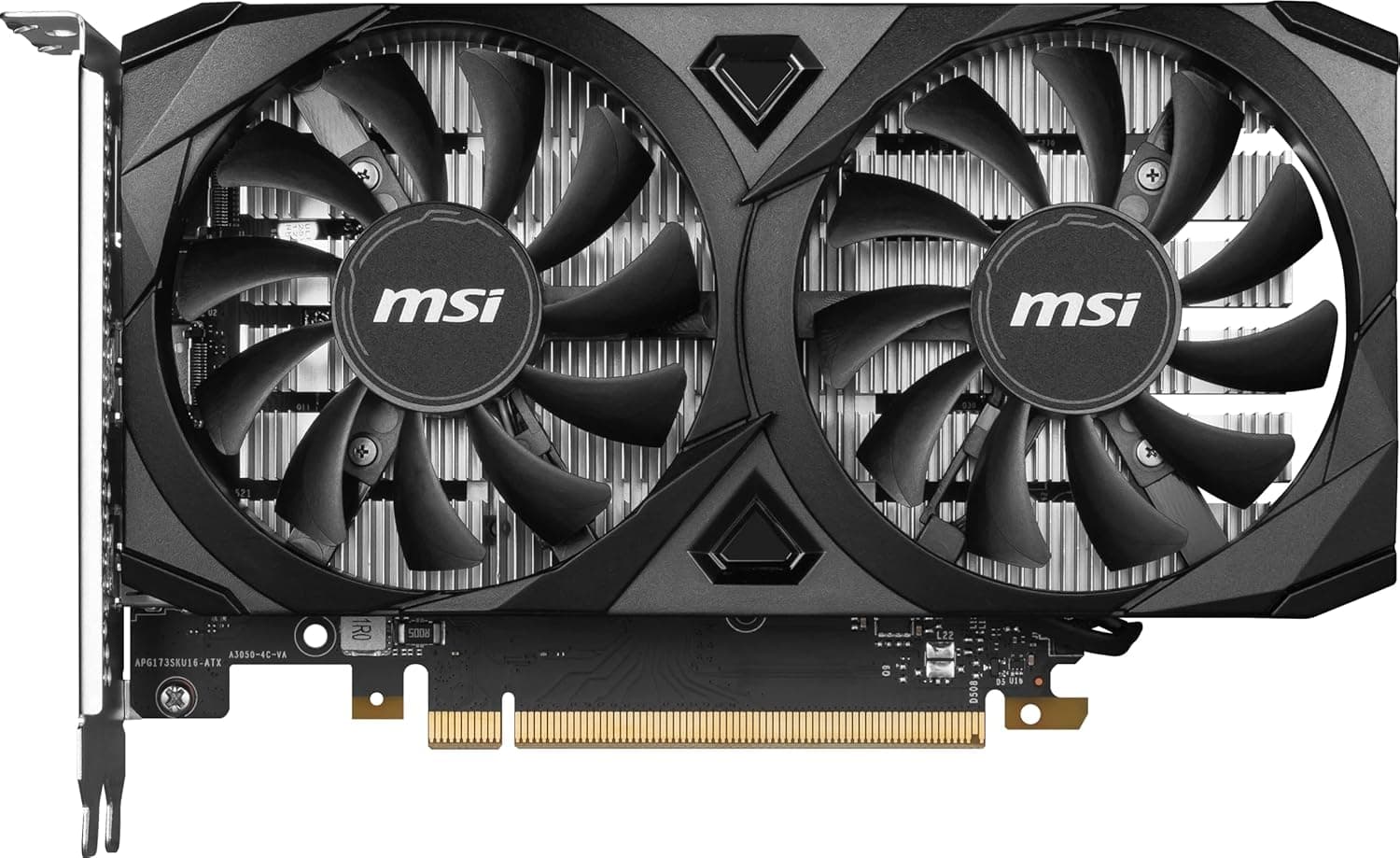
The MSI GeForce RTX 3050 VENTUS 2X 6G OC is an entry-level graphics card built on NVIDIA's Ampere architecture. With 2304 CUDA cores, a boost clock of 1492MHz, and 6GB of GDDR6 memory, it handles 1080p gaming, video streaming, and light creative tasks with ease. What sets this card apart is its 70W TDP and the fact that it requires no external power connector—everything is drawn from the PCIe slot. This makes it an incredibly easy upgrade for any desktop PC with a free x16 slot. The card features a compact dual-fan cooler with a reinforced backplate, measuring just 189mm in length. It provides one DisplayPort 1.4a and two HDMI 2.1 outputs, supporting up to 8K resolution (7680×4320) and triple monitors. G-SYNC compatibility ensures a tear-free gaming experience when paired with a compatible monitor. In the market hierarchy, this card sits firmly in the entry tier. Its standout feature is the zero external power requirement, making it ideal for upgrading office PCs or budget builds. At around $200 (or ¥30,000 in Japan), it competes directly with the Radeon RX 6400 and GeForce GTX 1650, but offers DLSS 2 and ray tracing support—features the competitors lack.
Compatibility Guide
The MSI RTX 3050 VENTUS 2X 6G OC uses a PCIe 4.0 x16 interface (electrically x8). It will work in PCIe 3.0 slots without issue, though the bandwidth drops to PCIe 3.0 x8 equivalent. For an entry-level GPU, this bandwidth difference is negligible in real-world use. Physically, the card occupies two slots and is 189mm long, 109mm tall, and 42mm thick. It fits most mid-tower and some small-form-factor cases, but always check case specifications for GPU length clearance. The card does not require any auxiliary power cables—all power comes from the PCIe slot. This means you can install it in systems with low-wattage PSUs, assuming the total system draw stays within the PSU's capacity. Output ports are one DisplayPort 1.4a (up to 8K@60Hz) and two HDMI 2.1 (up to 4K@120Hz). If you need more than one DisplayPort, you'll have to use an adapter. The card supports up to three simultaneous displays.
Product Info
The MSI GeForce RTX 3050 VENTUS 2X 6G OC (model VD8789) launched in early 2024 as a Japan-authorized product. Key specs: 2304 CUDA cores, boost clock 1492MHz, 6GB GDDR6 on a 96-bit bus at 14Gbps, 70W TDP, PCIe 4.0 x16 (x8 electrical). The dual-fan cooler keeps temperatures in check under load, and the backplate adds structural rigidity. Market positioning: clearly entry-level, but with a unique selling point—no external power. This makes it the perfect choice for users who want to add a discrete GPU to a prebuilt office PC or a budget gaming rig without upgrading the power supply. The price of around ¥30,000 puts it in direct competition with the GTX 1650 and RX 6400, but the RTX 3050 offers DLSS 2, ray tracing, and better overall performance. Warranty is 1 year through MSI Japan. Available at major retailers including Japan, PC Kojo, and Sofmap.
Best Use Cases
1080p Entry-Level Gaming This card is ideal for gamers who play esports titles like Fortnite, Apex Legends, and Valorant at 1080p. It can push 60–100fps at medium settings in most modern games. DLSS 2 provides a boost in supported titles. However, for 4K gaming or high-refresh-rate (144Hz+) monitors, this card will struggle. Consider a higher-tier card like the RTX 3060 for those scenarios. Office PC GPU Upgrade If you have a prebuilt office PC with a 300–400W PSU and a free PCIe slot, this card is a drop-in solution. No power cables needed—just plug it in and install drivers. Perfect for adding light gaming, video editing, or multi-monitor support to an otherwise basic system. But if your PSU is under 300W, check total system draw before buying. Home Theater PC (HTPC) or Secondary PC The compact size and low power draw make it a great fit for small cases used as media centers or secondary gaming rigs. The HDMI 2.1 output supports 4K@120Hz, which is great for connecting to modern TVs. However, it's not suitable for heavy 3D rendering, VR, or professional video editing where more VRAM and compute power are needed. Budget-Minded Users Wanting Modern Features Compared to the GTX 1650 or RX 6400, the RTX 3050 offers DLSS 2 and ray tracing support. If you're on a tight budget but want to experience these technologies, this card is the entry point. But note that ray tracing performance is limited; expect to use DLSS to maintain playable frame rates. ## Alternatives
Direct competitors include the Radeon RX 6400 (4GB) and GeForce GTX 1650 (4GB). The RX 6400 uses a PCIe 4.0 x4 interface and has only 4GB VRAM, making it slower in most scenarios. The GTX 1650 lacks ray tracing and DLSS support, so the RTX 3050 is the more future-proof choice. However, if you can find a used RTX 2060 (6GB) for a similar price, it offers better performance but requires a 6-pin power connector. Another alternative is the Intel A
Product Disclosure (Amazon)
- Manufacturer: MSI
- ASIN: B0CTK1SFVD
- Note: This article covers a manufacturer-made product based on Amazon listing details.