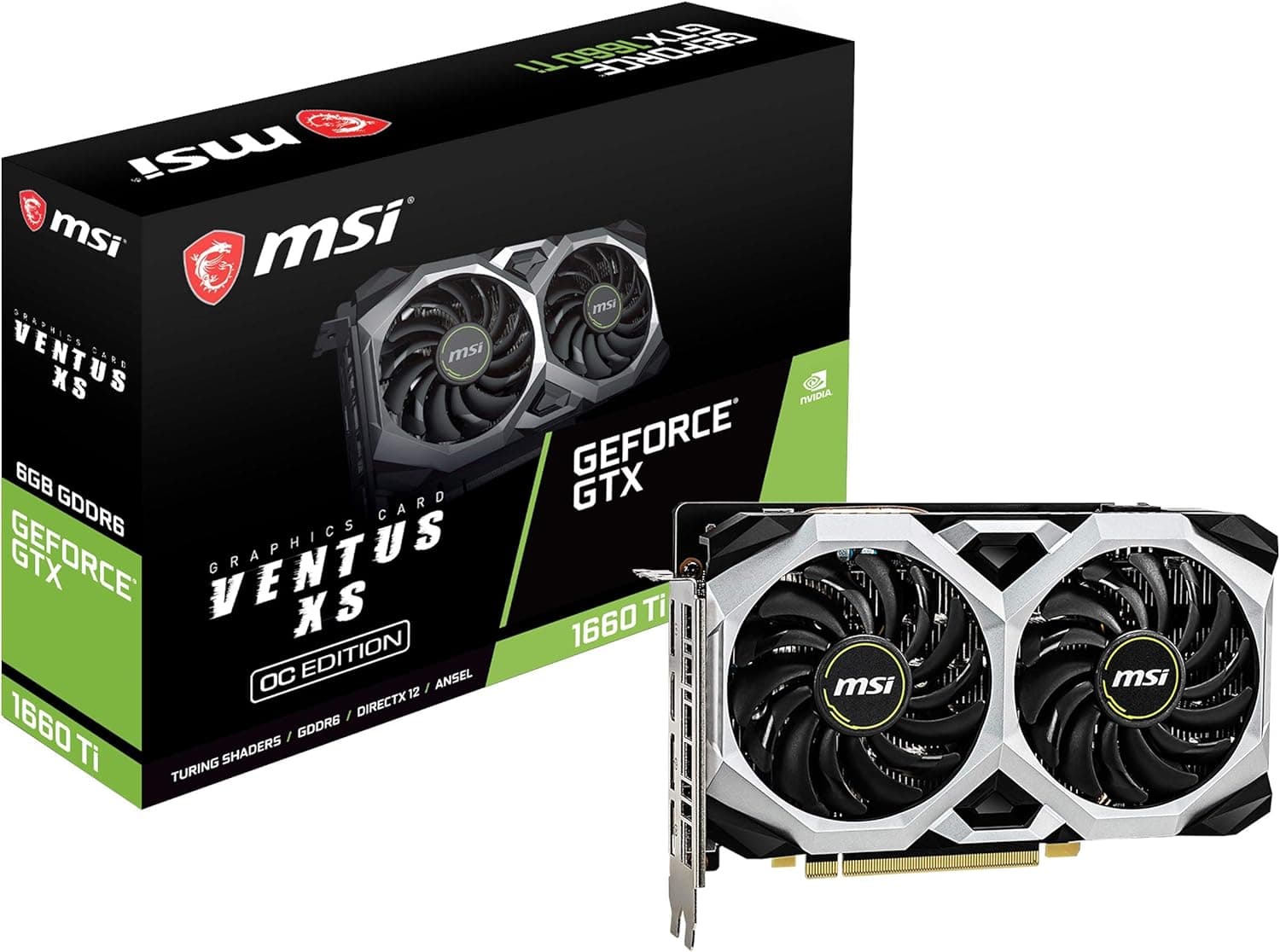
This article covers MSI(エムエスアイ) グラフィックボード GeForce GTX 1660 Ti VENTUS XS 6G OC [6GB.
Overview
The MSI GeForce GTX 1660 Ti VENTUS XS 6G OC is a mid-range graphics card built on NVIDIA's Turing architecture. It features a boost clock of 1830 MHz, 6GB of GDDR6 memory on a 192-bit bus, and a TDP of just 120W. This card is designed for smooth 1080p gaming, light video editing, and general creative work without breaking the bank. Part of MSI's VENTUS XS series, this dual-fan cooler is compact and minimalist, making it easy to fit into smaller cases. The GTX 1660 Ti sits above the GTX 1660 Super, offering higher shader count and memory bandwidth for better rasterization performance. It does not support ray tracing or DLSS, but excels in traditional rendering. This is an excellent choice for budget-conscious gamers who want reliable 1080p performance without the premium cost of RTX cards.
Compatibility Guide
Slot size: 2-slot design, fits most ATX and MicroATX cases. Power: One 6-pin PCIe power connector; recommended PSU is 450W or higher. Interface: PCIe 3.0 x16 (backward compatible with PCIe 4.0). Outputs: 3x DisplayPort 1.4, 1x HDMI 2.0b (supports up to 4K 60Hz). Memory: 6GB GDDR6, 192-bit bus, enough for high-texture 1080p gaming. Dimensions: ~205mm length, 112mm height, 42mm thickness. Fits many Mini-ITX cases.
Product Info
Released in February 2019, the MSI GeForce GTX 1660 Ti VENTUS XS 6G OC occupies the mid-range tier. Current market prices (new or used) range from around $200 to $350 depending on availability. Manufacturer warranty is typically 3 years (check with retailer). Market positioning: It sits between entry-level and mid-range. It lacks ray tracing but outperforms the GTX 1660 Super by about 10-15%. Best paired with a 1080p 144Hz monitor for high frame rates in competitive titles.
Best Use Cases
1080p 144Hz gamers: Play Fortnite, Apex Legends, Valorant, and similar titles at high settings with stable 144fps. The 1408 CUDA cores handle modern game engines well. Budget creative work: Light 4K video editing in Premiere Pro or DaVinci Resolve benefits from CUDA acceleration. Sufficient for 1080p exports. Power-efficient builds: 120W TDP means a 500W PSU is plenty; low heat output allows compact case use. Avoid if: You need ray tracing or DLSS, or plan to game at 1440p high settings in demanding titles (RTX 2060 or better recommended).
Things to Consider
No ray tracing or DLSS support: For modern RTX titles, consider an RTX 2060 or higher. Price vs. GTX 1660 Super: If the price difference is more than $50, the 1660 Super may offer better value. Used market caution: The card is over 5 years old; verify condition and warranty when buying used. Not suitable for 4K gaming: 6GB VRAM and 192-bit bus will bottleneck at 4K high settings. ## FAQ
Q: Will a 450W PSU handle this card? A: Yes, the recommended PSU is 450W. However, if paired with a high-end CPU (e.g., Core i9 or Ryzen 9), 500W or more is advised. Q: Which is better: GTX 1660 Ti or GTX 1660 Super? A: The 1660 Ti is about 10% faster. If the price difference is under $50, go for the Ti. Otherwise, the Super is a solid budget choice. Q: Can I use this card for VR? A: It can handle older VR headsets like Oculus Rift CV1, but modern high-resolution VR headsets require at least an RTX 2060.
Product Disclosure (Amazon)
- Manufacturer: MSI
- Seller: グリーンマイルズウェイ
- Fulfilled by: グリーンマイルズウェイ
- ASIN: B07N824KNV
- Note: This article covers a manufacturer-made product based on Amazon listing details.