Overview
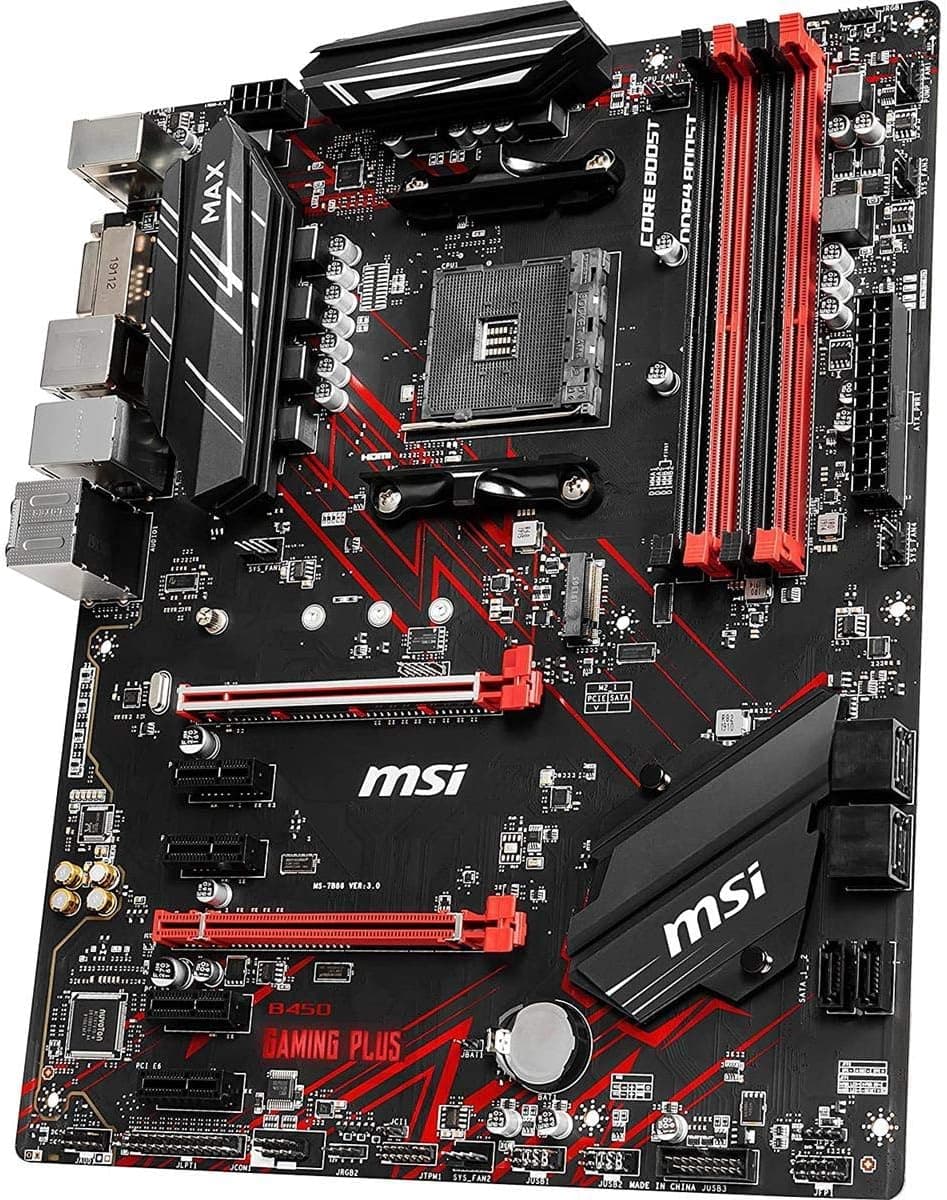
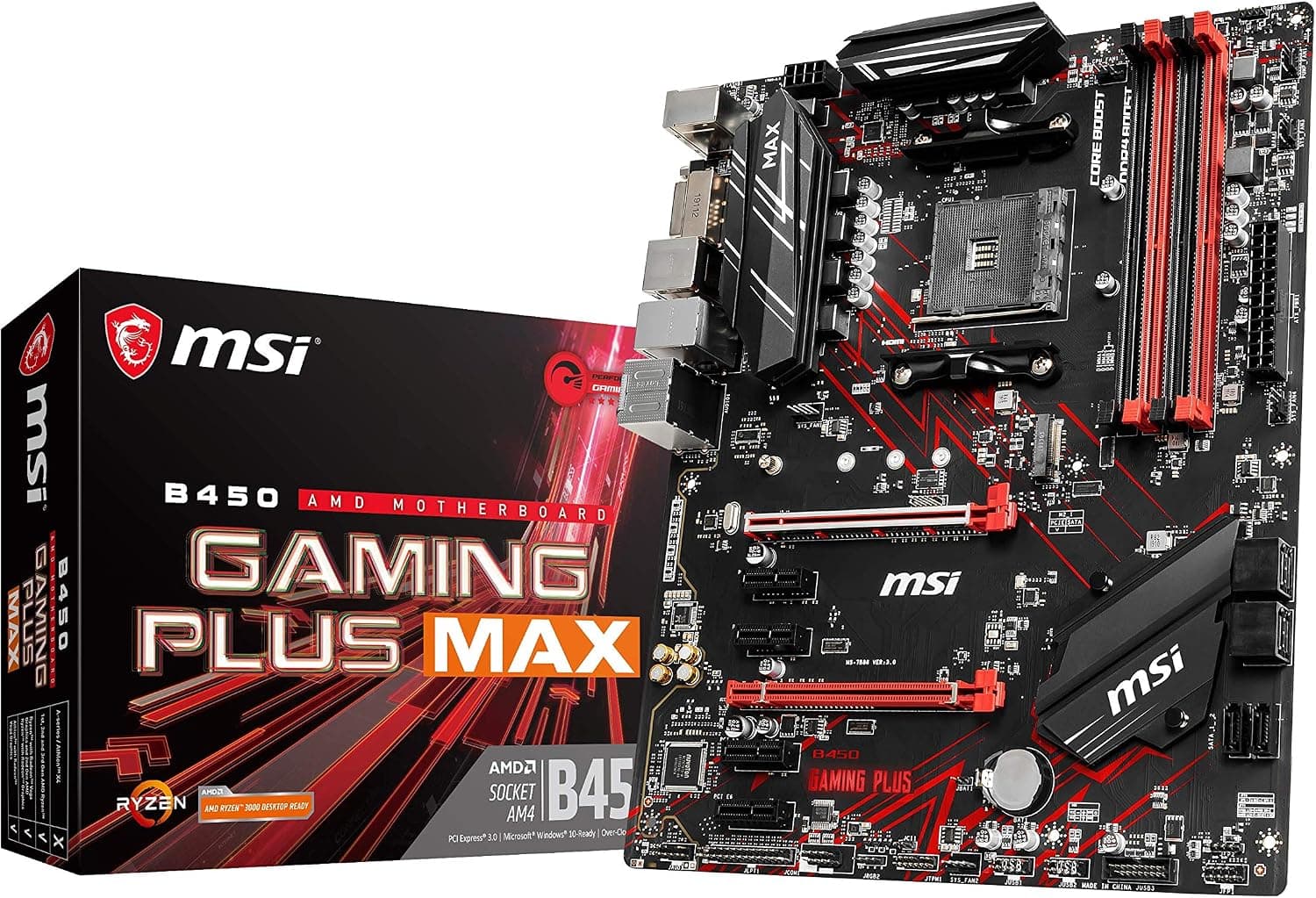
The MSI B450 GAMING PLUS MAX is an ATX motherboard designed for the AMD AM4 socket. Launched in 2019 as part of MSI's MAX series, it features a larger BIOS chip that guarantees out-of-the-box support for Ryzen 3000 processors. Even today, it remains a popular choice among budget-conscious builders who want to assemble a capable gaming PC without spending a fortune.
Built around the AMD B450 chipset, this board offers four DDR4 DIMM slots supporting up to 64GB of memory, with overclocking support up to DDR4-4133. Storage connectivity includes six SATA 6Gbps ports and a single M.2 slot with PCIe 3.0 x4 bandwidth. A single PCI Express 3.0 x16 slot provides room for a modern graphics card, making this a solid foundation for a mid-range gaming rig.
In the current market, the B450 GAMING PLUS MAX sits in the entry-to-mid tier, appealing to users who want to pair it with affordable AM4 CPUs like the Ryzen 5 5600 or Ryzen 7 5700X. While it lacks the PCIe 4.0 support of newer chipsets, its ability to reuse existing DDR4 memory and AM4 coolers makes it a cost-effective upgrade path for those already in the AMD ecosystem.
Compatibility Guide
The board uses the AMD AM4 socket and supports Ryzen 3000 and 5000 series processors, including G and XT variants. Second-generation Ryzen CPUs are also compatible, so users upgrading from older AM4 systems can often drop in a newer processor with just a BIOS update. The MAX series' larger BIOS chip makes this process more straightforward than on earlier B450 boards.
Memory support covers DDR4 DIMMs across four slots, with a maximum capacity of 64GB. Standard speeds range from DDR4-2133 to DDR4-3466, while overclocking can push compatibility up to DDR4-4133. XMP profiles are supported, so enabling higher-speed memory kits is generally a simple matter of selecting the profile in BIOS.
Expansion options include one PCI Express 3.0 x16 slot, one PCI Express 2.0 x4 slot (physically x16), and four PCI Express 2.0 x1 slots. The board also supports 2-way AMD CrossFire, allowing dual-GPU configurations with entry-level cards. Storage is handled by six SATA 6Gbps ports and one M.2 slot running at PCIe 3.0 x4 speeds (32Gbps).
Power delivery uses a standard 24-pin ATX connector and an 8-pin EPS connector, compatible with virtually any modern ATX power supply. The ATX form factor means it fits in most mid-tower and full-tower cases without clearance issues.
Product Info
The MSI B450 GAMING PLUS MAX was released in July 2019 and is sold in Japan as an official authorized product with a one-year warranty.Check the retailer's page for the latest price.
In terms of market positioning, this is an entry-to-mid-tier gaming motherboard. The B450 chipset lacks PCIe 4.0 support compared to X470 or X570, but it delivers more than enough performance for running Ryzen 5000 series CPUs at stock settings. MSI's Core Boost technology ensures precise power delivery to the CPU, while DDR4 Boost helps maintain memory stability under load, adding value beyond the modest price tag.
Best Use Cases
Budget gamers looking to build a system around a Ryzen 5 5600 or Ryzen 7 5700X will find this board an excellent match. Pairing it with a mid-range GPU delivers solid 1080p gaming performance without overspending on platform features they may never use.
Users who already own DDR4 memory and AM4-compatible coolers are another ideal audience. Switching to the AM5 platform would require new memory and potentially a new cooler, but this board lets you carry over existing components, significantly reducing the total cost of an upgrade.
It's also a good fit for secondary PCs, file servers, or light creative workstations. With six SATA ports, you can connect multiple hard drives for a high-capacity storage setup, making it versatile beyond just gaming.
On the other hand, users who need PCIe 4.0 for the fastest NVMe SSDs or require USB 3.2 Gen 2x2 (20Gbps) ports should look elsewhere. In those cases, a B550 or X570 board would be a more appropriate choice.
Things to Consider
The most significant limitation is the lack of PCIe 4.0 support. If you plan to use a modern graphics card or NVMe SSD at PCIe 4.0 speeds, you'll be restricted to PCIe 3.0 bandwidth. While the real-world impact on gaming is often just a few percent, enthusiasts chasing maximum benchmark scores may be disappointed.
The single M.2 slot, limited to PCIe 3.0 x4, is another constraint. If you want to run two NVMe drives, you'll need a PCIe adapter card or fall back to SATA SSDs for the second drive.
Availability is also a concern since this board launched in 2019. New stock is increasingly scarce, so verify that you're purchasing an authorized unit with valid warranty coverage.
Product Disclosure (Amazon)
- Manufacturer: MSI
- ASIN: B07W8WKV67
- Note: This article covers a manufacturer-made product based on Amazon listing details.