Game Overview
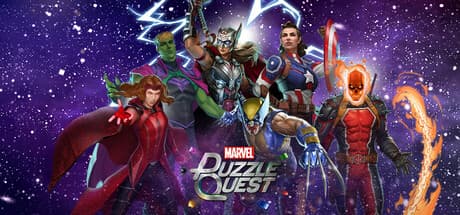
MARVEL Puzzle Quest: The Ultimate Match-3 Superhero RPG combines gem matching with turn-based character progression. Released on December 5, 2013, it is structured as an ongoing game in which players collect Marvel heroes and villains, improve a roster, and tackle a succession of compact battles.
A typical match begins by assembling a team and matching at least three gems of the same color. Matches can deal damage or build the resources needed for character powers, so the largest immediate match is not always the best move.
Players must decide whether to gather a color their team needs, deny an important color to the enemy, or prepare the board for a later turn.
Features and Systems
The central distinction is that every puzzle move also affects the combat system. Matching gems contributes to attacks and power use, while target selection and the timing of abilities determine how efficiently a team survives.
Cascades add uncertainty, but careful color priorities and board awareness make the outcome more than a simple test of luck.
The roster is described as containing more than 375 heroes and villains, including a 6-Star tier. That scale creates many possible teams, but it also makes unfocused upgrading inefficient.
New players will generally find it easier to invest in a smaller group whose roles complement one another instead of trying to improve every unlocked character equally.
Team building involves more than selecting individually powerful characters. It helps to check whether several characters compete for the same color and whether the lineup covers damage, protection, and board control.
A team that can use several colors effectively is usually less dependent on one favorable board layout.
Both single-player and multiplayer options are available. Single-player content suits players who want to learn powers and develop their roster at their own pace, while multiplayer provides another setting in which to test completed teams.
The two modes share the same collection-driven foundation rather than functioning as separate games.
Early-Game Priorities
Before making a move, identify which colors fuel the team's most useful powers. A visually impressive match may provide little value if none of the selected characters can spend that color.
Conversely, removing a color needed by a dangerous opponent can be worthwhile even when it produces limited immediate damage.
It is also useful to inspect what the next move may leave behind. Avoiding an easy match or cascade for the opponent can matter as much as maximizing the current turn.
After a loss, reconsider target order, color priorities, and team synergy before assuming that character levels are the only problem.
PC Requirements
Check the review panel on this page or the Steam listing for the latest user review trend. CPU examples are the Intel Core i3-3240 and AMD FX-4300, accompanied by 4 GB RAM.
The GPU requirement lists a GeForce GTX 560 Ti with 1 GB or Radeon HD 7750 with 1 GB, while DirectX 10 and 8 GB of available storage are also required.
These minimum components are modest compared with those demanded by recent high-end 3D games. However, no recommended specification is supplied, and meeting a minimum does not guarantee identical performance in every situation.
Anyone using integrated graphics or hardware near the lower boundary should verify GPU compatibility, available storage, and the presence of a 64-bit OS before installing.
Reception and Review Trends
Players commonly value the large Marvel roster, the satisfaction of building teams, and the extra tactical decisions layered onto familiar match-three play. Its strength is not a single set of puzzles with fixed solutions, but the long-term interaction between collection, upgrades, and team experimentation.
Reception is not uniform, however. As an ongoing free-to-play game, progression and access to characters can require patience, and the options available to a player depend partly on the roster already collected.
Someone expecting a self-contained premium puzzle campaign may find that collection and progression occupy more of the experience than desired.
Who Should Play It
The game suits match-three fans who want team composition and power timing to matter. It is also a natural fit for Marvel followers who enjoy gradually collecting heroes and villains, or for players who prefer short sessions that contribute to a longer progression path.
It works best for someone willing to return over time and refine several teams rather than finish one story in a few sittings. Support for multiple languages, including English, Japanese, and Korean, also makes it easier to study power descriptions in a supported language.
Limitations and Who May Not Enjoy It
A roster of more than 375 characters offers variety, but players should not assume that a desired character or finished team will be available immediately. Those who dislike narrowing upgrade priorities, waiting for collection progress, or working within a free-to-play progression structure may find the experience frustrating.
The opening hours are a useful opportunity to decide whether that progression loop feels rewarding.
Random gem layouts also mean that plans will not always unfold exactly as intended. Recovering from an unfavorable board through team construction and tactical choices is part of the appeal, but it will not satisfy everyone seeking deterministic puzzles with fixed solutions.
Players primarily interested in exploration, physics puzzles, or uninterrupted logic problems should recognize that this is first a collection-driven combat RPG built around match-three mechanics.