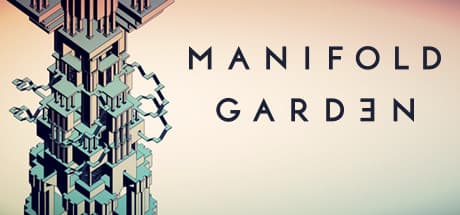
Game Overview
Manifold Garden: Explore Infinite Worlds and Bend Gravity is a first-person puzzle game built around architecture with no dependable up or down. You progress by changing gravity so that a wall becomes the floor and previously unreachable surfaces become paths.
Structures repeat in every direction, and falling out of the world can return you to another copy of the space instead of ending the attempt.
The core loop is to inspect a room, identify movable objects and accessible surfaces, then change orientation until the pieces can be placed correctly. Spatial reasoning matters more than reflexes.
A chamber can serve a completely different purpose when approached from another face, so simply searching for a conventional doorway is rarely enough.
Gravity and Infinite Space
Changing gravity is more than rotating the view. It changes where you can stand and affects how color-coded blocks can be moved or positioned.
Many solutions require an indirect sequence: reach another surface first, alter the orientation, and then use an object from the new gravitational frame.
The repeating world is also part of the puzzle design. A long fall is not necessarily a mistake because the architecture continues across the apparent boundary of the level.
Once that rule becomes intuitive, falling changes from a hazard into a navigation tool whose landing point can be planned.
The game communicates most rules visually rather than through lengthy instructions or formulas. That keeps the interface clean, but it also means that careless orientation changes can leave you confused.
Colors, stair directions, distinctive silhouettes, and block positions are useful landmarks when reconstructing the room in your head.
Restoring the World
The initially austere architecture develops through water, vegetation, and other environmental changes as you advance. These shifts are not merely decorative; they show that solving the mechanisms has altered a previously dormant place.
The world delivers its ideas through geometry, color, sound, and transformation instead of extensive dialogue.
Exploration is quiet, with no combat-driven loop or conversation-heavy story. Guidance is restrained, so players must scan their surroundings and decide which surface might lead forward.
This creates room to think without pressure, though it can feel vague to anyone who prefers explicit objectives and frequent directions.
PC Requirements Explained
The minimum requirements list Windows 7, 8, or 10, an Intel Core i5-750 at 2.66 GHz, an Nvidia 460, 2 GB RAM, and 3 GB of available storage.
The storage footprint is modest. Treat the minimum as a baseline for running the game rather than a promise of the smoothest presentation.
The recommended configuration lists an Intel Core i7-4790K at 4.00 GHz, an Nvidia 1070, 8 GB RAM, and the same 3 GB of storage.
Players who want smoother views across large repeating structures should use the recommended tier as the safer reference. Check system memory as well as the GPU name when comparing an existing PC with these requirements.
The published requirements are Windows-focused and name older Windows versions. They do not by themselves confirm every modern operating-system setup, handheld PC, or unusual hardware combination.
Check the current store information and device compatibility before purchasing for one of those environments.
Reception and Common Impressions
Manifold Garden has maintained strong long-term user approval. Its carefully unified visual design, unusual architecture, and gravity-based moments of realization are frequent reasons it resonates with puzzle fans.
The satisfaction comes from observing a rule, testing it, and finally understanding a space without the solution being explained outright.
The same design can be disorienting. Constant changes to up and down make it easy to lose a route, while repeated architectural forms can look deceptively similar.
Players sensitive to first-person camera movement, rotation, or extended falling sequences should also consider whether the visual motion will be comfortable.
How to Approach Difficult Rooms
When a route appears blocked, stop treating the visible doorway as the only possible exit. Inspect walls and ceilings as potential floors, and consider where a movable object will fall after the next orientation change.
In large vertical spaces, observe the repeated structures below before assuming that stepping off an edge is failure.
Randomly cycling through gravity directions usually creates more confusion. Instead, use a color, staircase, unusual opening, or block as a fixed landmark and track how its position changes.
The controls are straightforward; the real challenge is rebuilding the room mentally from several orientations. Taking a break can make an overlooked relationship much easier to see.
Who Should Play It
This is a strong fit for players who enjoy puzzles where the environment itself is the main tool. It also suits anyone drawn to impossible architecture, minimalist color, and solitary exploration.
Players who prefer studying one space carefully over receiving a rapid stream of objectives are especially likely to appreciate its pace.
It was released on October 20, 2020, and supports English, Japanese, Simplified Chinese, and other languages. The design is not heavily dependent on text, but localized menus make it easier to navigate settings and supporting information.
It is intended as a focused single-player experience that can be explored at an individual pace.
Cautions and Who May Not Enjoy It
Players seeking combat, character-driven dialogue, or a heavily narrated story may find the experience too sparse. Those who want objective markers and immediate hints may also become frustrated by periods of uncertainty.
It is not designed around cooperative puzzle solving, so players primarily looking for communication-based teamwork should consider another game.
Frequent orientation changes and long falls are fundamental rather than occasional effects. Anyone prone to motion sickness in first-person games should watch representative gameplay and begin with short sessions if possible.
The best buying criterion is not the striking artwork alone, but whether deliberately losing and rebuilding your sense of direction sounds enjoyable.