Game Overview
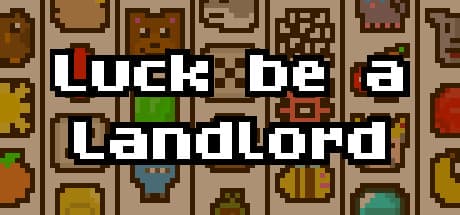
Luck be a Landlord is a roguelike deckbuilder about using a slot machine to earn rent and survive a series of payment deadlines. It does not involve real-money gambling or microtransactions.
After each spin, you choose from offered symbols and gradually shape the machine into a more productive build.
The title, Luck be a Landlord — Luck be a Landlord is a roguelike deckbuilder about using a slot machine to earn rent money and defeat capitalism, accurately points to its unusual premise. The actual loop is simple: spin, collect income, choose a symbol, and pay rent before the deadline.
This is a decision-driven strategy game rather than a reflex-based action game. TrampolineTales released it on January 6, 2023.
Features and Systems
Symbols do more than provide isolated payouts. Many depend on neighbors, matching types, or interactions that alter other symbols.
An option that is useful early can later dilute the board and reduce the chance of assembling the combination your build needs.
Unlike a conventional card deckbuilder, your selected pieces populate a slot-machine grid and produce income through each spin. Knowing a powerful combination does not guarantee that every required symbol will appear together.
Consistency usually comes from limiting unnecessary additions and concentrating on a few compatible groups.
Items modify the value of the available symbols from another layer of the build. An item may strengthen a category or make an otherwise modest choice useful, so a symbol cannot always be judged in isolation.
Successful runs reward adapting to the options already offered instead of forcing the same plan every time.
Early-Run Priorities
During the first few runs, focus on learning what symbols consume, remove, transform, or enhance. Adding every option with an attractive immediate payout can overcrowd the machine and make important interactions less reliable.
When declining an addition is possible, compare the current board size with the income you actually need.
Immediate value matters most when a rent deadline is close, while synergy and consistency become more important as requirements rise. A build based only on future potential may fail before its engine is ready.
A pile of unrelated short-term earners can also stop scaling, so the practical goal is to secure the next payment while developing a coherent core.
System Requirements
The supplied minimum requirements list a 2.0GHz CPU, 1GB RAM, and 165MB of available storage.
No dedicated GPU requirement appears in the provided data. Those CPU, memory, and storage demands are modest, making the game approachable for low-spec systems, but players should still verify operating-system support and integrated-graphics compatibility on the current store page.
The small storage requirement also makes it easy to keep installed alongside larger games. Minimum specifications are an entry point, however, and do not guarantee identical performance on every machine.
Laptop users may want to check power-saving settings and close unnecessary background applications if they encounter uneven behavior.
Review Trends
The game has maintained a broadly positive reception over time. Players commonly appreciate the quick turns, readable rules, and the satisfaction of watching several symbol interactions develop into a productive engine.
Its random offers also ensure that choosing a strategy involves adaptation rather than simply repeating a fixed solution.
That randomness is also the most likely source of frustration. A run may withhold a desired component, and a promising plan can fail before it becomes consistent.
The presentation and narrative are secondary to numbers, probabilities, and interactions, so enjoyment depends heavily on whether repeated experimentation feels rewarding to you. Check the live rating panel or Steam store for the latest reception.
Who Should Play It
Luck be a Landlord suits players who enjoy roguelike uncertainty, deckbuilding decisions, and compact strategy sessions. It is especially appealing if you like evaluating several imperfect choices and refining your selection rules after a failed run.
The controls are straightforward; the depth comes from understanding relationships between symbols and items.
It is also a good fit for players who prefer engine building over combat. Success relies more on restraint, probability management, and recognizing useful synergies than on fast reactions.
Each loss can provide information for the next attempt without demanding mastery of complicated movement or combat inputs.
Caveats and Who Should Skip It
Do not expect action combat, exploration, or a story-focused RPG structure. Players who strongly dislike random offers may find that strategic mitigation does not fully offset unlucky sequences.
It is also a poor match for anyone seeking a game where one memorized route produces the same dependable outcome every run.
The supplied metadata mentions multiplayer and Steam Workshop features, but it does not provide enough detail to confirm their current scope. If online, cooperative, competitive, or Workshop functionality is essential to your purchase, verify the feature list on Steam first.
Language-support data is also absent, so check the current store listing if a specific interface language is required.