Game Overview
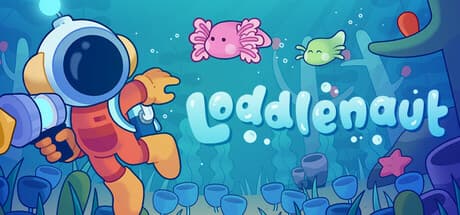
Loddlenaut: Ocean Cleanup Adventure on an Alien Planet is an underwater adventure about restoring seas polluted by an interstellar corporation. You play as a custodian who swims through the alien ocean, locates waste and toxic goop, and removes it with a bubble gun and unlockable gadgets.
Cleaning is reflected in the surrounding habitat, so progress is not merely a checklist: you can see life and color return to damaged areas.
The main loop involves entering unexplored waters, clearing pollution, collecting useful resources, and expanding where you can operate. Sunken corporate ruins add an exploratory thread while cleanup, discovery, and ecological recovery feed into one another.
Combat and demanding survival systems are not the focus; the reward is the gradual transformation of the ocean.
Features and Systems
The bubble gun is the foundation of cleanup, with additional gadgets helping against different obstacles and forms of waste. Because restored areas visibly contrast with polluted ones, the environment itself communicates progress.
The challenge is less about difficult inputs and more about choosing a route, noticing problems, and dealing with them methodically.
The native loddles are axolotl-like aquatic creatures whose growth depends on their diet. They are not present solely as decorations: feeding and raising them gives players a reason to pay attention to the habitat and available food.
Creature care and environmental restoration therefore support the same central objective instead of feeling like disconnected activities.
The open ocean rewards looking around for waste, wildlife, and submerged structures rather than rushing directly toward an objective marker. Trying to clear everything with maximum efficiency may make the repetition more noticeable, so the game works best when discoveries and environmental changes are allowed to set the pace.
Steam Achievements, Trading Cards, and Cloud support are listed, along with multiplayer functionality.
Getting Started
Early on, clean a manageable nearby area before pushing far into the ocean. This makes it easier to learn movement, resource collection, and the visual difference between damaged and restored habitats.
When you encounter loddles, observe how food affects their development so the raising system becomes part of your exploration routine.
Cleanup games can become unfocused when every visible object is collected without a plan. Pick a general zone, decide which pollution to address, and return when your resources or tools call for it.
There is no need to force immediate completion when a later gadget may make revisiting an area more convenient.
System Requirements
The listed minimum requires Windows 7 SP1 or later, a 1GHz or faster Intel or AMD dual-core CPU, a Radeon RX 550, 4GB of RAM, and DirectX 11. It also calls for 3GB of available storage, making the installation comparatively compact.
These requirements do not suggest that a current high-end gaming PC is necessary for basic play.
Only minimum requirements are supplied, with no recommended configuration available in the provided data. Treat them as a lower boundary for basic operation rather than a promise of high-resolution or consistently smooth performance.
On an older laptop or integrated graphics system, compare its graphics performance with the Radeon RX 550 and be prepared to reduce resolution or visual settings.
Reception and Player Fit
Loddlenaut has maintained strong reception over time. Its likely appeal comes from the gentle cleanup loop, the visible recovery of each environment, and the loddles themselves.
Small tasks provide natural stopping points, making it well suited to players who prefer self-paced progress over competition or reflex-heavy challenges.
The repetition is also the clearest dividing line. Players seeking frequent combat, elaborate character builds, or difficult puzzles may find the cleanup and collection loop too light.
Enjoyment depends heavily on whether a restored landscape and thriving creatures feel rewarding enough on their own; check the article's live panel or Steam for the latest reception.
Who Should Play It
This is a good match for players who enjoy underwater exploration, environmental restoration, and caring for cute creatures. It also suits anyone who likes seeing a clear before-and-after result from short sessions.
The colorful setting and flexible route make it appealing to players who prefer choosing their own order of activities.
It is also worth considering if you want a constructive objective without competitive pressure or harsh survival demands. Developed by Moon Lagoon and published by Secret Mode, it combines simulation, casual, and adventure elements.
It was released on November 16, 2023.
Limitations and Things to Check
Players looking for fast action or constant tension may not enjoy a game built primarily around cleaning, gathering, and exploration. Its open-world format is valuable less for sheer scale than for the freedom to restore compact ocean regions at your own pace.
If checklist-style completion feels tiring, focusing on loddle care and informal exploration may be more satisfying.
The supplied data does not confirm recommended hardware or current language support, so check the Steam product page before purchasing. If multiplayer is important, verify its current scope and supported player setup rather than assuming every activity is shared.
Hardware that only matches the minimum specification should not be treated as a guarantee of smooth performance at higher settings.


