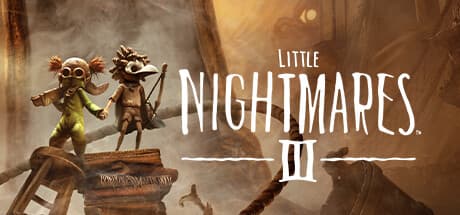
Game Overview
Little Nightmares III: A Cooperative Journey Through a Child's Nightmare is a horror adventure developed by Supermassive Games and published by Bandai Namco Entertainment. Released on October 9, 2025, it follows the young friends Low and Alone through the hostile realm known as the Nowhere.
The core loop involves observing unsettling environments, avoiding threats, solving spatial puzzles, and choosing the right moment to move. This is not a combat-driven game built around defeating every creature.
Stealth, timing, and environmental clues are the primary tools for surviving its dangerous spaces.
Low and Alone's Roles
Low carries a bow, while Alone uses a wrench. These items are more than conventional weapons: they also provide different ways to interact with obstacles and create a path forward.
Progress depends on recognizing which character can affect a particular part of the environment.
With two players, one person may operate a mechanism while the other moves into position or completes the next step. Communication therefore matters, especially when the game requires coordinated timing.
In single-player mode, an AI companion fills the second role, allowing the story to be completed without arranging a partner.
The two formats can feel meaningfully different. Online partners can explain discoveries and coordinate intentions directly, while solo players must read the companion's behavior and control their own pace.
Neither format changes the basic premise, but the choice affects how puzzles and tense sequences are experienced.
Horror and Puzzle Design
The horror comes from vulnerability, distorted spaces, and enormous threats seen from a child's perspective. Rather than managing a large inventory of survival supplies, players watch enemy behavior, use cover, and decide when it is safe to move.
Failed attempts can function as information, revealing the timing or route needed on the next try.
The bow-and-wrench division also keeps cooperation from becoming two players performing identical actions. At the same time, this is not a build-heavy role-playing game with extensive skill trees or loot management.
Its appeal depends more on noticing visual clues, interpreting movement, and maintaining the right position relative to the companion.
PC Requirements
The minimum specification lists Windows 11, an Intel Core i5-6500 or AMD Ryzen 3 1200, a GeForce GTX 1060 or Radeon RX 580, and 8 GB of RAM. This target is described as Low settings at 1080p and 60 FPS.
PCs close to that baseline may need reduced visual settings and fewer background applications.
The recommended specification calls for an Intel Core i5-8400 or AMD Ryzen 5 1600, a GeForce RTX 2080 with 8 GB or Radeon RX 6800, and 12 GB of RAM. It targets High settings at 1080p and 60 FPS.
The substantial GPU gap between the two tiers means players seeking higher visual settings should check graphics performance and VRAM, not just the processor.
Laptop GPUs can perform differently depending on their power limits, even when their names appear similar to desktop parts. Integrated graphics that share system memory should not be judged by name alone against the dedicated GPUs in the requirements.
Confirm Windows 11 support, installed RAM, and the exact GPU model before buying.
Choosing Solo or Online Co-op
Single-player is the better fit for players who want to absorb the environments and story at their own pace. It removes the need to coordinate schedules and makes it easier to pause after an intense sequence.
The AI companion also preserves the two-character structure of the puzzles.
Online co-op suits players who want to share discoveries, scares, and puzzle-solving with another person. However, a partner who immediately gives every solution can reduce the satisfaction of exploring.
For two first-time players, sharing observations before stating the answer usually creates a better cooperative rhythm.
Reception and Review Context
Player reception is divided, so this is not a release that should be recommended without considering personal priorities. Someone focused on atmosphere, environmental storytelling, and character-specific puzzles may judge it differently from a player focused on responsiveness or frictionless online play.
Check the latest Steam feedback before deciding, and separate comments by the mode you intend to use. Prospective online players should look for recent discussion of connections and progression, while solo players should focus on reports about companion behavior.
That distinction is more useful than treating every opinion as if it describes the same experience.
Who It Suits
Little Nightmares III is best suited to players who enjoy slow, careful exploration and horror communicated through spaces and imagery. It is also a strong match for those interested in puzzles built around the different uses of a bow and wrench.
Fans of vulnerable protagonists escaping oversized threats should immediately understand its appeal.
It can also work for players seeking a shared narrative rather than competitive matches or score chasing. Because single-player is available, it remains approachable for people who cannot consistently arrange an online partner.
Caveats and Who Should Skip It
Players expecting frequent combat, loot collection, or long-term character builds may find the design too restrained. Progress emphasizes observation and repeated attempts, so those who dislike retrying chase sequences or stopping to inspect a puzzle should be cautious.
If co-op is the main reason for buying, verify the supported platform, current online features, and partner requirements on the product page. The supplied game information confirms single-player and online co-op, but players expecting same-screen play should verify that specific feature separately.Check the review panel on this page or the Steam listing for the latest user review trend.