Overview
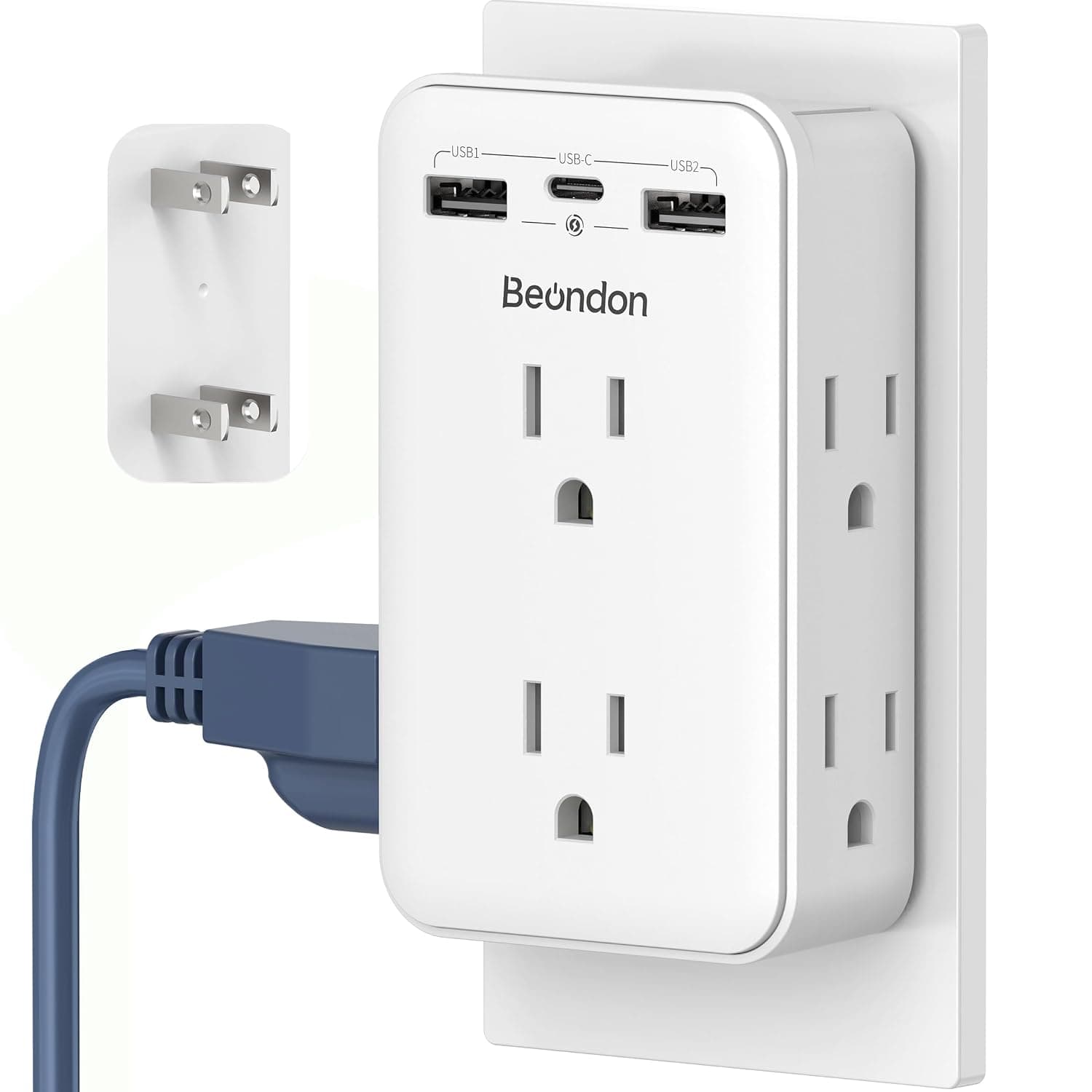
This article covers LIDER フラットフェイスコンセントエクステンダー コンセント3個 8フィートコード 1625W 2個パック — the LIDER Flat Face Outlet Extender. It plugs into an existing wall receptacle, sits almost flush against the wall, and uses an 8-foot (2.44 m) cord to bring three outlets to wherever you actually need them.
The point of the product is not outlet count; it is the missing centimetres between your furniture and the wall, plus the ability to move the power location.
On Amazon.co.jp it holds 4.5 out of 5 stars from 767 reviews, a 90% positive score (fetched 28 July 2026) — solid for this price band.
The caveat is that this is a US-spec device: NEMA 5-15P, 125 V / 15 A / 1625 W, ETL Listed. If your goal is simply more sockets, a domestic surge-protected strip is the more rational buy.
If your goal is killing the bulge at the wall, this is the product for that.
Typical Use Cases
The extender earns its keep when outlet position is the problem. Behind a bed, sofa or cabinet, a conventional strip adds its own body depth on top of the plug, forcing the furniture further out.
The flat face removes that depth, and the 8-foot cord carries three outlets to a reachable spot.
At a desk it suits low-draw gear: monitor, laptop adapter, phone charger, desk lamp. It is not for running several 1000 W-class appliances at once — see the load maths below.
Compatibility Guide
Ratings: 125 V / 15 A / 1625 W maximum, NEMA 5-15P grounded plug, 8 ft (2.44 m) cord, three outlets, wall plate roughly 14 cm (H) × 8 cm (W), ETL Listed, two units plus mounting screws in the box.
On Japan's 100 V supply, keep total load under about 1500 W, as the manufacturer's compatibility note states. The 1625 W figure belongs to a 125 V circuit.
Adding up loads is simple arithmetic from the labels: a 65 W laptop adapter, a 30–50 W 27-inch monitor and a 20–30 W phone charger fill all three outlets at roughly 200 W total — plenty of headroom. A 1000 W kettle plus a 1000 W toaster, by contrast, hits the ceiling on its own.
In a kitchen, treat "one high-draw appliance at a time" as the rule.
Mechanically, the product targets US duplex and decorator receptacles. Japanese wall plates also commonly use a centre screw, but the dimensions are not identical to the US standard.
If you intend to secure it with the plate screw, measure your own plate against the 14 × 8 cm body before buying. Used purely as a plug-in device it still works, but you lose much of the flush-mount benefit.
Note also that replacing a wall receptacle or altering fixed wiring requires a licensed electrician in Japan; stay within plug-in use.
Product Info
Prices move, so treat these as snapshots. Amazon.co.jp listed ¥9,429 as of 27 July 2026 and ¥9,180 as of 5 September 2026, both for the 2-pack — roughly ¥4,500–4,700 per unit.
The eBay entry is a search page with no confirmed price, so no figure is quoted here. Always check the product page for the current amount.
Key specs again: 1625 W max (125 V / 15 A), 8 ft cord, three outlets, 125 V rating, 14 × 8 cm wall plate, ETL Listed, two units and mounting screws. ETL is a North American safety certification and is distinct from Japan's PSE scheme.
Warranty terms follow the manufacturer; check the package or product page.
Market position: entry-to-mid-range household power tap. Per socket it loses to a domestic 6-outlet strip.
What it sells is thinness and relocation, not socket count.
Compared With Alternatives
Against domestic strips with surge protection, individual switches and dust shutters, this unit loses on outlet count and protective features — there is no surge rating stated and no per-outlet switch. It wins on wall-flush depth and on shipping as a 2-pack.
Against a plain extension cord it wins on three-way splitting and wall anchoring. Against a dedicated refrigerator surge protector it is simply a different category.
In short: it removes an installation constraint rather than adding a feature.
Best Use Cases
/ Recommended Users
Buy it if you want furniture flat against the wall, or if outlets behind a bed, sofa or TV unit are effectively dead. Two units mean two such spots solved, so households with the problem in more than one room get the most value.
It also suits desk cable tidying, where a fixed, shallow source feeding a cord to your work surface is easier to manage than a strip on the floor. Renters who want no wall modification are fine — as long as you stay with plug-in use.
Before You Buy
The biggest caveat is certification. ETL Listed is a North American mark; Japan's requirement is PSE.
Check the product page for a PSE marking and decide accordingly — either accept a non-domestically-certified device knowingly, or choose a Japanese-market product.
Second, the capacity misunderstanding. 1625 W is a 125 V figure; at 100 V the practical ceiling is about 1500 W.
A kettle and a toaster together reach it. Consolidating high-draw appliances on this kind of device shows up later as tripped breakers or heat.
Third, the installation misunderstanding. Photos of a flush face lead some buyers to expect an in-wall, professionally installed unit.
It is a plug-in device. Conversely, if you plan to fix it with the plate screw, measure whether the 14 × 8 cm body matches your Japanese plate first.
Finally, listing data. Amazon aggregates product metadata automatically, and manufacturer, model or voltage fields occasionally disagree with the physical item.
Manufacturer and product match as of writing, but the page you open may show something different — confirm the product and its ratings from the images, the title and the label on the unit itself. Standard precautions apply too: keep it away from water and do not daisy-chain taps.
FAQ
Q. Can I use it on Japanese 100 V outlets? A.
The grounded two-pole plug is compatible in form, but the rating is based on 125 V. Keep total load under 1500 W on 100 V, and verify PSE marking on the product page.
Q. Is three PC peripherals on it safe? A.
A laptop adapter, a monitor and a phone charger typically total around 200 W, well within range. Add the label figures to confirm.
Q. Does it include surge protection? A.
The published specs list only 1625 W max and ETL Listed; no surge protection is stated. Choose a product that explicitly advertises it if that matters.
Q. Is installation work required? A.
No, for plug-in use. Replacing the wall receptacle or plate requires a licensed electrician in Japan.
Q. What does it cost? A.
¥9,429 as of 27 July 2026 and ¥9,180 as of 5 September 2026 on Amazon.co.jp, both for the 2-pack.
Prices change often; check the listing.
Product Disclosure (Amazon)
- Manufacturer: LIDER
- Seller: Amazon US
- Fulfilled by: Amazon US
- ASIN: B0CN94F6D9
- Note: This article covers a manufacturer-made product based on Amazon listing details.