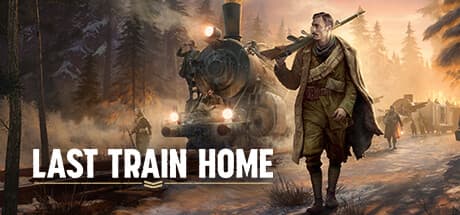
Last Train Home: Lead Czechoslovak Soldiers Through a Siberian Civil War is a single-player strategy game that combines armored-train management with real-time tactical missions. Set during the Russian Civil War after World War I, it follows Czechoslovak Legion soldiers attempting to cross Siberia and return home.
Developed by Ashborne Games and published by THQ Nordic, Last Train Home was released on November 28, 2023.
Game Overview
The campaign alternates between traveling by train, investigating stops, and deploying squads into the surrounding area. Combat is only part of the problem: food, fuel, ammunition, fatigue, and injuries all affect whether the unit can continue its journey.
A detour may provide essential supplies but expose valuable soldiers to danger, while rushing onward can leave the train unprepared for the next stretch.
The train is a mobile base rather than a decorative campaign map. You decide who joins a field mission, who performs work aboard the train, and who must recover before being deployed again.
The central challenge is therefore not simply winning the current battle, but preserving enough people and resources to survive the entire route.
Train Management and Tactical Missions
The game has two closely connected layers. On the train, you monitor supplies, crew condition, assignments, and the needs of the journey.
During missions, you directly command squads in real time, using terrain, cover, observation, and timing to deal with hostile forces.
What makes the structure effective is that mission costs carry back into the campaign. Spending too much ammunition or risking experienced soldiers may secure an immediate victory while creating a larger problem later.
Avoiding every confrontation is not a complete solution either, because supplies and access to the route may depend on field operations. The important question is not only whether you can win, but what that win will cost.
Soldiers are more useful when treated as individuals with roles and current physical limits rather than interchangeable units. Sending the strongest personnel repeatedly can make early missions easier, but injuries or losses among those veterans can weaken future options.
Rotating personnel and protecting the train's essential workforce are therefore parts of tactical planning, not administrative chores detached from combat.
Early-Campaign Priorities
Avoid committing every capable soldier to a single early mission. Deployed personnel accumulate fatigue, and wounded troops may not be ready for the next operation.
Since jobs aboard the train also require people, keeping a reserve makes it easier to respond when several problems occur close together.
No single stockpile can keep the expedition stable. Fuel is needed to move, food supports the crew, and ammunition determines how many combat options remain when stealth or avoidance fails.
Before accepting risk, compare the likely reward with the supplies and manpower the mission may consume. Withdrawal or a less ambitious approach can be strategically better than a costly success.
In tactical encounters, observe enemy positions and patrols before beginning a direct firefight. Moving the whole squad as one group can expose everyone to the same firing lane and leave no safe route out.
Establish cover, preserve an escape path, and use separate angles when the terrain allows it. These habits reduce both casualties and ammunition expenditure.
PC Requirements
The listed minimum requirements are Windows 10 64-bit, a 3GHz quad-core CPU, and 8GB of RAM. The specified GPUs are a GeForce GTX 1050 Ti with 4GB or a Radeon RX 570 with 4GB, while the game requires 20GB of available storage.
Because a dedicated GPU with 4GB of VRAM is the stated baseline, PCs relying only on integrated graphics should be assessed carefully.
Only minimum requirements are available in the supplied data, so there is no reliable recommended configuration to cite. Minimum specifications indicate an entry point, not a guarantee of high settings or consistently smooth performance.
On hardware close to the GTX 1050 Ti or RX 570, expect to leave room for reductions in resolution, shadows, or other graphics settings.
Laptop performance can also vary even when the GPU name looks comparable, since power limits and cooling affect sustained speed. Leaving more than exactly 20GB free is sensible because updates and temporary files need working space.
Check the current Steam system-requirements panel before purchasing, especially if your hardware is near the minimum.
Reception and Common Impressions
The game has maintained a strongly positive reception on Steam. Players are likely to appreciate how train management and tactical missions feed into each other, how named soldiers are difficult to treat as disposable pieces, and how the Czechoslovak Legion setting gives the campaign a distinct historical identity.
Consequences returning with the squad make individual encounters feel like chapters of one continuous expedition.
The same structure can feel demanding to players expecting a fast, combat-led RTS. Repeatedly checking supplies, assignments, fatigue, and injuries is an intentional part of the experience.
Tactical missions also depend on detailed positioning, so imperfect unit movement or a failed order can become frustrating. This is not simply a historical story with occasional battles; both management and direct command require sustained attention.
Who Should Play It
Last Train Home suits players who enjoy historical strategy and want responsibility for individual soldiers as well as the wider expedition. It is particularly appealing if you like planning supplies, rotating tired personnel, and living with consequences that persist beyond one encounter.
Players who value survival through controlled losses more than flawless victories should find its campaign structure rewarding.
It also works well for those who want more direct action than a purely turn-based grand strategy game provides. Long-term decisions happen aboard the train, while immediate positioning and timing matter during field missions.
The alternating layers provide two different forms of strategy without separating them into unrelated modes.
Caveats and Who May Not Enjoy It
This is a poor fit if you mainly want rapid battles with minimal preparation. Crew assignments, recovery, supply checks, and route planning are central systems rather than optional details.
Enjoyment depends partly on whether preparing for the next stage feels meaningful to you instead of feeling like downtime between fights.
Earlier decisions can also create later shortages or leave important soldiers unavailable. Players who dislike persistent losses, or who expect mistakes to be erased immediately, may find that pressure exhausting.
Those who enjoy revising priorities and rescuing a deteriorating plan are more likely to appreciate what the game does best.
Although the campaign uses real historical circumstances, it is not merely an interactive documentary. Real-time squad control and ongoing logistical management remain substantial parts of play, so story-only players may find the mechanical workload heavier than expected.
Confirm current language support and other store details on Steam before buying.