Overview
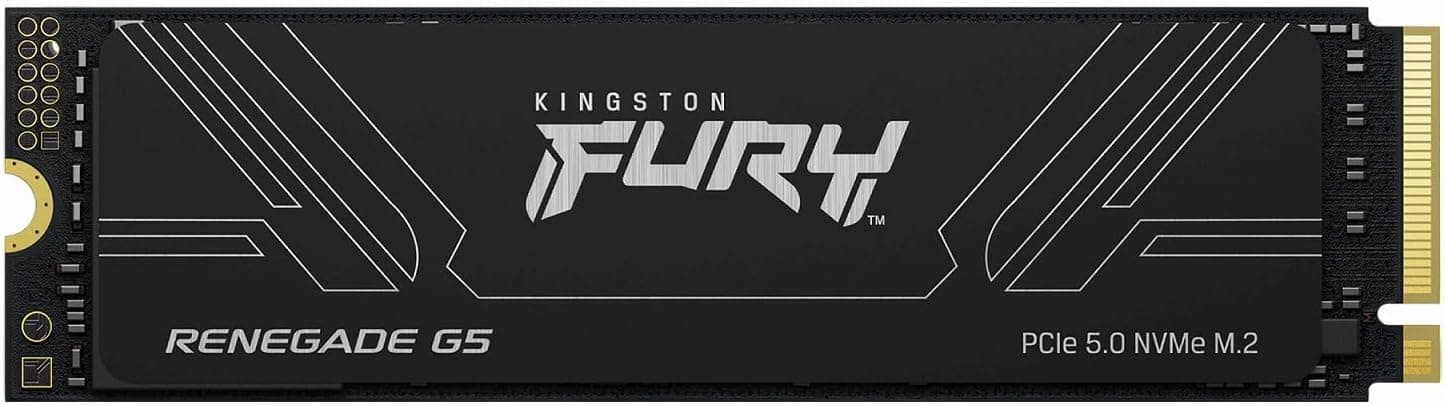
Kingston's FURY Renegade is a high-performance PCIe Gen 4.0 NVMe M.2 SSD built for gamers and power users who demand the lowest load times. The 1TB model SFYRS/1000G delivers sequential reads up to 7,300 MB/s and writes up to 6,000 MB/s, placing it among the fastest drives in its class. It uses 3D TLC NAND flash and comes with an ultra-thin graphene-aluminum heat spreader to maintain peak performance under sustained loads. The drive is officially validated for PlayStation 5 expansion, making it a versatile upgrade for both PC and console.
Positioned as a top-tier Gen 4 SSD, the Renegade competes directly with the Samsung 980 Pro and WD Black SN850. It offers a 5-year warranty with 1,000TB TBW (1.0PBW) and an MTBF of 1.8 million hours, reflecting its enterprise-grade reliability. Whether you're building a new gaming rig or breathing life into an older Gen 3 system, this drive removes storage bottlenecks decisively.
Compatibility Guide
The drive uses the standard M.2 2280 form factor and connects via PCIe Gen 4.0 x4. It works in any M.2 NVMe slot, but Gen 3.0 slots will limit bandwidth to around 3,500 MB/s. For best results, pair it with a motherboard that supports PCIe 4.0, such as Intel Z690/Z790 or AMD X570/B550/X670/B650.
The Renegade is fully PS5 compatible out of the box. Its pre-installed heat spreader is thin enough to fit under the console's drive cover without any modification. On the PC side, the drive runs well with most M.2 heatsinks, but its own spreader is sufficient for typical workloads. Ensure your motherboard's M.2 slot supports PCIe 4.0 to achieve advertised speeds.
Product Info
Released in late 2021, the Kingston FURY Renegade SFYRS/1000G currently retails for about ¥77,200 on online retailers (October 2026). It comes with a 5-year limited warranty and a TBW endurance rating of 1,000TB. The drive features 3D TLC NAND and a Phison PS5018-E18 controller with a DRAM cache, delivering consistent low-latency performance.
In the market, it sits firmly in the high-end Gen 4 SSD segment. It excels in random 4K reads and writes (up to 900K/1M IOPS), which translates to snappy OS responsiveness and fast game-level loading. It's an ideal choice for users who want uncompromised storage speed without stepping up to more expensive Gen 5 drives.
Best Use Cases
- High-end Gaming PC Builds: Perfect for gamers running AAA titles at 4K or 1440p high refresh rates. The fast sequential and random read speeds drastically reduce map and level load times. Not ideal for budget-conscious builders who could save money with a Gen 3 drive.
- PlayStation 5 Storage Expansion: Officially validated, fits perfectly with zero modifications. The graphene heat spreader keeps temperatures in check. Note that PS5 caps effective transfer speeds slightly below the drive's theoretical max, but real-world gains are still massive compared to the internal SSD.
- Content Creation Workstations: Excellent as a scratch disk for 4K/8K video editing or a high-speed project drive for 3D rendering. The write speed of 6,000 MB/s handles large file transfers quickly. However, if your workflow involves petabytes of writes per year, consider an enterprise-class drive.
Things to Consider
To get the full 7,300 MB/s read speed, you need a PCIe 4.0-capable motherboard. Using this drive in a Gen 3 system will halve its bandwidth. Also, note that the 1TB model has a write speed of 6,000 MB/s, while the 2TB and 4TB variants reach 7,000 MB/s — a difference noticeable only in sustained large-file writes.
Thermal performance is good but not exceptional. In tight cases with poor airflow, the drive can hit higher temperatures; adding an aftermarket M.2 heatsink may help. For laptops, check that your system's thermal solution can handle the 5W-7W typical power draw under load. Finally, the price is at a premium; if your workload is light, a mid-range Gen 3 SSD offers better value.
FAQ
Q: Can I use this drive on a PCIe 3.0 motherboard?
A: Yes, it's backwards compatible. However, the interface will run at Gen 3×4 speeds (≈3,500 MB/s), losing about half the sequential performance. Random IOPS remain largely unaffected, so OS and game loads will still feel very quick.
Q: Does it work with the PS5 without extra accessories?
A: Absolutely. The drive's graphene heatsink is slim enough to fit the PS5's drive bay without additional screws or heatspreaders. Just insert it and format — no extra steps required.
Q: How does it compare to the Samsung 980 Pro in real-world use?
A: Both drives offer nearly identical sequential and random performance in most benchmarks. The Renegade has a slight edge in sustained write performance thanks to its larger SLC cache. Choose based on pricing and warranty preference — Kingston offers a straightforward 5-year warranty in most regions.
Product Disclosure (Amazon)
- Manufacturer: Kingston
- Seller: P-LAB
- Fulfilled by: P-LAB
- ASIN: B09K3H2YHX
- Note: This article covers a manufacturer-made product based on Amazon listing details.