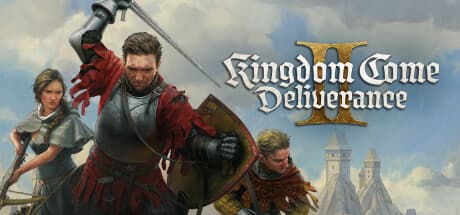
Kingdom Come: Deliverance II is a first-person open-world RPG set in 15th-century Bohemia. Developed by Warhorse Studios and published by Deep Silver, it continues the story of Henry, a blacksmith's son caught in a period of political conflict and personal revenge.
The PC version launched on Steam on February 4, 2025.
Rather than presenting a frictionless heroic power fantasy, the game asks the player to live as a person within a medieval society. Conversation, combat, travel, equipment, and character growth interact with one another, so Henry's conduct matters as much as his raw combat ability.
Game Overview
A typical journey involves speaking to people in a town or village, traveling to a location, gathering context, and choosing how to resolve the problem. Direct combat may be possible, but persuasion, investigation, avoidance, or a different route can also be useful.
Understanding the situation is often more rewarding than simply following an objective marker.
The story combines political intrigue with Henry's personal struggles. Decisions are not isolated menu choices; they help define how the player approaches people and problems throughout the adventure.
Some outcomes are morally uncertain, making role-playing a particular version of Henry more satisfying than searching for a perfect answer every time.
Because this is a direct continuation, familiarity with the first Kingdom Come: Deliverance makes relationships and motivations easier to understand. New players can still follow the available context, but those who want the full emotional continuity should play the original or read a story recap first.
Features and Systems
Combat takes place from a first-person perspective and emphasizes distance, attack direction, and defensive timing. It is not designed around effortlessly defeating groups of enemies.
Being surrounded can remain dangerous even after improving Henry's equipment and skills, so retreating, changing position, or avoiding a fight can be sensible solutions.
Character development is tied to the actions the player regularly performs. Henry does not begin as a master of every discipline, which makes early limitations an important part of the progression.
Choosing whether to emphasize weapons, speech, exploration, or a balanced approach gives the role-playing systems a practical effect on moment-to-moment play.
Dialogue is more than a way to receive objectives. The useful response depends on the person, circumstances, and version of Henry the player is building.
Aggression is not universally effective, and the consequences of a choice may not be obvious immediately.
The historical approach also affects the pace outside combat. Preparing equipment, reaching a destination, resting when necessary, and considering Henry's position within a settlement all contribute to the experience.
Players who enjoy travel and preparation may find this absorbing, while those who want every routine action removed may find it deliberately slow.
Early-Game Priorities
Expect even an ordinary duel to be difficult while learning the controls. Look for ways to avoid a disadvantage, observe the number and position of enemies, and create distance when a confrontation turns against you.
Training opportunities are valuable because defensive timing and spacing are more dependable early lessons than attacking constantly.
Pay attention to names, locations, and conditions mentioned during conversations. Context is part of the role-playing rather than disposable flavor text, and listening carefully can reveal information relevant to a decision.
Rushing through every exchange can make quests feel less clear and may hide alternative approaches.
Focusing first on methods you use frequently gives Henry a coherent direction. However, investing only in combat can reduce flexibility when words could prevent a fight, while relying entirely on speech may leave you unprepared for unavoidable danger.
A preferred specialty supported by basic self-defense is a practical starting plan.
PC Requirements
The listed minimum specification requires 64-bit Windows 10 or newer, an Intel Core i5-8400 or AMD Ryzen 5 2600, and an NVIDIA GeForce GTX 1060 with 6GB or an AMD Radeon RX 580. The game also requires 16GB of RAM, 100GB of available storage, and an SSD.
These components represent a minimum entry point, not a promise of high settings or high frame rates. A system close to the minimum should be prepared to lower demanding options such as shadows, effects, or view distance.
The supplied requirements do not state a target resolution or frame rate, so a more precise performance claim would be unreliable.
Check the whole configuration rather than comparing only GPU names. The 16GB memory requirement, 100GB installation size, and mandatory SSD are just as important.
GTX 1060 owners should specifically confirm that their card is the listed 6GB version.
No recommended specification is included in the supplied data. Players seeking sharper visuals or smoother performance should compare their CPU, GPU, and memory with the latest requirements shown on Steam before purchasing.
Reception and Player Impressions
The game has maintained strong user reception over time. Its most distinctive strength is how combat, dialogue, travel, and growth combine into a coherent form of historical role-playing.
Henry's gradual development gives practice and preparation a meaningful place in the adventure.
The same design can also divide players. Unusual combat, a vulnerable early character, preparation, and travel create friction that faster action RPGs often remove.
Whether that friction feels immersive or inconvenient will largely determine how much a player enjoys the game.
Who Should Play It
Kingdom Come: Deliverance II suits players who want to act as an individual within a historical society rather than explore a medieval-looking fantasy playground. It rewards reading conversations, considering motives, and looking beyond combat for solutions.
It is also a strong fit for anyone who enjoys starting with an inexperienced character and earning competence through repeated use and occasional failure. Players who value the journey between objectives, not only the reward at the end, are likely to get the most from its open world.
Caveats and Who Should Skip It
This is a difficult recommendation for players seeking fast combat, short self-contained missions, or clear moral answers. Learning the controls and systems takes time, and decisions may produce imperfect results.
The experience works best when mistakes can become part of the player's story instead of prompting an immediate reload.
Players uncomfortable with first-person melee combat or slow preparation should also be cautious. Storage-constrained PCs need space for the required 100GB SSD installation, and 16GB of RAM is part of the minimum specification.
Language support is absent from the supplied data, so check the current Steam listing before purchasing if Japanese or another specific language is essential.