Game Overview
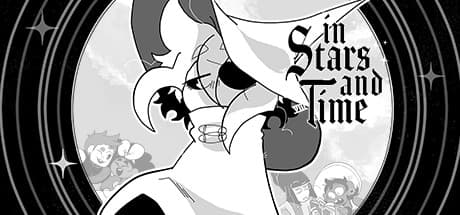
In Stars And Time: Relive Your Failures, Break the Loop is a story-focused, turn-based RPG that begins near the end of Siffrin and their companions' quest to defeat a tyrannical king. When the party fails, time returns to an earlier point, but Siffrin retains the memories of previous attempts.
Conversations, exploration, and battles must then be approached with knowledge nobody else possesses.
The loop is more than a retry system. Information learned during one attempt can reveal new responses and paths during another, so revisiting events advances both the mystery and the relationships within the party.
Greater knowledge brings progress, but it also places an increasing emotional burden on the only person who remembers every failure.
The Loop and Exploration
A typical cycle involves speaking with the party, exploring the dungeon, attempting to reach the king, and carrying useful knowledge into the next loop. Familiar locations and conversations return, yet Siffrin's changing perspective can alter their meaning.
Comparing small differences is therefore part of both progression and character discovery.
The goal is not simply to brute-force a perfect sequence. To the companions, each repetition is still their first experience, while Siffrin accumulates memories they cannot fully share.
That imbalance turns time travel from a convenient power into the source of the game's tension and isolation.
Combat and Character Growth
Combat uses a party-based turn system built around a rock-paper-scissors-style relationship between attack types. Reading an enemy's weakness and choosing the appropriate party member are the fundamentals, so success depends more on command selection than reflexes.
Battles provide tactical breaks without displacing the narrative as the main attraction.
Memories function as equipment-like upgrades while also revealing pieces of character history and emotion. Reading their descriptions makes progression part of the storytelling rather than a separate statistics screen.
Players seeking extensive build crafting should temper expectations, however, because combat primarily supports the journey instead of dominating it.
PC Requirements
The listed minimum configuration requires 64-bit Windows 7, 4 GB of RAM, and 500 MB of available storage. CPU examples are an Intel Core i3-530, an AMD Phenom 9650 Quad-Core, or an equivalent processor.
The GPU floor is a GeForce GT 440 or Radeon HD 7750 with 1 GB of video memory.
No recommended specification is provided, so the available data cannot promise a particular resolution or frame rate. The low minimum requirements nevertheless indicate a relatively accessible game that does not demand a recent high-end graphics card or a large installation drive.
Owners of older laptops should confirm 64-bit OS support, usable RAM, and integrated-graphics capability before buying.
Reception and Common Impressions
The game has maintained strong player reception over time. Discussion commonly favors its character dialogue, carefully planted narrative clues, and the way Siffrin's mental state changes as repetitions accumulate.
Its LGBTQ+ characters and themes are integrated into identities and relationships rather than treated as detached decoration.
The same repetition that gives the story its force can also divide players. Returning to familiar spaces and rereading variations of earlier scenes may feel slow to anyone eager for constant new locations.
Its rewards come from noticing altered wording, context, and behavior rather than rushing from one major event to the next.
Who Should Play It
This is a strong match for players who want a time loop to explore loneliness, memory, and relationships instead of serving only as a puzzle device. It suits readers who enjoy examining dialogue closely and recognizing how a later loop changes the meaning of an earlier scene.
It is also approachable for players who prefer turn-based choices over action-heavy execution and who appreciate distinctive monochrome 2D presentation. Because revelations are delivered gradually, avoiding story guides and spoilers helps preserve much of the intended surprise.
Caveats and Who Should Skip It
Repetition is inseparable from both the theme and the structure. Players looking for an RPG centered on continual map expansion, loot collection, or elaborate character builds may find the experience too narrow.
The story also moves into psychologically heavy territory, despite the party's warmth and humor.
Skipping dialogue can make important changes and progression clues easy to miss. The supplied article metadata also lists multiplayer, but the experience is centered on following Siffrin through a solo narrative.
If store feature labels conflict, verify the current play modes and language support on the product page before purchasing.