Game Overview
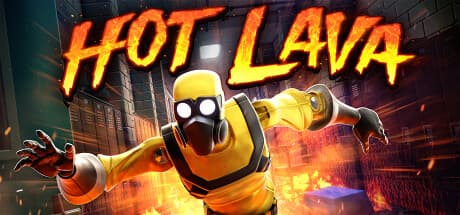
Hot Lava: Childhood Imagination Meets Molten Danger turns the childhood game of avoiding the floor into a first-person precision platformer. Familiar places such as schools, playgrounds, and rooftops become obstacle courses where players run, jump, climb, and use surrounding objects as safe routes above the lava.
A typical run begins with identifying safe platforms, lining up an approach, and attempting a sequence of jumps. When a move fails, the player repeats the section, adjusts the takeoff point or camera angle, and gradually learns the route.
Its racing element is therefore closer to an obstacle-course time trial than conventional vehicle racing.
Movement and Course Design
The main appeal of Hot Lava is improving at movement itself. A platform that initially seems unreachable can become manageable after adjusting momentum, direction, and where the jump begins.
Progress comes from recognizing why an attempt failed and turning an awkward series of moves into a controlled route.
Looking beyond the next landing point is especially useful. Stopping after every jump makes it harder to maintain momentum, while planning two or three moves ahead creates a smoother run.
New players should prioritize reaching the finish safely, then experiment with faster lines after learning the course.
Solo and Multiplayer
Single-player mode provides room to practice without pressure from other participants. It suits players who want to study routes, repeat difficult sections, or improve personal times.
It is also the easier place to tune camera sensitivity and learn how jumping feels from a first-person perspective.
In multiplayer, another player's route can become a practical demonstration. Following a more experienced runner may reveal a landing point or line that was easy to overlook.
The mode can support friendly cooperation as well as informal competition, so groups will have a better experience if they decide whether the goal is speed or helping everyone finish.
Early Tips
Do not chase the shortest route immediately. Start by connecting the safest visible platforms and build consistency before adding speed.
After a missed jump, determine whether the cause was insufficient momentum, poor direction, an early takeoff, or losing sight of the landing area.
First-person movement also makes body position less obvious than it would be in a third-person platformer. Learning how the center of the screen relates to platform edges helps make landings repeatable.
Players sensitive to rapid camera movement should begin with short sessions and inspect the available view and display settings in the current game version.
System Requirements
The listed minimum requirements are Windows 7, 4 GB RAM, DirectX 11, and 10 GB of available storage. The recommended requirements are Windows 10, 8 GB RAM, DirectX 11, and 15 GB of available storage.
No specific CPU or GPU models are included in the supplied requirements, so memory capacity alone cannot confirm expected performance.
Minimum specifications are best treated as an entry point rather than a promise of consistently smooth play. Stable frame delivery matters in a precision platformer because timing and visual feedback affect takeoffs and landings.
If possible, use the recommended 8 GB RAM and 15 GB storage figures as the safer baseline, and verify the current OS and hardware requirements on the store page before buying.
Reception and Player Expectations
Hot Lava has maintained strong user reception over time. Its premise is immediately understandable, but the challenge develops through route learning, repeated attempts, and increasingly precise movement.
Players who enjoy measurable improvement and short retry loops are likely to appreciate that structure.
The same repetition can be frustrating for anyone who dislikes replaying a failed section. Some players may also find first-person jumping harder to judge than platforming with a visible character.
When checking current user feedback, focus on comments about movement, camera behavior, and difficulty rather than relying only on the overall label.
Who Will Enjoy It
Hot Lava is a good fit for fans of first-person parkour, precision jumps, exploration, and time trials. It rewards players who enjoy learning a course and reducing mistakes instead of expecting every obstacle to be cleared on the first attempt.
The childhood setting also works well for groups looking for a playful obstacle-course experience.
It may also suit players who prefer compact challenges over a story-heavy campaign. Switching between personal practice and multiplayer runs gives the game both a self-improvement angle and a social one.
That flexibility is useful for people who enjoy friendly competition but do not want every session to be purely competitive.
Cautions and Who Should Skip It
Players who strongly dislike repeated failure or who mainly want combat and narrative may not find the core loop satisfying. Rapid running, jumping, and camera adjustments can also be uncomfortable for people prone to motion sickness.
Check the current in-game options or store information if particular camera or accessibility settings are essential to you.
Multiplayer support does not guarantee that every participant will progress at the same pace. A large skill gap can leave experienced players waiting or newcomers feeling rushed, so agreeing on a cooperative or competitive approach helps.
Hot Lava was released on September 19, 2019; verify current online activity and platform support before planning a multiplayer-focused purchase.