Game Overview
Higurashi When They Cry Hou: Onikakushi - A Village's Dark Secret is a single-player visual novel set in Hinamizawa during the summer of 1983. The village has fewer than two thousand residents, yet a mysterious death and a disappearance occur there each year.
Players follow the story through dialogue, character art, music, and sound rather than combat or exploration.
The opening spends time establishing ordinary rural life and the relationships between its characters. As the story progresses, casual remarks and familiar places begin to feel threatening.
The central experience is noticing those changes, questioning what can be trusted, and continuing despite incomplete information.
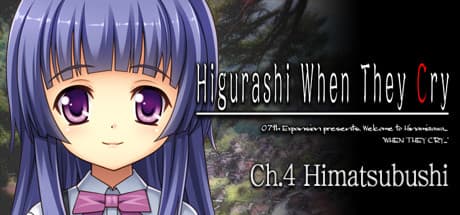
Developed by 07th Expansion and published by MangaGamer and Sunflower Ocean, this Steam edition was released on May 15, 2015. It presents the story with new character art and serves as the source material behind the popular anime adaptation.
Features and Structure
Interaction primarily consists of advancing text, so there are few controls or systems to learn. That makes the game accessible to players who do not enjoy action-heavy titles, but it also means that attention is more important than mechanical skill.
Remembering small inconsistencies and earlier conversations adds considerably to the mystery.
Onikakushi builds horror through contrast. Cheerful daily scenes establish familiarity before suspicion changes how the same people and locations are perceived.
It is less about constant external threats and more about the anxiety of no longer knowing whether a trusted interpretation is correct.
Steam Achievements, Trading Cards, and Steam Cloud are supported. Cloud saves are useful for reading the lengthy narrative across compatible systems or in shorter sessions.
The listed languages are English, Japanese, and Simplified Chinese.
For Newcomers and Anime Viewers
Newcomers can begin with Onikakushi without researching the setting first. The village, relationships, and central mystery are introduced through the narrative, and encountering uncertain information without spoilers is part of the appeal.
Players who enjoy forming and revising theories will get more from the gradual setup than those waiting only for a final explanation.
Anime viewers already familiar with the broad events can focus on the internal perspective, conversational detail, and pacing of the original visual novel. Knowing major developments changes the experience from surprise to re-examination, making foreshadowing and character behavior easier to notice.
However, anyone expecting the speed of an animated episode should be prepared for a much slower, text-led presentation.
System Requirements
The minimum specification lists Windows XP, 7, or 8, a Pentium III 800 MHz processor, 512 MB of RAM, 500 MB of available storage, and DirectX 9.0.
The recommended specification raises that to a Pentium 4 1.4 GHz processor and 1 GB of RAM.
No dedicated gaming GPU requirement is listed, so the hardware demand is modest by modern standards.
Older laptops and integrated graphics systems should therefore be reasonable candidates from a performance perspective. The operating-system list focuses on older Windows releases, however, so check the Steam product page and your own setup for current compatibility.
For a text-heavy game, display readability, comfortable text sizing, and good headphones may matter more to the experience than additional graphics power.
Reception and Common Impressions
The game has maintained strong user sentiment over time. Players commonly value its slow shift from comedy and routine into distrust, its layered mystery, and the way music and sound create tension without relying exclusively on graphic imagery.
Reading the source at a personal pace is also a major attraction for fans of the adaptation.
The same deliberate pacing can divide readers. Extended everyday conversations may feel excessive to anyone who wants the central incident to advance immediately, while players expecting frequent choices or complex mechanics may find the experience passive.
It is also important to approach this chapter as part of a larger mystery rather than assuming every question will receive a complete answer here.
Who Should Play It
Onikakushi suits readers who enjoy building theories, psychological horror, and stories in which earlier scenes gain new meaning later. It is especially effective for players who want to understand the cast during ordinary moments before watching trust break down.
The minimal controls also make it a comfortable choice when the goal is to concentrate on prose and audio.
Short sessions are possible, particularly with Steam Cloud support, but uninterrupted reading can preserve the tension during major sequences. Patient readers who accept uncertainty are likely to find more value here than players who need immediate answers.
Cautions and Who Should Skip It
This is not a strong match for players seeking fast action, regular decision points, character progression, or collectible-driven systems. Reading is the core activity, and skipping the long conversations can remove much of the foreshadowing and emotional context that makes later scenes effective.
The content includes occasional coarse language, blood, and violence, along with sustained psychological pressure. The appealing character art should not be mistaken for a consistently gentle story.
Players sensitive to disturbing material, or those who require a self-contained mystery with rapid resolution, should approach it cautiously.