Game Overview
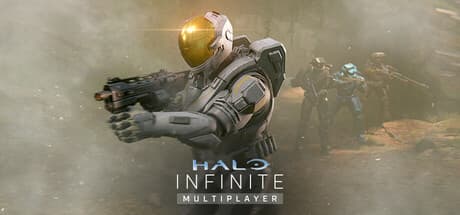
Halo Infinite — Expansive World & Free Multiplayer combines a Master Chief campaign with a separate multiplayer-focused experience. In the campaign, players explore Zeta Halo, attack Banished positions, rescue stranded allies, and advance the story.
It is not entirely linear: you can head directly to a mission or investigate nearby activities and collectibles first.
The basic loop alternates travel, reconnaissance, and combat. Firearms, grenades, melee attacks, equipment, and vehicles all have practical roles, while captured positions provide useful staging points for further exploration.
The open area is best understood as a space that lets Halo combat unfold across different terrain and approaches, rather than as a world built around extensive civilian activities.
Multiplayer can be installed and played independently of the campaign, with cross-platform play between PC and Xbox. Its modes range from compact arena matches to larger battles involving vehicles.
Halo Infinite launched on November 15, 2021, and lists Japanese among its supported languages.
What Makes the Combat Distinctive
Success involves more than placing the crosshair on an opponent. Players generally strip shields before dealing finishing damage, creating room for grenade placement, coordinated fire, retreats, and melee attacks.
Encounters often last longer than in military shooters with very short elimination times, so knowing when to disengage while shields recover matters.
Weapons serve different ranges and tactical roles, and replacing your current gun with equipment found on the map is part of the decision-making. Learning weapon spawn locations provides access to stronger options and helps predict where opponents may move.
Because every respawn does not guarantee the same loadout, map knowledge can create a meaningful advantage.
Equipment such as the Grappleshot works as both a movement and combat tool. It can help Master Chief reach high ground, pull an item closer, or rapidly close distance.
In the campaign it reduces friction while exploring; in multiplayer it enables attacks from unexpected angles and adds verticality to familiar firefights.
Campaign and Multiplayer Compared
The campaign suits players who want to explore Zeta Halo at their own pace and test different approaches. An enemy position may be attacked directly, observed from high ground, weakened with a long-range weapon, or approached in a vehicle.
Optional exploration also provides collectibles and progression opportunities that can help with later encounters.
Multiplayer places greater weight on weapon spawns, respawn routes, teamwork, and mode objectives. Winning individual duels is useful, but it will not secure a match if the team ignores a flag, ball, zone, or other objective.
Players who can switch between elimination-focused and objective-focused tactics will get more from the mode variety.
Armor and weapon appearance can be customized, but cosmetic choices should be separated from combat fundamentals. New players gain more immediate value from learning starting-weapon range, shield timing, grenade placement, and the location of useful pickups.
PC Requirements and Practical Targets
The minimum specification lists Windows 10 RS5 x64, an AMD Ryzen 5 1600 or Intel Core i5-4440, an AMD RX 570 or NVIDIA GTX 1050 Ti, and 8 GB RAM. It also requires DirectX 12 and 50 GB of available storage.
Treat this as an entry point; lower-end systems may require compromises in resolution, visual quality, or frame-rate expectations.
The recommended specification rises to Windows 10 19H2 x64, an AMD Ryzen 7 3700X or Intel Core i7-9700K, a Radeon RX 5700 XT or GeForce RTX 2070, and 16 GB RAM. The substantial GPU gap between the two tiers matters when aiming for higher resolution or graphics settings.
For competitive play, prioritizing clear visibility and stable performance over maximum visual detail is usually the more practical choice.
Both tiers list 50 GB of available space, but leaving additional working room for installation and updates is sensible. A nearly full drive can complicate update processing even when the listed game size fits.
Cross-platform multiplayer also depends on a stable network connection, not just adequate CPU and GPU performance.
Reception and Common Feedback
Positive feedback commonly focuses on weapon feel, the shield-based combat rhythm, and the mobility offered by the Grappleshot. The campaign's wider spaces give those mechanics more room without discarding the recognizable Halo combat structure.
Multiplayer also provides a direct starting point for friends who mainly want team matches rather than the story campaign.
Reception is not uniformly positive. Players have also raised concerns about parts of the live-service structure, progression and customization systems, and technical issues.
Because ongoing updates can change these areas, check the current in-game systems and recent player feedback before committing significant time; launch-period impressions may no longer describe every part of the experience accurately.
Who Should Play It
Halo Infinite is a strong fit for players who enjoy shield-based duels in which grenades, melee attacks, weapon control, and team fire are as important as aim. It also suits groups that want to alternate between compact arena modes, objective play, and vehicle-heavy large-team battles.
Campaign players who prefer optional detours without the density of a full simulation-oriented sandbox may appreciate its structure.
Series knowledge helps with the characters and larger setting, but newcomers can still learn the mechanical core through multiplayer. The key attraction is the combat sandbox: changing weapons and approaches in response to the map is more important than following a single fixed build.
Caveats and Who May Not Enjoy It
Players seeking highly lethal, realism-oriented firefights may find the shield system and longer engagements unfamiliar. Repeated solo pushes are vulnerable to concentrated team fire, so strong individual aim does not solve every situation.
The early multiplayer experience can also be demanding for anyone who dislikes learning item locations and mode-specific objectives.
The campaign's open structure mainly expands route choice, exploration, and combat approaches. It is not aimed at players expecting a life simulation, a large set of peaceful side activities, or heavily branching role-playing decisions.
The campaign and multiplayer do not share identical access conditions, so confirm that you are installing the component you actually intend to play.
Japanese is listed as a supported language, but checking the current store entry for the exact interface, subtitle, and voice coverage remains advisable. Players forming cross-platform parties should also complete account linking and party settings before a planned session.