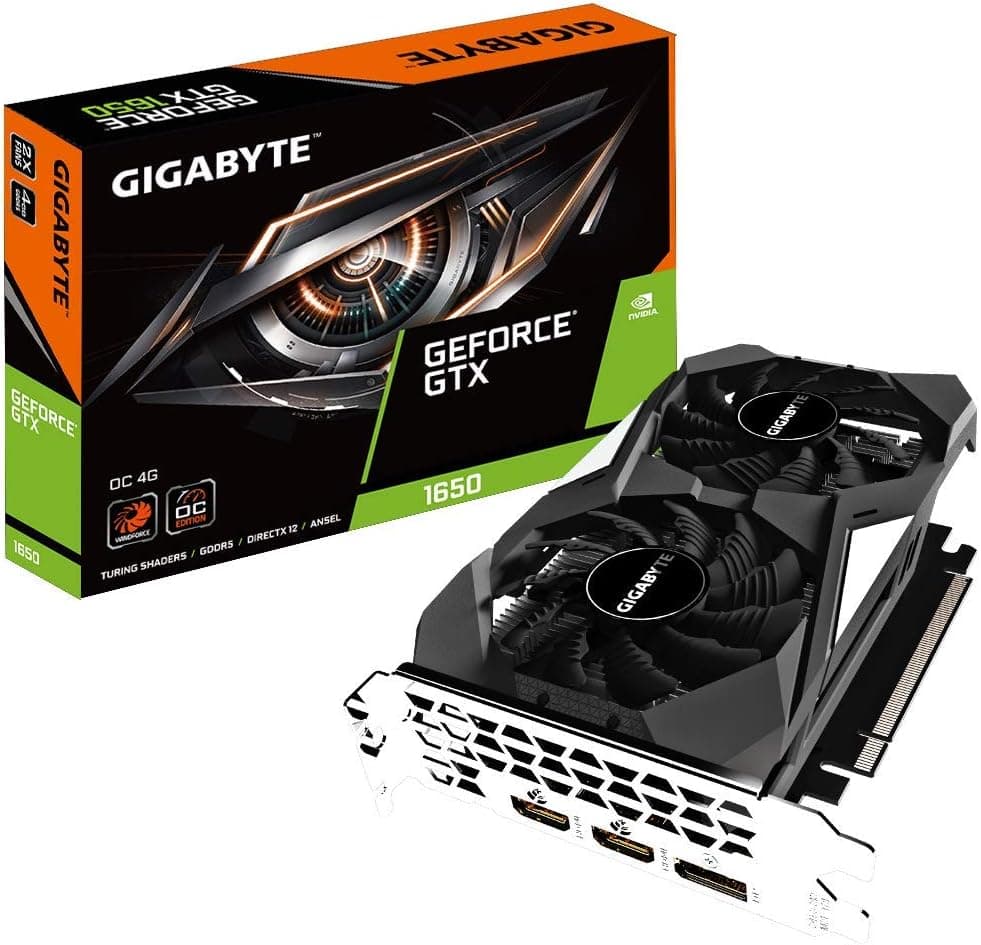
This article covers GIGABYTE NVIDIA GeForce GTX 1650 搭載 グラフィックボード 4GB デュアルファン搭載OCモデル GV-N1650OC-4GD.
Overview
The GIGABYTE GV-N1650OC-4GD is an entry-level graphics card built around the NVIDIA GeForce GTX 1650. It packs 4GB of GDDR5 memory and a dual-fan cooling solution with an out-of-the-box overclock boosting to 1,710MHz. Without any auxiliary power connector, the card draws only 75W from the PCIe slot, making it a drop-in upgrade for many existing office PCs or budget gaming builds. This card targets 1080p gaming at medium to low settings in popular titles like Fortnite, Valorant, and CS2. It also serves as a solid multimedia accelerator for video playback and dual-monitor productivity. At roughly 191mm in length, it fits comfortably in most mainstream cases, including many Mini-ITX enclosures.
Compatibility Guide
Interface: PCI Express 3.0 x16 ? works in any PCIe slot, including PCIe 4.0/5.0 slots (backward compatible). Power: No external power required. The card draws up to 75W solely from the motherboard slot. A 300W PSU is typically sufficient for a full system with this card and a mid-range CPU. Dimensions: 191mm (L) x 112mm (W) x 36mm (H). Verify case clearance, especially in smaller cases with drive cages. Outputs: 2x HDMI (likely HDMI 1.4) and 1x DisplayPort (1.4). The DisplayPort supports 4K at 60Hz; HDMI is limited to 4K 30Hz. * Memory: 4GB GDDR5 on a 128-bit bus. Sufficient for eSports titles and older games; may struggle with modern AAA games at higher texture settings.
Product Info
The GV-N1650OC-4GD is a factory-overclocked variant of the GTX 1650. It retains the standard 75W TDP while offering a modest clock bump over the reference design. The dual-fan cooler (Windforce 2X) provides adequate cooling for the OC state, though fan noise is audible under load. Market positioning is clear: entry-level segment for budget builders and office upgrades. Released several years ago, the card remains widely available through major retailers. Prices typically range from ¥25,000 to ¥35,000. GIGABYTE backs it with a standard 3-year warranty. No additional software extras beyond the basic driver and AORUS Engine utility.
Best Use Cases
Budget 1080p Gaming: Ideal for players who want to run eSports titles at 60+ fps on medium settings. The card handles Overwatch, Rainbow Six Siege, and Rocket League without breaking a sweat. Not suitable for ray-racing or high-fidelity modern single-player games. Home Office/Media PC Upgrade: A huge leap over integrated graphics. Smooth 4K video playback, dual-monitor productivity, and light photo editing. Overkill for simple web browsing, but excellent for users who also play casual games. * Small Form Factor (SFF) Builds: With a sub-200mm length and no extra power cable, it is one of the easiest GPUs to fit in compact cases like the Fractal Design Node 202 or SilverStone RVZ03. However, check thickness for bracket clearance in extremely slim cases. Who Should Skip: Gamers targeting 144fps+ in shooters should consider a GTX 1660 or RTX 3050. Also, anyone planning to use VR or work with 3D rendering will find the 4GB VRAM and 896 CUDA cores limiting.
Things to Consider
The GTX 1650 is now a legacy architecture (Turing without RT/Tensor cores). Performance is near the bottom of the current GPU stack. If your budget allows even a small stretch, the GTX 1660 Super or used RTX 2060 offer markedly better value. The dual-fan cooler is not required for a 75W card; many single-fan models are quieter and smaller. GIGABYTE’s cooler is effective but noise under load is mediocre ? around 35 dBA. If silence is paramount, look for a passive or semi-passive model. Output limitations: HDMI ports are likely HDMI 1.4, so 4K 60Hz output is only possible via DisplayPort. Users with older monitors that rely on HDMI might need an adapter. Overclocking headroom is limited; the factory OC already pushes near the power ceiling. Manual overclocking won’t yield significant gains. ## FAQ
Q: Does the GV-N1650OC-4GD support DirectX 12 Ultimate? A: No. It supports DirectX 12 (feature level 12_1), but lacks hardware support for ray tracing, mesh shaders, and variable rate shading. DirectX 12 Ultimate features require an RTX card. Q: Can this card run Fortnite at 144 fps? A: At 1080p with performance mode and low settings, you may reach around 100-120 fps, but stable 144 fps is unlikely. For competitive shooters at high refresh, consider a faster GPU. * Q: How does it compare to the AMD Radeon RX 6400? A: The GTX 1650 generally offers similar or slightly better performance in most games. The RX 6400 lacks hardware encoding (NVENC) support, so GTX 1650 is better for streaming or recording gameplay.
Product Disclosure (Amazon)
- Manufacturer: GIGABYTE
- ASIN: B07QSCY8QM
- Note: This article covers a manufacturer-made product based on Amazon listing details.
![MSI GeForce RTX 2080 Ti GAMING X TRIO グラフィックスカード [日本国内正規品]](/_next/image?url=https%3A%2F%2Fm.media-amazon.com%2Fimages%2FI%2F61tiTeCn2JL._AC_SL1000_.jpg&w=1920&q=75)