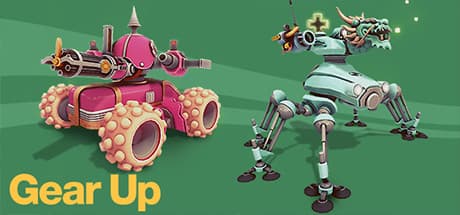
Gear Up: Build and Battle Robotic Mayhem is an arena shooter built around designing and piloting robotic tanks. Accuracy matters, but every match also tests choices made before deployment: the chassis, movement system, weapons, and the role intended for the machine.
Doctor Entertainment AB developed and published the game, which launched on January 28, 2015.
Game Overview
The central loop is straightforward: assemble a machine from chassis, movement, and weapon parts, take it into battle, then revise the build after seeing how it performs. Players must consider mobility, practical range, and how easily attacks can be delivered while moving.
Building is therefore not a cosmetic side activity; it is one of the main forms of strategy.
The system offers more than one million possible combinations. Movement options include caterpillar tracks, spider legs, and jetpacks, while weapons include tools such as mines.
A stable ground vehicle, an unusual walking machine, and an airborne build can approach the same arena in very different ways.
How Customization Shapes Combat
The meaningful question is not simply how many parts are available, but whether movement and weapons support the same plan. A highly mobile vehicle gains little if its weapon is difficult to aim while repositioning.
A less dramatic but controllable setup may give a new player more attention for reading opponents and learning the arena.
It helps to assign each early build one clear job. A machine might fight directly, exploit elevation, or use mines to restrict an opponent's route.
When a focused build fails, it is easier to decide whether the problem was execution, weapon range, or a movement system poorly suited to the situation.
This relationship between construction and immediate testing is Gear Up's strongest identity. Players who enjoy engineering a solution can treat every defeat as useful design feedback.
Those who only want mechanical shooting skill to determine the outcome may find the preparation less appealing.
A Practical Start for New Players
Change one variable at a time when learning the parts. Keep a comfortable movement system and compare weapons first, then hold the weapon constant while testing tracks, spider legs, and a jetpack.
This makes their effects on turning, positioning, and aim much easier to recognize.
Maximum damage should not be the only priority. Check whether the weapon can be aimed consistently and whether the vehicle can leave a dangerous position after attacking.
A reliable machine is a better learning platform than a spectacular design that is difficult to control.
Once that baseline works, unusual combinations become easier to judge. If a new part makes the build worse, there is a known reference point to return to.
This method also prevents the large combination count from becoming overwhelming.
System Requirements
Check the review panel on this page or the Steam listing for the latest user review trend. The minimum CPU is an Intel Core 2 Duo at 2.4 GHz or an Athlon X2 at 2.7 GHz, with 2 GB of RAM.
Graphics requirements call for a DirectX 10 or 11 compatible Nvidia or AMD ATI card, with the ATI Radeon 3870 and Nvidia GeForce 8800 GT given as minimum examples.
The installation requires 1 GB of drive space, and DirectX 11 is also listed. These requirements are modest by current standards, but they are minimum specifications rather than a promise of a particular resolution or frame rate.
Laptop users should verify DirectX support and driver availability instead of relying only on the graphics chip's name.
Connection quality also affects an online arena game. Brief wireless interruptions can feel like poor performance even when the computer renders the game correctly.
A short test can help separate frame-rate problems from network latency before settings are changed unnecessarily.
Reception and Player Expectations
The appeal of Gear Up centers on the freedom to build a robot and immediately test that design in combat. Players who want to experiment with spider legs, jetpacks, mines, and unconventional tactics have more to explore than those seeking a conventional soldier-based shooter.
A strange machine finally working as intended can be more satisfying than simply selecting a predefined character.
That freedom also creates an initial learning burden. Players must be willing to lose, identify a weakness, and modify the machine instead of expecting a perfect build immediately.
The number of choices may feel like friction to anyone who dislikes experimentation.
As with an older title focused on online play, opponent availability can vary by region and time of day. The supplied data does not establish current matchmaking activity, so checking it in the game is safer than assuming that a match will always be available.
This matters more here because testing a build against other players is a major part of the intended loop.
Who Should Play It
Gear Up suits players who want vehicle construction to affect tactics, not merely appearance. It rewards people who enjoy forming a hypothesis, testing it in a short battle, and returning to the workshop with a specific adjustment in mind.
It is also a candidate for anyone seeking a robotic arena shooter rather than another infantry-focused game.
The game is especially fitting for players comfortable creating their own objectives. They can pursue direct combat, mobile harassment, or route control with mines instead of following one prescribed setup.
Single-player modes, Steam Achievements, and Steam Trading Cards are also included.
Limitations and Who Should Skip It
Players primarily seeking a long, story-driven campaign may not find the construction-and-battle loop sufficient. It is also a poor fit for anyone who wants balanced predefined characters and no equipment experimentation.
Building is central, so treating it as an obstacle removes much of what distinguishes the game.
Listed language support includes English, Russian, and Simplified Chinese. Check the current store listing before installing if another interface language is essential.
Players mainly interested in online competition should also confirm matchmaking conditions during the hours and in the region where they expect to play.
Finally, low hardware requirements do not resolve every compatibility issue. Modern systems may still require attention to drivers, display settings, and network stability.
Testing those factors early is the most practical way to decide whether the game is worth keeping in regular rotation.


