Game Overview
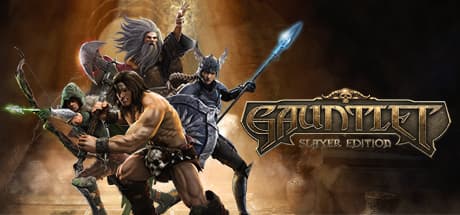
“Gauntlet™ Slayer Edition – Classic Co-op Dungeon Brawling Returns!” is a top-down action game built around clearing monster-filled dungeons with up to four players.
You select one of four distinct heroes, cut through waves of enemies, collect treasure, and push into the next dangerous room.
The core loop is easy to understand: defeat enemies, avoid incoming attacks, gather rewards, and keep moving. The focus is immediate positioning and combat rather than dialogue choices or open-world exploration.
It works for short sessions, but coordinating targets and staying close enough to support the group adds more depth than simple button mashing.
Handcrafted areas are combined with procedurally generated content, so routes and encounters are not entirely identical on every attempt. This is closer to a replayable arcade dungeon brawler than a story-heavy RPG designed to be finished once.
Why Co-op Matters
Four-player action is the heart of the experience. Both local and online co-op are available, making it suitable for a group sharing a room or friends playing from separate locations.
A coordinated party can focus dangerous targets, cover exposed teammates, and avoid being divided by enemy waves.
Because the four heroes play differently, their roles become clearer as the party grows. One player can hold the front, another can attack from safer ground, and others can control crowded sections of the battlefield.
A regular group can discuss failed encounters and adjust its positioning or priorities on the next run.
Coordination does not need to be perfect to be entertaining. Players may disagree over treasure, safety, or which direction to take, and those small conflicts are part of the party-game appeal.
Gauntlet works especially well for groups that enjoy friendly competition alongside cooperation.
Solo Versus Group Play
Gauntlet™ Slayer Edition can also be played alone. Without teammates to cover mistakes, solo runs place more pressure on positioning, retreat timing, and avoiding encirclement.
They are useful for learning a hero before joining a group.
However, the game's defining spectacle comes from several players handling a crowded battlefield together. Solo-only players will miss the teamwork, chaotic rescues, and unexpected mistakes that make co-op memorable.
Judge it primarily as a combat-focused replay game, not as a substitute for a long narrative RPG.
PC Requirements
The minimum specification lists Windows Vista or Windows 7, a 2.4 GHz dual-core CPU, 4 GB RAM, a 512 MB NVIDIA GeForce 9800 or ATI Radeon HD 2600 XT, 2 GB of available storage, and DirectX 10.
The recommended specification keeps the same CPU, memory, and storage figures but raises the GPU target to a 1 GB NVIDIA 460 or AMD Radeon 5870.
Those graphics cards are from much older generations, and the 2 GB storage requirement is modest compared with modern large releases. The listed operating systems are also old, however, so these requirements should not be treated as a guarantee for every current Windows configuration.
Check current store information, GPU drivers, and input-device support before buying.
Visibility can matter as much as graphical quality during four-player battles. Enemies, effects, and heroes often occupy the same area, so reducing demanding settings may be worthwhile if unstable performance makes attacks difficult to read.
Reception and Player Expectations
The game has maintained a broadly favorable reception over time. Its accessible combat, support for both local and online co-op, and four contrasting heroes are likely reasons it remains appealing.
It also preserves the classic Gauntlet rhythm of controlling crowds while steadily advancing through a dungeon.
Players expecting deep equipment spreadsheets, elaborate character builds, or a long branching story may find the structure comparatively lean. Enjoyment depends heavily on whether repeated combat runs and chaotic group play are satisfying to you.
Consult the current rating panel and Steam listing for the latest reception information.
Who Should Play It
Gauntlet is a strong fit for friends or families seeking a local action game, as well as online groups that want to begin playing without a lengthy explanation. Fans of top-down combat, large enemy waves, distinct heroes, and repeatable dungeon runs should understand its appeal quickly.
It also suits players who prefer mechanical execution over extensive build planning. Differences in player experience can be managed through teamwork, with confident players handling dangerous threats while newcomers learn the flow.
Caveats and Who Should Skip It
This should not be your first choice if you want a solitary, story-driven RPG, extensive exploration, or dialogue choices that reshape the campaign. Procedural elements add variation, but the central activity remains fighting through dungeons.
Anyone uninterested in refining the same basic combat loop may find it repetitive.
If co-op is your main reason for playing, decide in advance who will join and whether the group will use local or online play. Local groups should confirm that every required input device is recognized and that the shared display is large enough to follow the action.Check the review panel on this page or the Steam listing for the latest user review trend.