Game Overview
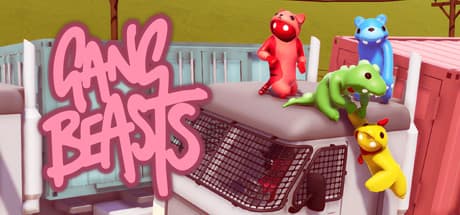
Gang Beasts: Hilarious Multiplayer Mayhem is a physics-driven party brawler starring soft, gelatinous fighters. Players grab, lift, and shove one another toward stage hazards or off the arena while trying to remain standing.
Released on December 12, 2017, it supports both local and online multiplayer in the hazardous setting of Beef City.
A match is not simply about landing punches. You must secure a grip, move your opponent, and release at the right place without losing your own balance.
Because every fighter bends and stumbles, an attempted throw can become a shared fall, making the mistakes as entertaining as the victories.
Features and Systems
The defining system is physics-based movement. Holding an opponent does not guarantee control, since body position, nearby players, and the shape of the arena can change the outcome.
This is less about memorizing exact fighting-game combos and more about judging grips, positioning, and distance from danger.
The arenas are active parts of each fight. On narrow or exposed platforms, focusing entirely on one opponent can cause your own elimination.
Fighting near the center, waiting beside a hazard, or stepping away from a crowd are all useful choices, giving the simple controls a layer of situational strategy.
Costumes and accessories let players personalize their fighters. Customization is amusing by itself, but distinct outfits also make it easier to identify your character during a crowded brawl.
Groups can turn this into part of the party by choosing themes or deliberately ridiculous combinations.
Practical Tips for New Players
New players should first learn to grab, walk, and release while facing a safe direction. Trying to lift someone at the very edge can let their resistance pull both fighters down.
Practicing these basic actions near the middle of an arena is more useful than repeatedly attacking without a plan.
It also helps to avoid chasing one target through a large crowd. Letting other players struggle while you move away from a dangerous edge can be a valid strategy.
Survival often depends as much on avoiding chaotic collisions as it does on direct fighting skill.
PC Requirements
The minimum requirements list Windows 7, a 2nd generation Core i3 or AMD A6 or higher, and 4 GB RAM. Listed graphics options include the Nvidia 8800 GT, AMD 5670, and Intel HD 3000.
The game also requires DirectX 10 or higher and 2 GB of available storage.
The recommended configuration moves to Windows 10, a Core i5, 8 GB RAM, and an SM4 GPU with 1 GB VRAM. Storage remains 2 GB, with DirectX 10 or higher.
These are modest requirements, though systems close to the minimum may still benefit from reduced visual settings when several fighters and moving hazards fill the screen.
Consistent input response matters more here than elaborate visuals. If performance fluctuates, resolution and demanding effects are sensible settings to reduce first.
For online play, remember that unusual movement can also come from network conditions, so check both performance and connectivity before blaming the controls.
Reception and Common Impressions
Gang Beasts has maintained a positive reception over time because its unpredictable reversals create memorable group moments. Differences in traditional fighting-game experience do not always decide the winner, and spectators can quickly understand why a precarious situation is funny.
The same instability can divide players. Anyone expecting precise moves on command may find the wobbling bodies and accidental falls frustrating rather than amusing.
Enjoyment depends heavily on whether the group treats physics mishaps as part of the joke instead of as competitive failures.
Who Should Play It
It suits friends or families seeking a game that is easy to start and entertaining in short sessions. Groups that can laugh at their own mistakes will get more from repeated matches, since familiar arenas can still produce different outcomes.
Online multiplayer is available for players who want remote opponents, but the game is especially effective when everyone can react and talk together. It is also a good fit for people who want to enter a match without first managing equipment, character builds, or a lengthy progression system.
Caveats and Who Should Skip It
Players who prioritize precise controls, technical move lists, or tightly consistent competitive outcomes may not enjoy it. Fighters can fall unexpectedly, and a leading player can lose to an environmental accident.
If that sounds irritating, watch unedited gameplay first to understand how deliberately awkward the movement feels.
It is also a weak fit for anyone primarily seeking a solo story or long-term character growth. The value comes from the brawl and the reactions between participants.
Before planning local sessions, confirm that every required controller or input device is recognized correctly by the PC.