Game Overview
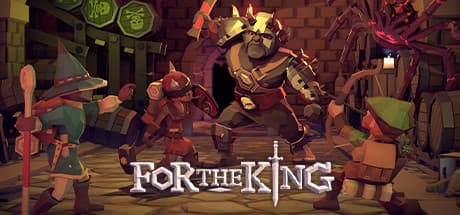
For The King: A Roguelike Strategy RPG Adventure takes place in Fahrul after the king's murder throws the realm into disorder. Released on April 19, 2018, it was developed by IronOak Games and published by Curve Games.
It supports both solo play and co-op, letting a group discuss how to approach each stage of the journey.
A typical run alternates between overworld movement, encounters, turn-based battles, equipment choices, and quest objectives. The wilderness, seas, and underground areas all create different risks along the route.
Rather than following a purely linear RPG campaign, players manage an expedition whose plans must change when an encounter or die roll goes wrong.
Dice-Based Combat and Resource Management
Combat uses turn-based commands, but actions depend on probability-based checks. This means that choosing the strongest-looking attack is not always the safest answer.
Players must weigh reliability against potential impact, giving the JRPG-style command system some of the uncertainty associated with tabletop adventures.
The outcome is not left entirely to luck. A limited Focus resource can improve important checks, creating a choice between spending it now or saving it for a dangerous enemy or decisive objective.
Health, equipment, consumables, and Focus must last beyond a single fight, so a clean victory can still be a poor result if it consumes the supplies needed for the next destination.
Overworld Decisions and Roguelike Structure
Movement on the world map involves more than selecting the next quest marker. The order in which heroes move and the distance between them can affect how readily the party supports one another.
Splitting up may improve exploration, but excessive separation can make an unexpected battle much harder to handle.
The roguelike structure rewards knowledge gained through failed attempts. Learning enemy matchups, when to recover, which equipment matters most, and when to avoid a risky encounter gradually makes runs more manageable.
The goal is not to reproduce one perfect route, but to adapt a sound plan to the conditions generated for the current adventure.
Why Co-op Changes the Experience
In co-op, discussion is part of the game rather than something limited to combat. Players decide who receives useful equipment, whether healing should be spent immediately, and whether a dangerous detour is worth its possible reward.
These decisions rarely have one universal answer, and coordinating the party is usually more effective than having every player optimize only their own hero.
Groups that debate every choice may find that the pace slows considerably. The game is therefore best suited to friends who enjoy planning together and can treat an unlucky failure as part of the shared story.
Solo play offers a different strength: one player controls the broader plan and can consider each tactical decision without negotiating it.
PC Requirements
The minimum specification lists a 64-bit version of Windows 7, 8, 8.1, or 10, an Intel Core2 Duo E4300 or AMD Athlon Dual Core 4450e equivalent, and 4 GB of RAM.
Listed graphics options include the GeForce 8800 GTX with 768 MB, Intel HD 4600, and Radeon HD 3850 with 512 MB. The game also calls for 3 GB of available storage and DirectX 9.0c.
The recommended specification moves to an Intel Core i5-4570T or AMD FX-6100 equivalent while retaining 4 GB of RAM. The listed GPUs are the GeForce GTX 750 Ti and Radeon HD 7850, both shown with 2 GB of video memory.
These are modest requirements compared with modern high-end games, although meeting the minimum specification does not guarantee identical performance in every area or software configuration.
The operating systems named in the requirements are notably old. Players using a current version of Windows should check the latest compatibility information before purchase, particularly if the PC uses unusual drivers or hardware.
Laptop users should compare the actual GPU model rather than assuming that any integrated graphics processor will match the listed Intel HD 4600 baseline.
Strengths and Common Friction Points
The main strength is how combat, travel, and resource conservation feed into one another. Success depends not only on selecting commands in battle, but also on preparing before entering dangerous territory and recognizing when retreat is the better option.
Changing run conditions prevent the experience from becoming a fixed sequence of solved encounters.
The same uncertainty can also be frustrating. A sensible plan may still be damaged by an unfavorable check, and players who expect preparation to remove every chance of failure may find the system harsh.
It is more rewarding when approached as a game about creating enough spare resources and alternative options to survive bad outcomes.
Early-Game Priorities
At the beginning of a run, expanding carefully while preserving access to recovery and equipment is usually more dependable than rushing every hero toward a distant objective. Spending all Focus or consumables for minor advantages can leave the party without answers during a critical encounter.
When an enemy appears too dangerous, changing routes or improving the party first can be more valuable than forcing a fight.
In co-op, equipment should be assigned according to party roles rather than simply kept by whoever finds it. The group should also watch the distance between heroes so that allies can participate when support matters.
Distinguishing urgent objectives from optional detours helps prevent a useful expedition from collapsing through unnecessary attrition.
Who Should Play It
For The King suits players who enjoy turn-based combat, tabletop-style uncertainty, and roguelike experimentation. It is particularly appealing to those who like reducing risk through good decisions without expecting to eliminate chance completely.
Co-op groups that enjoy discussing plans and laughing about unexpected disasters are likely to get more from it than groups focused only on winning quickly.
Support for English, Japanese, and Simplified Chinese also makes the game accessible across several language preferences. It favors planning, party roles, equipment choices, movement order, and resource allocation over fast reflexes or action-heavy execution.
Caveats and Who May Not Enjoy It
Players who strongly dislike probability-based failure may struggle with the central design. The adventure can unravel despite preparation, and starting another attempt is part of its roguelike identity.
Progress also includes time spent traveling, supplying the party, and considering routes rather than a constant stream of major story scenes.
Co-op works best when participants are willing to communicate and share resources. Players who want to act entirely independently, or who only want short sessions of immediate spectacle, may find the pace restrictive.
Because the official requirement list names older Windows versions, confirm current compatibility and recent user reports for the exact PC configuration you intend to use.