Game Overview
Check the review panel on this page or the Steam listing for the latest user review trend. Its central loop is to prepare fields, sow crops, harvest them, sell the produce, and reinvest the proceeds in equipment.
It combines hands-on driving with decisions about which jobs and machines should receive priority.
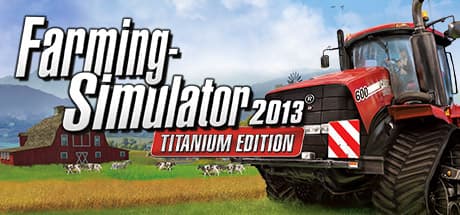
The Titanium Edition adds an American farming environment alongside the existing setting, giving players another landscape in which to build their operation. GIANTS Software developed and published the game, which was released on October 9, 2013.
It supports single-player, online multiplayer, and cooperative play.
The Farming Loop
Most progress comes from repeating a chain of cultivation, sowing, maintenance, harvesting, transport, and sales. Different stages require suitable machines or attachments, so purchasing decisions directly affect how efficiently the farm can operate.
Buying the largest equipment immediately is not necessarily the best approach; matching machinery to the current field size can reduce unnecessary travel and idle time.
Cows, chickens, and sheep provide activities beyond crop farming. A farm devoted to fields has a different daily rhythm from one that combines crops with several types of livestock.
Each new activity adds more tasks to monitor, so beginners may find it easier to learn one production chain before expanding into additional crops or animals.
Making Use of More Than 100 Machines
The fleet contains more than 100 agricultural vehicles and machines, including equipment associated with Case IH, Deutz-Fahr, Lamborghini, and Grimme. This variety matters because tractors, harvesters, transport vehicles, and attachments serve different stages of the workflow.
Learning how those roles connect turns routine fieldwork into a practical optimization challenge.
There is no need to master the full catalogue at once. Start by identifying which step each owned machine performs, then treat field operations and transport to storage or selling points as separate jobs.
Players who enjoy real agricultural brands and machinery will find a clear purpose behind each equipment upgrade rather than viewing the fleet as a simple collection.
Solo and Cooperative Play
In single-player, every crop choice, equipment purchase, and driving task remains under one player's control. This suits anyone who wants to work without pressure or design the entire operation personally.
As the cultivated area grows, however, travel and fieldwork also demand more time, so uncontrolled expansion can turn a relaxed routine into a heavy workload.
Cooperative play allows participants to divide jobs. One person can operate a harvester while another handles transport, improving both efficiency and the feeling of running a shared farm.
Players may disagree about purchases or priorities, so agreeing on roles and a short-term goal before starting can make a session run more smoothly.
System Requirements in Context
Check the review panel on this page or the Steam listing for the latest user review trend. Hardware requirements include a 2.0GHz AMD or Intel CPU, 1,024MB RAM, and 2GB of storage.
The GPU baseline is an ATI Radeon X1600, NVIDIA GeForce 7600, or Intel HD 2000 with at least 256MB of video memory.
Those specifications are light compared with a typical modern PC, and the inclusion of Intel HD 2000 indicates that a dedicated GPU is not part of the stated minimum. Minimum requirements only describe the lower boundary for basic play, however.
Large farms, many active vehicles, and multiplayer may still justify lower graphics settings or additional performance headroom.
The listed operating systems are also from an older era. On a current version of Windows, compatibility with the operating system, drivers, controllers, and multiplayer services may matter more than raw processing power.
Check the current Steam information for any platform-specific issues before installing.
Reception and Player Expectations
The game has maintained a strong reputation over time, particularly among players who enjoy repetitive agricultural routines, recognizable machinery, and gradual farm expansion. It does not rely on a constant stream of dramatic events.
Instead, satisfaction comes from setting personal goals and noticing how better equipment and planning improve the workflow.
Its age can also be apparent in the interface, presentation, and handling when compared with later simulation games. Players seeking a strong story, frequent scripted events, or rapid rewards may find the pace too restrained.
The most useful question is whether operating machinery and repeating farm tasks sounds satisfying in its own right.
Who Should Play It
Farming Simulator 2013 Titanium Edition suits players who enjoy learning the purpose of each machine and refining a multi-step process. It is also a good fit for those who prefer long, calm sessions and want control over the scale and direction of their farm.
Cooperative players can turn routine work into a shared project by assigning clear roles.
It is especially relevant to anyone who wants direct vehicle operation rather than management through menus alone. The supported language list includes English, German, French, Italian, Spanish, Russian, and Japanese, making the game accessible across several regions.
Caveats and Who May Not Enjoy It
Travel and repeated field operations are fundamental parts of the experience. Players who need constant novelty may find the pace slow, while the large machinery selection creates an initial learning period involving vehicles and attachments.
It is not ideal for anyone who expects every objective and correct action to be explained immediately.
Check the review panel on this page or the Steam listing for the latest user review trend. Modern computers should generally exceed the stated performance requirements, but compatibility can still vary.
Anyone buying primarily for multiplayer should confirm the current online situation and the other players' environments before committing to a shared farm.