Game Overview
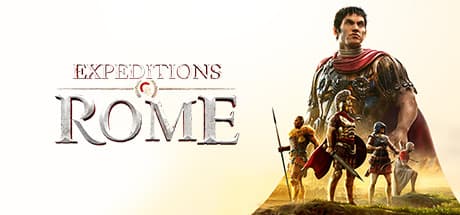
Expeditions: Rome – Forge Your Legacy as a Roman Legatus is a single-player RPG combining dialogue, political choices, squad-based turn-based combat, and legion management. After the protagonist's father is murdered, the young Roman leaves the city to join a military campaign and eventually commands troops as a legatus.
Developed by Logic Artists and published by THQ Nordic, the game was released on January 20, 2022.
The core loop moves between exploring regional maps, negotiating with characters, preparing companions and equipment, and completing objectives on tactical battlefields. The campaign travels through Asia Minor, North Africa, and Gaul, expanding from a personal crisis into decisions about Roman politics and conquered territories.
It uses history as the setting for a branching fictional narrative rather than presenting a fixed reenactment of events.
Combat and Character Building
Battles place a small squad on a grid where positioning, attack range, turn order, and cover matter. Strong equipment alone is not enough: a durable character may hold a route while another moves to a flank and a support specialist protects an injured ally.
Because objectives are not always limited to eliminating every enemy, reading the mission conditions before committing the squad is important.
Skills and equipment define what each companion can contribute. The player must decide who should spend limited actions, which threat needs to be disabled first, and whether a character should attack or withdraw to a safer position.
Newcomers to turn-based tactics can reduce early mistakes by checking every ability's range and avoiding an unsupported advance by the entire group.
Larger legion operations sit alongside the squad battles. These sections ask the player to think like a commander choosing an approach and managing a campaign rather than personally defeating every opposing soldier.
The shift between battlefield tactics, military leadership, and political responsibility gives the game a broader scope than a sequence of isolated encounters.
Choices and Story
Conversations frequently place personal loyalty, political standing, and military advantage in conflict. A decision that solves an immediate problem may affect later relationships, so searching for a universally correct answer is less rewarding than deciding what kind of legatus the protagonist should become.
Following a consistent set of priorities also makes the consequences easier to understand as part of a personal story.
Companions are not merely combat units; they have distinct backgrounds, loyalties, and opinions. Skipping dialogue can hide motives and disagreements that matter when later decisions appear.
Players interested in the role-playing side should pay attention not only to whether a mission succeeds, but also to whose argument they supported along the way.
System Requirements
The minimum specification lists 64-bit Windows 7 or Windows 10, an AMD FX-8350 X8 or Intel Core i5-4690K, an AMD R9 380 4GB or GTX 960 4GB, and 8GB of RAM. It also requires DirectX 11 and 30GB of available storage.
This should be treated as the baseline for running the game, with room to lower resolution or graphics settings if necessary.
The recommended specification moves to 64-bit Windows 10, a Ryzen 5 3600X or Intel Core i5-9500F, an AMD RX Vega 56 8GB or GTX 1070 8GB, and 16GB of RAM. The increase from 4GB to 8GB of graphics memory and from 8GB to 16GB of system memory makes the recommended tier a more useful target for players prioritizing steadier performance and higher settings.
Both tiers list 30GB of storage, but leaving additional free space for updates and saves is sensible.
Laptop buyers should check the actual GPU and memory instead of relying on the processor name alone. Mobile graphics performance can vary with power limits and cooling even when product names appear similar.
The supplied requirements only specify Windows, so anyone planning to use another operating system should verify current compatibility before buying.
Reception and Common Impressions
The game has maintained a broadly positive reputation for combining historical drama with tactical combat across a substantial campaign. Its consequential decisions, distinct companion roles, and mixture of Roman politics and military leadership are likely to appeal most strongly to CRPG players.
Current reception should still be checked through the live information on the article page or the Steam store.
The same structure can feel slow to players who want uninterrupted battles. There is considerable dialogue, equipment preparation, and campaign administration between encounters, while later stages introduce more decisions to manage.
Players who dislike reading explanations or learning interconnected systems may find the opening demanding.
Who Should Play It
Expeditions: Rome is a strong fit for players who enjoy historical CRPGs, small-squad turn-based tactics, and dialogue choices with consequences. It particularly suits those who want to make decisions as both a battlefield officer and a political figure.
Fans of companion-driven games such as Baldur's Gate 3 may find it an interesting alternative grounded in a Roman setting rather than high fantasy.
Caveats and Who May Not Enjoy It
Players seeking real-time action or direct control over enormous armies should note that the central combat system is squad-based and turn-driven. The campaign also asks for sustained attention to conversations and management, making it less suitable for someone who only wants brief, self-contained action sessions.
Checking objectives and equipment before each fight, then using manual saves before major decisions, can make the learning process smoother.
Japanese is listed among the supported languages, alongside English, French, German, Simplified Chinese, Polish, Russian, and Spanish from Spain. However, the story contains many names and political or military terms, so it rewards careful reading.
The previous article's multiplayer claim does not match the game's core format; anyone specifically seeking cooperative or competitive play should verify the current store features and approach this as a single-player RPG.