Game Overview
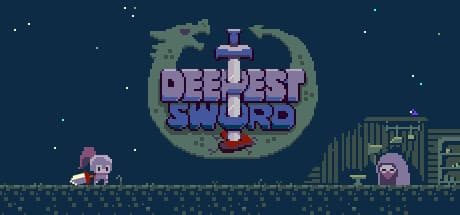
Deepest Sword: Wield Your Unwieldy Blade in a Pixelated Puzzle Platformer is a 2D puzzle platformer developed and published by Cosmic Adventure Squad. Released on June 9, 2021, it sends the player into the Cavern of Longing in pursuit of a dragon.
The defining restriction is that the character cannot jump. Progress instead comes from rotating a long sword, planting it against floors or walls, and using it as a brace or lever to cross ledges.
The blade is less a conventional weapon than a deliberately awkward piece of traversal equipment.
The project began as a 72-hour Ludum Dare 48 entry built around the theme “deeper and deeper.” Its game-jam origin is reflected in a compact design focused on one strong mechanic rather than a large world or a long list of systems.
The expanded Steam version adds achievements, key rebinding, and controls intended for speedrunning.
How the Sword Puzzles Work
Play revolves around coordinating character movement with the angle of the sword. You may need to catch the tip on a ledge, lift the character around an obstacle, or feed the blade through a narrow opening before moving the body.
Finding the idea behind a puzzle is only half the task; executing the required position and angle is part of the solution.
The sword is both a tool and an obstruction. In tight spaces, its length makes it easy to collide with a wall or ceiling and lose a useful position.
It often helps to decide where the blade tip should go first, then move the character around that anchor rather than pushing directly toward the exit.
As the run develops, handling the blade becomes more demanding, so familiar terrain shapes can require different angles and sequences. This keeps the limited control scheme useful as a puzzle instead of reducing it to a single trick.
It also gives completed sections a second life when players return to perform them more cleanly or quickly.
Tips for the Opening Sections
When a route appears impossible, watch the sword’s contact points instead of looking only at the character. If the tip can reach a higher surface, test whether it can support or redirect the character.
When a position collapses, returning to stable ground is sometimes faster than trying to rescue a badly wedged blade.
Key rebinding is worth using if the default layout makes simultaneous movement and sword control uncomfortable. An obstacle that first seems dependent on luck usually becomes repeatable once you observe the tip, hilt, and character as separate parts of the same movement.
Players who treat each failure as information about a collision or angle will get more from the design.
System Requirements
The listed minimum specification is Windows 7 or newer, an Intel Core i3 M380, Intel HD 4000 graphics, 2 GB of RAM, and 100 MB of available storage. These are modest requirements, and the absence of a dedicated-GPU requirement makes older laptops and integrated-graphics systems plausible candidates.
The small storage footprint also makes the game easy to keep installed.
Only a minimum specification is provided, so it should not be treated as a guarantee for every configuration. Integrated-graphics users should still check operating-system and driver compatibility.
Because the challenges depend on precise control, keyboard responsiveness and reliable simultaneous key detection can matter as much as raw rendering performance.
Reception and Common Impressions
Deepest Sword has maintained a positive reception over time, particularly for turning one unusual control idea into a focused challenge. Replacing the jump with a sword is easy to understand visually, while failed attempts often produce amusing contortions.
That humor can make repeated attempts feel less punishing than they would in a more serious precision platformer.
The same awkwardness can also be frustrating. A sword that refuses to fit through a gap may require several retries even after the intended solution is clear.
Players expecting a long narrative, extensive exploration, or a large collection of puzzle systems should instead approach it as a compact exercise in mastering a single rule.
Multiplayer and Replay Value
Multiplayer support is included, although the central appeal remains learning how to use the blade to navigate obstacles. It is safer to expect shared fun around the unusual movement and its mishaps than an elaborate cooperative campaign with distinct player roles.
Check the current Steam feature listing before playing if a particular multiplayer format or player count is essential to you.
After reaching the end, Steam achievements and speedrun-oriented controls provide reasons to return. Previously difficult rooms can become routing problems in which unnecessary movements are removed.
The compact structure particularly suits players who enjoy repeating short runs and improving their own execution.
Who Should Play It
Deepest Sword suits players who enjoy physics-flavored puzzles, precision platforming, and learning through repeated failure. It is also a good match for anyone interested in small pixel-art games that take one game-jam concept and explore its consequences thoroughly.
The best fit is a player who enjoys not only finding a solution but also performing it more smoothly on the next attempt. Sessions are easy to keep short, yet mastering the controls still rewards patience and close observation.
Caveats and Who May Not Enjoy It
The cumbersome movement is intentional and forms the puzzle rather than merely getting in its way. Players who want a nimble character, generous automatic movement, or immediate one-to-one action may find repeated collisions irritating.
If retrying the same passage and diagnosing why the blade caught on the scenery sounds exhausting, the central mechanic is unlikely to change that impression.
The supplied data confirms the minimum PC requirements but does not establish details such as Japanese-language availability. Players who require a particular language, controller configuration, or multiplayer mode should verify the current feature list on the Steam product page before installing.