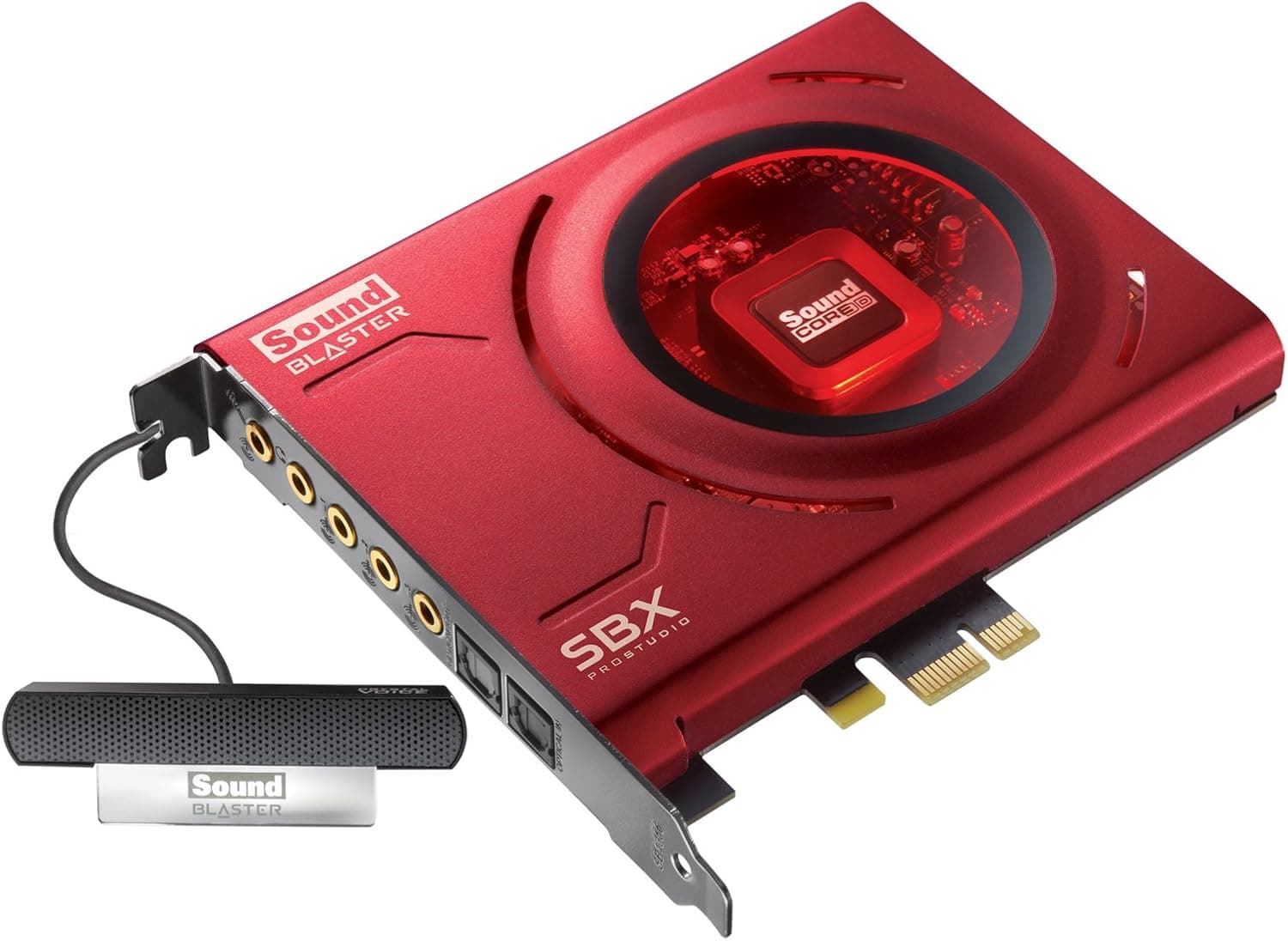
Creative Sound Blaster recon3d THX PCIEサウンドカードsb1350 is a PCI Express x1 sound card that still circulates as new-old-stock and used inventory, aimed at people moving up from onboard audio. This article covers compatibility, how it actually sounds in practice, and the pitfalls buyers discover after installation.
Overview
The card is built around a quad-core Sound Core3D audio processor on a PCI Express x1 interface. It combines THX TruStudio Pro processing with a dedicated headphone amplifier rated for loads up to 600 ohms, positioning it as a step up from motherboard audio.
On Amazon.co.jp it holds 4.2 out of 5 stars across 146 reviews — roughly an 84% approval rate, which is steady for a product this far past launch.
The short version: it makes sense if you fit one of three profiles — you want everything contained inside a desktop chassis, you drive high-impedance headphones, or you need an optical output to feed an AV receiver. If you also use a laptop, or you care about long-term OS support, the caveats below make it hard to recommend.
Compatibility Guide
Physical requirements are simple: one free PCI Express x1 slot. No auxiliary power connector is needed and no recommended PSU wattage is specified — the compatibility notes state only "requires a PCI Express x1 slot, no external power needed." Slot power is sufficient, so you will not need to reassess your power supply on a wattage basis.
What actually goes wrong is mechanical, not electrical. Check these three things before you buy.
| Check | Where to look | Why it bites people |
|---|---|---|
| x1 slot position | Directly above/below the GPU | A 2–3 slot GPU cooler can physically block the slot |
| Slot clearance | Rear of the x1 connector | Short cards usually clear, but M.2 heatsinks can interfere |
| Rear bracket space | Free expansion slot openings | You need access to the bracket for optical and analog jacks |
The OS situation needs care. The listed supported OS is Windows 7; Windows 10 and 11 are a "may work with drivers" proposition.
Sound Core3D cards generally play back audio under the inbox Windows drivers, but THX TruStudio Pro and the effects suite require Creative's own software, which is not guaranteed to run fully on current versions of Windows. On a product more than a decade old, do not buy assuming every feature will work on a modern OS.
For outputs, you get stereo plus Dolby Digital 5.1 and a TOSLINK optical digital output.
Whether your receiver accepts optical depends on the model — many recent AV receivers are HDMI-centric and offer only one optical input, or none at all. Confirm the input side first.
Versus Onboard Audio and USB DACs
Modern motherboard audio — Realtek ALC1220-class implementations with dedicated amps and audio-grade capacitors — has closed much of the gap, so the old "onboard sounds bad" assumption no longer holds by default. What still justifies this card is that DSP work happens on the card rather than the CPU, and that the headphone amp targets loads up to 600 ohms.
If your headphones sit at 250 ohms or above and your onboard jack runs out of volume, the difference is immediately audible.
Against a USB DAC, though, the card gives ground. A USB unit survives your next PC build and works with a laptop, and an internal card sits inside a chassis full of electrical noise.
The internal option only makes sense when you have one desktop, a free slot, and no interest in adding another box to your desk.
Product Info
As captured on 2 September 2026, the Amazon listing showed ¥19,158 and the eBay marketplace listing showed $159.99.
Both are point-in-time figures; discontinued hardware swings hard on inventory levels, so check the product page for the current price. Note also that the domestic and international entries share the same ASIN and the same yen figure, so treat the overseas line as indicative only.
Key specifications: Quad-core Sound Core3D audio processor, PCI Express x1 interface, Dolby Digital 5.1 surround, headphone amplifier rated up to 600 ohms, and Windows 7 as the supported OS (Windows 10/11 may work with drivers).
It launched around 2011–2012 as an entry-to-mid-range member of the Sound Blaster line. Warranty terms vary by seller, so read the listing before ordering.
On reception, the 146-review, 4.2-star figure is worth weighing.
The sample is modest, but it is not skewed toward low scores — buyers whose use case matched the hardware were broadly satisfied.
Product Disclosure (Amazon)
- Manufacturer: CREATIVE
- Seller: GOLDENFIELD
- Fulfilled by: GOLDENFIELD
- ASIN: B00654PUPA
- Note: This article covers a manufacturer-made product based on Amazon listing details.
Best Use Cases
Owners of high-impedance headphones — the built-in amp targets loads up to 600 ohms, so 250- or 300-ohm cans that your onboard jack cannot drive to volume work without a separate amplifier. This is the card's clearest advantage.
Optical-to-receiver setups — the TOSLINK output carries Dolby Digital 5.1, letting the PC act as a movie source while your home theater handles the sound.
Builders who want it all inside the case — no desk clutter, no extra power brick. If an x1 slot is free, an internal card is the only option that delivers that.
FPS-focused gamers — THX TruStudio Pro processing helps with positional cues, though the software caveat below applies on current operating systems.
Before You Buy
Software is the biggest risk. The specified OS is Windows 7, and Windows 10/11 support is only "likely to work." Even when basic playback succeeds, Creative's control panel — the part that delivers THX TruStudio Pro and the effects — may not function fully on current Windows.
Since much of this product's value lives in that software, buying with the expectation of a complete modern-OS experience will disappoint. Verify driver availability for your OS on Creative's official site before purchasing.
The price has drifted from its original positioning. The ¥19,158 figure captured in September 2026 reflects discontinued-stock pricing, and that budget also reaches current-generation internal cards and USB DACs.
This is no longer the budget upgrade it once was. Choosing it for a specific reason — an existing setup, a requirement for this exact model — is reasonable; choosing it purely to improve on onboard audio deserves a comparison against current products first.
Who should skip it: anyone who also uses a laptop, anyone who wants gear that carries over to the next PC, anyone with an HDMI-only AV setup, and anyone unwilling to spend time on driver troubleshooting. An external USB DAC/amp will serve all four better.
Discrete 7.1-channel output is also outside this card's scope.
One note on the listing itself. The seller and fulfiller here differ from the manufacturer, and Amazon listing details vary by seller.
Mismatched manufacturer names, model numbers, or accessory lists are not rare in general, so confirm from the product images and title that you are buying the SB1350 before ordering. For used or parallel-import units, also check the listing text for whether the driver CD and original packaging are included.
FAQ
Q. Does it work on Windows 11? A.
Official support stops at Windows 7 and full Windows 11 operation is not guaranteed. Audio output often works via inbox drivers, but THX TruStudio Pro needs Creative's software.
Check driver availability for your OS on the official site first.
Q. Do I need extra power or a bigger PSU? A.
No. It runs on PCI Express slot power with no recommended wattage specified, so your existing supply is fine.
Q. Can I install it in an x16 slot? A.
PCI Express is backward compatible, so an x1 card in an x16 slot generally works. Watch for physical interference with the graphics card and check your motherboard manual regarding lane allocation.
Q. Card or USB DAC? A.
The card wins if you have one desktop, a free slot, and high-impedance headphones to drive. A USB DAC wins on portability and reuse across future builds.
Q. How is it rated? A.
4.2 out of 5 stars across 146 reviews on Amazon.co.jp — about 84% positive — as captured on 2 September 2026.
Check the product page for current figures.