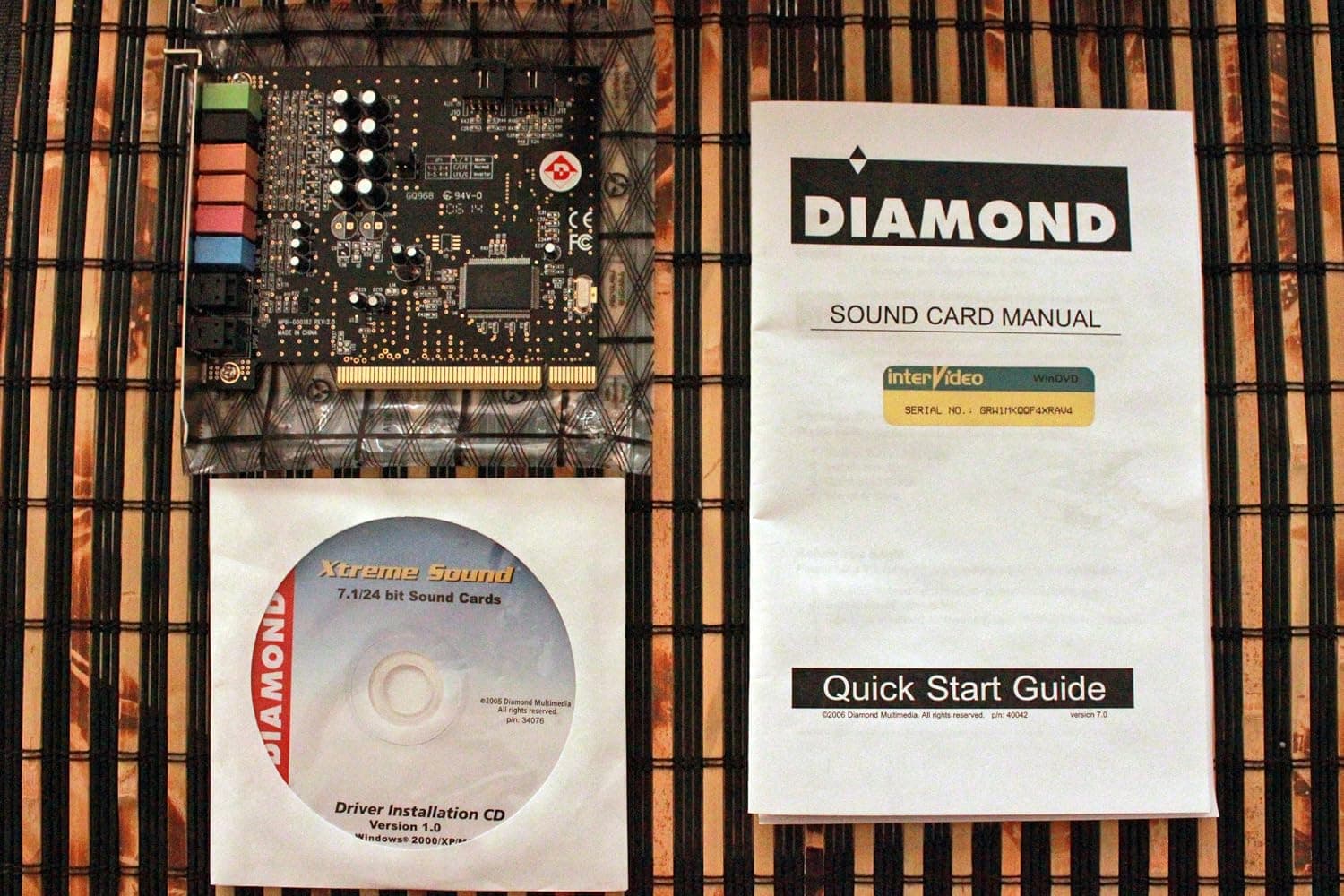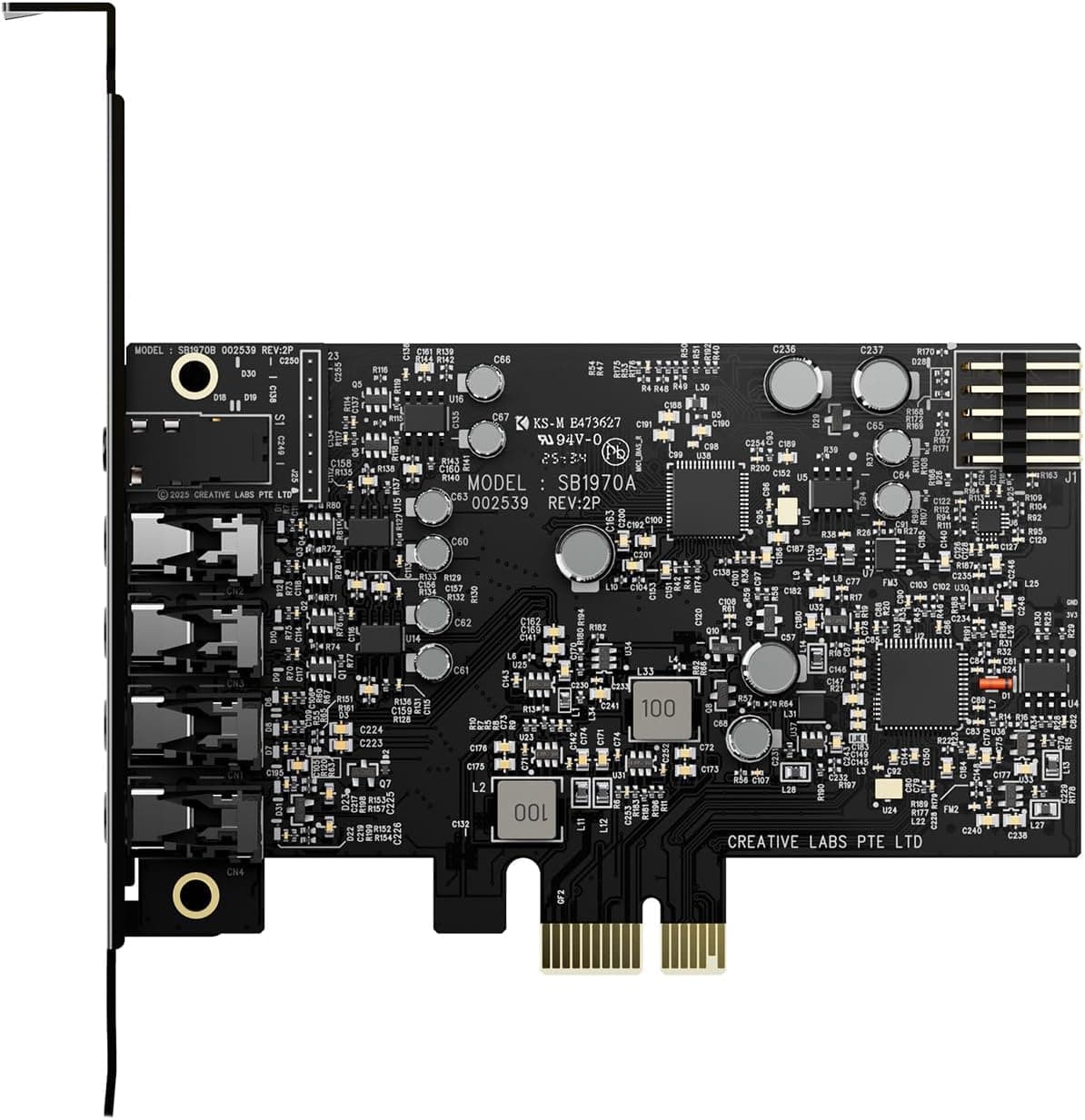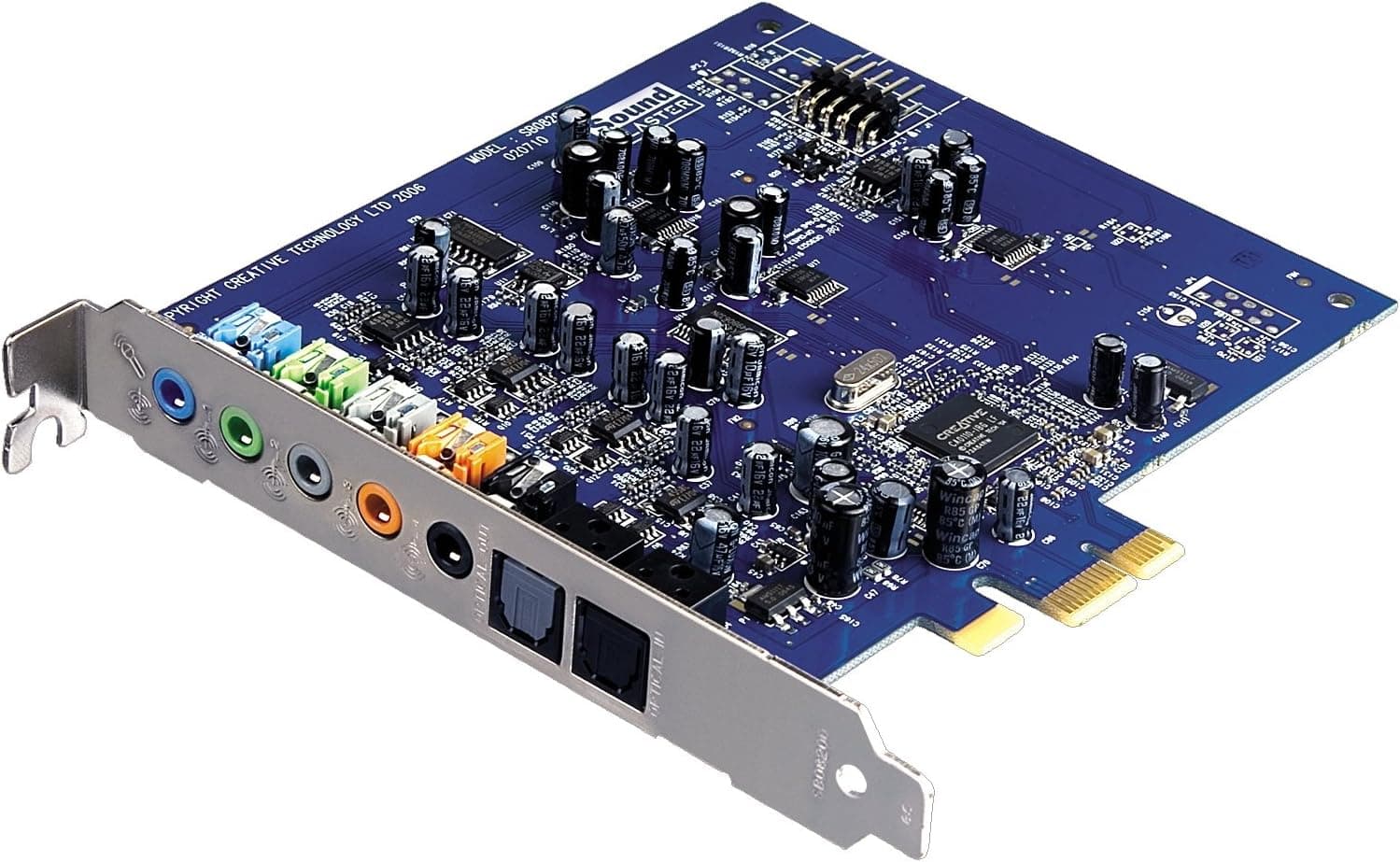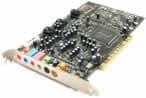
The Creative Labs Sound Blaster Audigy 2 ZS 7.1 PCI Sound Card (SB0350) is a landmark card from the golden age of PC audio.
This article goes beyond the spec sheet to cover what actually goes wrong when you buy one today.
Overview
This is a THX-certified PCI sound card offering 24-bit/192kHz stereo playback, 24-bit/96kHz 5.1 surround output, and a 108dB signal-to-noise ratio.
It supports 7.1-channel output and was optimized for more than 400 3D games of its era.
The short verdict: this is not a card for improving audio on a modern PC. It is a component for retro builds running Windows XP or earlier.
If your goal is hardware-accelerated EAX for period-correct games, it still has few substitutes. For anything else, newer hardware wins.
| Spec | Value | How to read it |
|---|---|---|
| SNR | 108 dB | Excellent against the ~90dB onboard audio of its day |
| Channels | 7.1 | Downmixes to 6.1/5.1 |
| Max sample rate | 192 kHz (stereo) / 96 kHz (5.1) | Multichannel does not reach 192kHz |
| Bit depth | 24-bit | High-end for consumer gear of the era |
| Interface | PCI 2.2 | Not PCI Express — the single biggest constraint |
| Certification | THX | The era's quality badge |
Those numbers look competitive even now, but 108dB SNR was an advantage over contemporary onboard audio, not a claim against today's DACs. The real value here is hardware audio processing that period games were written to expect.
Compatibility Guide
Start with the physical requirement: this card needs a PCI 2.2 slot.
It will not fit PCI Express, and that is not a problem you can casually adapt away. PCI slots largely disappeared from motherboards around 2010, so realistically you need a pre-2010 system or one of the few industrial boards that retained PCI.
Supported operating systems are Windows 9x/Me/2000/XP. This matters more than anything else on the spec sheet: from Windows Vista onward, the audio stack removed hardware DirectSound3D acceleration entirely.
Even if you get sound out of the card on a newer OS, hardware EAX — the whole point of this product — will not work the way it was designed to. Creative offered ALchemy to emulate it in software, but coverage varies by title.
If you want period-correct game audio, build a Windows XP machine.
Connectors include line-level outputs (front/side/rear/center/subwoofer), line input, microphone input, digital output (5.1 not supported), and analog/digital CD audio input.
It supports 7.1/6.1/5.1 surround but not DTS surround or SRD.
Because multichannel output is analog, bitstreaming to an AV receiver over HDMI or optical is not the intended use. You need analog multichannel speakers or an amplifier with 6-channel input.
Power is drawn entirely from the PCI slot — no auxiliary connector, and the registered recommended PSU wattage is 0. That said, on aging systems a degraded power supply can inject noise directly into the analog output stage, which is a disadvantage this card has against modern digital-output devices.
One clearance note: PCI slots usually sit at the bottom of the board. In period cases this is fine, but in builds with a large GPU, check for roughly two slots of free space around the target slot before installing.
Product Info
rmation
Released in the early 2000s, this was Creative's high-end consumer offering. It is long discontinued, so anything you buy is used or old stock.
Warranty depends entirely on the seller, and driver discs and cables may or may not be included. Assume no driver disc unless the listing explicitly says otherwise.
On price: as captured on 7 September 2026, the Amazon listing recorded ¥45,724. That is a marketplace reseller price for a discontinued collectible, not an original MSRP, and it sits far above what the card sold for when new.
Such pricing is common in the retro-parts market, but equivalent units frequently appear far cheaper on other used channels. Prices move constantly, so check the product page for the current figure and compare against eBay and other outlets before committing.
Note also that the entry recorded as "Amazon US" carries a yen price and the same ASIN (B000RPMLC8), so it likely points at the same listing.
The review score is 4.8 out of 5 (96% positive), but that is from only 9 reviews.
With a sample that small, treat it as "no glaring complaints" rather than statistical evidence.
Recommended Users
- Retro PC gamers maintaining a Windows XP box — with hardware EAX and DirectSound3D intact, this is exactly the right part for the job.
- Period-correct rebuilders — a clear step up from AC'97 onboard audio on Pentium 4 or Socket 939 era systems.
- Owners of analog multichannel speaker sets — if you have 6ch/8ch analog inputs, this is one of the few remaining ways to feed them.
- Listeners who specifically want that Creative-era character, including SoundFont-based MIDI playback.
It is not for improving audio on a current PC. For that, a modern PCIe Sound Blaster or an external USB DAC is the sensible choice.
Before You Buy
Most disappointments with this card come from these constraints, not from its specs.
1. The Amazon listing data conflicts with the product. The page lists the manufacturer as "Tenhitoys." This is a Creative Labs product, so that entry is simply wrong — marketplace sellers can enter arbitrary text in that field.
You will see the same discrepancy when you open the page. Verify the board model (SB0350) from the product photos and title before ordering, since several visually similar Audigy variants exist.
2. No PCI slot means no deal. Confirm your motherboard has one.
PCIe-to-PCI adapter boards exist, but latency and DMA behavior change enough that audio cards — especially ones doing hardware processing — are not reliably stable through them. Do not buy expecting an adapter to solve this.
3. Vista and later cripple the card's purpose. Hardware DirectSound3D was removed from the OS audio path.
Buying this to upgrade a modern gaming PC is money poorly spent.
4. Drivers are a real obstacle. Official distribution for a product this old may be reduced or gone.
If the listing includes no driver disc, confirm you can obtain drivers for your target OS before buying.
5. Used analog circuitry ages. After twenty-plus years, electrolytic capacitors may have degraded — symptoms include added noise, one channel running quiet, or audio stabilizing only after warm-up.
The 108dB SNR is a new-condition specification, not a measurement of the unit you receive.
6. The asking price is detached from original value. Discontinued retro parts swing hard on supply.
Watching several channels for a few weeks usually costs less than buying immediately.
Comparison With Alternatives
Even within Creative's own range, the right generation depends on your goal. For 7.1 surround on a modern PCIe-only machine, an Audigy Fx or Sound Blaster Z series card is the straightforward answer.
For a laptop of the same era, the PCMCIA version of the Audigy 2 ZS exists. For very old systems where availability matters more than EAX, a simpler card like the Sound Blaster PCI 128 (CT4750) can be easier to live with.
The one strong reason to choose the PCI Audigy 2 ZS is this: a pre-Vista machine with a PCI slot where you want hardware EAX in its best consumer implementation. Outside that case, newer generations win.
FAQ
Q. Will it work on Windows 10 or 11? A.
Officially supported operating systems end at Windows XP. With a PCI slot and a working driver you might get sound, but hardware EAX will not function as designed.
Do not buy it for a modern OS.
Q. Can a PCIe adapter let me use it in a new PC? A.
It may physically install, but stability is not dependable for audio cards. Do not plan a purchase around it.
Q. Is 192kHz available in 7.1?
A. No. 192kHz applies to stereo playback; multichannel tops out at 96kHz.
Q. Can I send 5.1 to an AV receiver over digital out? A.
The digital output is documented as not supporting 5.1.
Multichannel is delivered through the analog outputs.
Q. Is the 4.8 rating trustworthy? A.
96% positive is high, but with only 9 reviews it is weak evidence. For used hardware, unit condition matters more than the score.
Q. How does it compare to a modern USB DAC? A.
Different purposes. A current external DAC wins on raw playback quality and noise floor; this card wins on running period game audio in hardware.