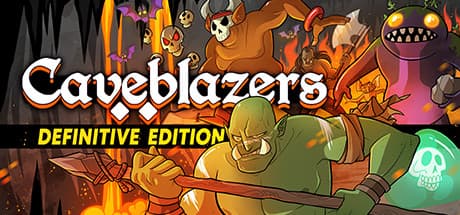
Game Overview
Caveblazers: Action Roguelike Platformer in a Mysterious Cave sends you into a procedurally generated cavern to find weapons and equipment while pushing deeper into danger. It was developed by Deadpan Games, published by Yogscast Games, and released on May 24, 2017.
A run consists of crossing hazardous platforms, fighting monsters, searching for useful items, and locating the route to the next area. Defeat ends the current attempt and takes its temporary power with it, so each new run requires another build.
Success depends less on memorizing one fixed route and more on reading the terrain, judging the available gear, and deciding when a fight is worth taking.
Combat and Build Decisions
Combat combines side-scrolling platform movement with real-time action. Enemy spacing, vertical terrain, and an escape route all matter; repeatedly attacking from the front can quickly turn minor damage into a failed run.
Players must decide whether to engage at close range, attack from safety, or use platforms to separate a dangerous group.
The cave contains a broad selection of weapons and equipment. The best pickup is not always the item that appears strongest in isolation, but the one that supports the current attack style or covers a weakness.
Procedural generation means the ideal combination will not appear on demand. Making an imperfect loadout work is a central part of Caveblazers rather than a temporary inconvenience.
What Procedural Generation Changes
Room layouts and item locations change between attempts, so the exact path from a previous run cannot be followed every time. General knowledge still carries forward: watch an enemy before committing, avoid jumping blindly into an obscured area, and identify an exit before starting a risky fight.
The map changes, but sound habits remain useful.
Replayability therefore comes from more than shuffled rooms. Players gradually improve at limiting early damage, isolating enemies with terrain, and changing tactics when the available equipment demands it.
The game works especially well for someone willing to identify one mistake after a loss and correct it on the next attempt.
Cooperative Play
Shared-screen and split-screen co-op are supported, allowing two players in the same local setup to explore together. The game does not require rigid character roles, but partners can still divide their positioning between a frontline attacker and ranged support.
Deciding who benefits most from an item adds another tactical choice to a run.
An extra player does not automatically remove the platforming challenge. Moving at different speeds can make the screen harder to read and can disrupt attack or escape timing.
Co-op is best with a partner who is willing to communicate, share equipment deliberately, and advance at a common pace.
System Requirements
The listed minimum is Windows Vista, 7, 8, or 10, a Dual Core CPU, 2 GB RAM, graphics with 512 MB, and DirectX 9.0.
These are modest requirements by modern gaming-PC standards, so a relatively recent system with dedicated graphics should have substantial headroom. However, a memory figure alone does not establish GPU compatibility, and very old integrated graphics should be checked individually.
No recommended specification is supplied, so the available data cannot guarantee performance at a particular resolution or on an unusual configuration. The OS list also names older Windows releases and gives no basis for judging other operating systems.
Check the current store information against your OS, input devices, and intended local co-op arrangement before buying.
Early-Run Priorities
New players should learn attack ranges and falling hazards before trying to clear rooms quickly. Triggering several enemies at once can remove safe landing and dodge space, so drawing out opponents from the edge of a group is usually more reliable.
When finding a weapon, test whether its reach and timing suit your movement rather than judging it only by apparent power.
Avoiding a dangerous position is generally more dependable than trying to recover after taking damage. In an unfamiliar room, locate the retreat path and vertical platforms before attacking.
Thinking about the decision that caused each loss makes improvement easier and prevents every setback from feeling like mere random chance.
Reception and Common Reactions
Players have continued to respond positively to Caveblazers over the long term. Its responsive action, changing runs, and need to adapt to found equipment make it appealing to people who enjoy repeated attempts.
Runs also provide natural stopping points while retaining the familiar temptation to try once more.
The same structure can be divisive. A small movement error may affect an entire attempt, and procedural generation can produce runs in which a preferred setup never appears.
It suits players who enjoy responding to uncertainty better than those who want to reproduce one strategy under identical conditions.
Who Should Play It
Caveblazers is a strong fit for fans of demanding 2D action and roguelites built around creating a fresh loadout during every attempt. Its focus is on movement, combat, and player improvement rather than lengthy dialogue or a story-led campaign.
It is also worth considering if you want a local action game that encourages discussion and coordination with a friend.
The game supports English as well as French, German, Spanish, Russian, Simplified Chinese, Traditional Chinese, and Japanese. Language support makes item information easier to follow, but it does not soften the underlying challenge.
Enjoying the process of learning enemies and terrain through repeated failure is the clearest sign that the game will suit you.
Caveats and Who Should Skip It
Players who dislike losing the progress of an individual run may find the core loop frustrating. It is also a poor match for anyone seeking a completely predictable build that develops independently of random item drops.
Platforming and combat frequently overlap, so repeated falls or contact damage may be especially irritating to players who want a forgiving adventure.
Anyone planning remote play with a friend should pay close attention to the shared-screen and split-screen wording. Confirm that the currently supported connection method and controller arrangement match the intended setup.
Because the listed operating systems are dated, do not assume compatibility with a current or non-Windows environment from the minimum specification alone.