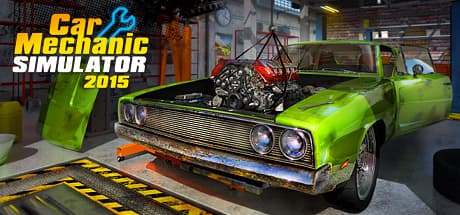
Game Overview
Car Mechanic Simulator 2015 – Build Your Auto Repair Empire puts you in charge of accepting customers' cars, diagnosing faults, replacing parts, and earning money from completed jobs. It is not primarily a racing game: the central experience is hands-on repair work followed by reinvestment in your garage.
Developed by Red Dot Games and published by PlayWay S.A., it was released on April 23, 2015.
The core loop moves from taking an order and identifying faulty components to disassembly, repair or replacement, and reassembly. Reaching a buried component may require removing surrounding parts in the correct order, adding a light puzzle element to each job.
As you complete repairs, you gain the resources and skills needed to improve the workshop and handle a broader range of work.
How the Repair System Works
The appeal comes from approaching a fault through the vehicle itself instead of selecting an instant fix from a menu. You inspect likely trouble spots, raise the car when necessary, and work inward until the defective part is accessible.
Prior mechanical knowledge is not essential, but learning component locations and removal sequences makes later jobs faster and more satisfying.
This should not be treated as professional automotive training. It can familiarize players with part names, broad layouts, and the logic of disassembly, but it does not reproduce every safety procedure, electrical diagnosis, or real-world fastening requirement.
Its realism is best understood as an accessible simulation of inspection and parts replacement.
Garage Progression and Restoration
Income from customer jobs can be invested in workshop expansion, tools, and mechanic skills. These upgrades broaden what you can do and turn investment choices into part of the progression.
The management layer supports the repair loop, however; it is not a deep business simulator focused on staffing, negotiation, or corporate accounting.
You can also acquire worn vehicles, restore them, and sell them for profit or keep them as part of a personal collection. Unlike customer orders with defined objectives, restoration gives you more ownership over the car and the amount of work you put into it.
This creates a useful long-term goal for players who enjoy completing one vehicle piece by piece.
PC Requirements
The minimum specification lists a 3.1 GHz Core i3 or 2.8 GHz AMD Phenom II X3, 4 GB of RAM, and a GeForce GTX 560 or Radeon HD 6870.
The graphics card needs 2 GB of VRAM, while storage requires 8 GB of available space and the DirectX requirement is version 9.0c.Check the review panel on this page or the Steam listing for the latest user review trend.
The recommended tier calls for a Core i5-2300 or AMD Athlon X4 760K or better, 8 GB of RAM, and a GeForce GTX 670 or Radeon HD 7970 with 2 GB of VRAM. Storage remains 8 GB.
These requirements are modest compared with current graphically intensive driving games, although users on newer Windows versions should be prepared to check compatibility settings and drivers if startup or display issues occur.
Reception and Player Expectations
The game has maintained a strong reputation over time and is especially well suited to players who enjoy taking vehicles apart, locating faults, and rebuilding them correctly. Its satisfaction comes from finishing a procedure and gradually making the garage more capable, rather than from spectacle or high-speed competition.
Its basic job structure is deliberately repetitive, so enjoyment depends on whether you like mastering and streamlining familiar procedures. Anyone approaching it mainly for driving or racing may find the balance of activities surprising.
Most of the meaningful play happens around a stationary vehicle on the lift, not behind the wheel on a circuit.
Who Should Play It
Car enthusiasts who want to learn broad component layouts and players who enjoy improving through procedural knowledge are the clearest audience. Fans of cleaning, assembly, restoration, and other task-focused simulators should also find the order-by-order structure easy to appreciate.
The used-car restoration and collection options add another reason to continue beyond routine customer work.
It can also suit people who do not enjoy competitive racing games. The single-player format emphasizes patient diagnosis and gradual garage development rather than reflexes or direct competition.
If methodical work feels relaxing rather than tedious, the game's pace is likely to be a strength.
Limitations and Who Should Skip It
This is a poor fit for players seeking constant driving, a character-led story, or elaborate company management. Repairs reuse many disassembly and replacement actions, so players who dislike repetition should consider that central structure carefully.
It is also a simplified game, not a substitute for qualified instruction or safe procedures on a real vehicle.
The official system requirements name older Windows versions, so behavior on a current operating system may depend on the individual PC setup. This is specifically the 2015 entry, and newer games in the series differ in vehicles, features, and hardware demands.
Check the title and release year on the store page to avoid buying a different installment by mistake.