Game Overview
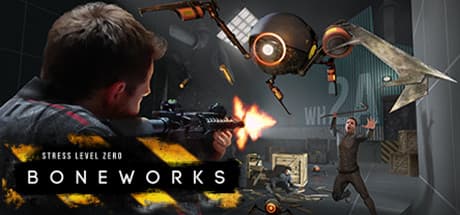
BONEWORKS: The Ultimate VR Physics Sandbox Adventure is a first-person VR action-adventure developed and published by Stress Level Zero. Released on December 10, 2019, it sends players through a story-led sequence of exploration, combat, and environmental puzzles.
Progress depends on physical actions such as grabbing, lifting, pushing, throwing, climbing, aiming, and manipulating objects rather than selecting preset solutions.
The typical loop is to inspect a space, identify useful tools or movable objects, create a route, and deal with enemies using firearms or melee weapons. A box can become a step, a loose object can serve as an improvised tool, and a mechanism may be approached from an unexpected angle.
The same obstacle can therefore feel different depending on the player's plan and comfort with VR controls.
How Physics Changes the Action
The defining idea is that hands, weapons, enemies, and scenery occupy the same simulated world. Melee combat asks players to consider reach, direction, contact, and surrounding obstacles instead of relying on a simple attack animation.
Long objects can be awkward in cramped rooms, while a poorly positioned hand or weapon may collide with the environment.
Firearms still require VR aiming and handling, but shooting is only one option within the larger system. Players can move cover, improvise platforms, push enemies, or combine actions with both hands.
This creates more room for spontaneous solutions than a conventional monitor-based shooter, although the simulation can also produce clumsy or unexpected results.
Puzzles and Exploration
When progress stalls, it helps to inspect the entire room rather than stare at the nearest switch. Movable objects, height differences, momentum, leverage, and balance may all provide a solution.
The goal is often to find a method that works physically, not to discover one hidden interaction chosen by the designer.
That freedom comes with friction. Actions that would be simple in reality can take practice in VR, especially when hands and tools collide with nearby geometry.
Players who see that awkwardness as part of the experiment will get more from the game than those expecting generous automatic correction.
System Requirements
The listed minimum configuration calls for Windows 10, a quad-core 3.0GHz CPU, 8GB of RAM, DirectX 11, and 20GB of available storage.
The minimum GPU guidance names a GTX 1060 or GTX 970. These targets are specifically based on Rift CV1 with Touch, the original Vive at 90Hz, and Rift S at 80Hz.
CPU performance deserves particular attention because the official minimum notes explicitly connect it to physics calculations. Scenes containing several active objects or enemies can increase simulation work, so the graphics card should not be the only component checked.
The quad-core 3.0GHz CPU requirement is a meaningful part of the baseline.
No recommended configuration is included in the supplied data. A headset with a higher resolution or refresh rate than the reference devices may demand more graphics performance, so the minimum list should not be treated as a universal comfort target.
Check both the headset requirements and the current product page before judging compatibility.
Preparing a Safe VR Space
BONEWORKS frequently encourages broad arm movement, reaching, and standing interaction. Clear nearby desks, walls, lights, cables, and fragile objects, then configure the headset's boundary system and use the controller straps.
Attention can shift so completely to an object inside VR that the real room becomes easy to forget.
Players who are not accustomed to smooth locomotion should begin with shorter sessions and stop when discomfort appears. The combination of artificial movement and physical interaction can be demanding for people sensitive to motion sickness.
It is better viewed as an experience for players with some VR familiarity than as the gentlest possible introduction to the medium.
Reception and Common Impressions
BONEWORKS has maintained strong user sentiment over time. Its most distinctive strengths are the range of direct environmental interaction, the ability to mix melee combat with shooting, and puzzles that permit experimentation.
VR interaction is not a decorative feature here; it drives navigation, combat, and problem-solving.
The same systems can divide players. Climbing, changing grips, moving heavy objects, or handling a weapon in a confined area may feel cumbersome when the simulation does not match the player's intention.
Anyone expecting uninterrupted, fast-paced gunplay should account for the substantial emphasis on navigation, puzzles, and experimental controls.
Who Should Play It
This is a good fit for players who enjoy touching, testing, and understanding simulated spaces through trial and error. It particularly suits those who want to alternate between firearms, melee weapons, throwing, climbing, and improvised platform building.
Unexpected or inelegant outcomes are easier to enjoy when they are treated as part of a personal physics experiment.
It also rewards players who prefer devising a route over following a tightly scripted solution. The key question is whether discovering that an unusual method works sounds entertaining, even when it takes several attempts.
Caveats and Who Should Skip It
It is not suitable for anyone seeking a standard mouse-and-monitor FPS or for players without compatible VR equipment. The minimum specifications reference particular older headsets, so identical performance cannot be assumed with every modern device.
Verify current headset, controller, and connection compatibility on the product page before purchasing.
Motion-sensitive players, anyone easily frustrated by unpredictable physical interactions, and those wanting combat with minimal manual handling should approach cautiously. The supplied article data also conflicts on multiplayer support while separately identifying the game as single-player.
If cooperative or competitive play is essential, confirm the current store feature list rather than relying on the inconsistent registration data.