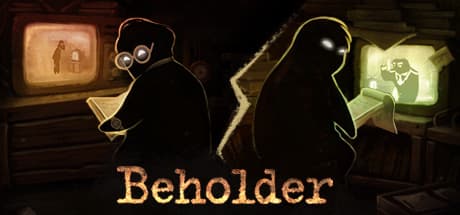
Game Overview
“Beholder: Become the Ultimate State Watcher” is a narrative simulation in which you manage an apartment building for a totalitarian State while secretly monitoring its residents. Developed by Warm Lamp Games and published by Alawar, it was released on November 9, 2016.
The basic loop has you walk through the building, speak with tenants, search rooms while their occupants are away, install surveillance equipment, and collect information. You may report prohibited behavior or possessions, but mechanically obeying every order is not necessarily the only path.
Looking the other way, helping a resident, or exploiting a secret can alter relationships and later events.
Features and Systems
Beholder stands apart by placing property management and espionage inside the same confined space. To the residents, the protagonist is the landlord who handles everyday problems.
To the State, he is an informant responsible for surveillance and enforcement, creating tension whenever personal trust conflicts with official duty.
Investigation involves more than watching people move around the building. You enter apartments, inspect belongings, and use details of daily life to identify possible violations.
Finding evidence does not remove your agency: you still decide whether to submit it, withhold it, or consider the resident's circumstances.
The choices are rarely divided into an obviously good option and an obviously evil one. Helping one person can expose somebody else to danger, while a practical compromise may create a later burden.
The game works best when you make decisions with incomplete information and accept their consequences instead of treating every scene as a puzzle with one perfect solution.
What the Play Loop Demands
Early progress is easier when you learn each tenant's name, apartment, and routine. Chasing every request immediately can cause you to miss a useful opportunity because the person or room you need is unavailable.
Regular patrols and conversations help you compare what residents say with what they actually do.
Information is effectively a resource. Learning a secret and using it immediately are separate decisions, so it pays to consider who will be affected before filing a report.
Failure can remain part of the story; choosing a personal code and living with mistakes often suits the game's bleak tone better than trying to perfect the first playthrough.
PC Requirements
The minimum specification lists an Intel Pentium Dual CPU E2180 at 2.00GHz, a GeForce 600M or ATI Radeon HD 5450 with 1GB of VRAM, and 2GB of RAM.
The recommended specification lists an Intel Core i5 at 2.4GHz, a GeForce GT 730 with 1GB of VRAM or a Radeon R7 A10-7700K, and 3GB of RAM.
Both tiers require 1600MB of available storage.
Check the review panel on this page or the Steam listing for the latest user review trend. DirectX 9.0c is specified at minimum, while DirectX 11 is recommended.
The hardware requirements are modest, but behavior on a current Windows installation may depend on drivers and compatibility settings, so older PCs should be checked for DirectX and graphics-driver support as well as free storage.
Reception and Player Expectations
Beholder has maintained strong user sentiment over time. Its most compelling element is the way surveillance mechanics support the story: learning enough to condemn a tenant also means learning enough to understand that person's situation.
Because the cast shares one apartment building, reports feel personal rather than abstract.
Players looking for a cheerful management game or an unrestricted sandbox should adjust their expectations. Oppressive atmosphere, uncertainty, and decisions made without complete information are central to the experience.
Anyone who dislikes outcomes that cannot be fully controlled may find the pressure frustrating rather than engaging.
Who Should Play It
This is a good fit for players who want narrative and mechanics to reinforce each other. It particularly suits those who enjoy interpreting limited evidence, considering ethical trade-offs, and revisiting decisions to see how events can unfold differently.
It also works well for players who prefer observation, dialogue, and planning over combat or reflex challenges. The more you regard the occupants as people with routines and needs rather than as management units, the more forcefully the conflict between surveillance and empathy comes through.
Cautions and Who May Not Enjoy It
The story deals with authoritarian control, informing on neighbors, and invasions of privacy. It is therefore a poor choice for anyone seeking a light, relaxing escape.
Even a compassionate decision may fail to produce a comfortable outcome, and the game expects you to tolerate bleak consequences.
The experience is built around repeated patrols, conversations, and investigations inside the same building rather than fast action or broad exploration. Players who prioritize constant novelty or a rapid pace may find that structure repetitive.
Check the current store information before buying if language availability or compatibility with a newer operating system is essential to you.